


In my experience helping gig workers navigate their tax obligations, Instacart shoppers often have the most pressing questions about instacart taxes. Whether you’re just starting or have been shopping for Instacart for years, understanding your tax responsibilities is critical to keeping more of your earnings and staying compliant with the IRS. This comprehensive guide walks you through everything you need to know about instacart taxes, from self-employment tax calculations to quarterly payments and deductions.
Understanding instacart taxes and self-employment obligations
When you work as an Instacart shopper, you’re classified as an independent contractor, not an employee. This classification fundamentally changes how instacart taxes work. Unlike traditional employees, you don’t have taxes withheld from your earnings, which means you’re responsible for calculating, reporting, and paying your own taxes throughout the year.
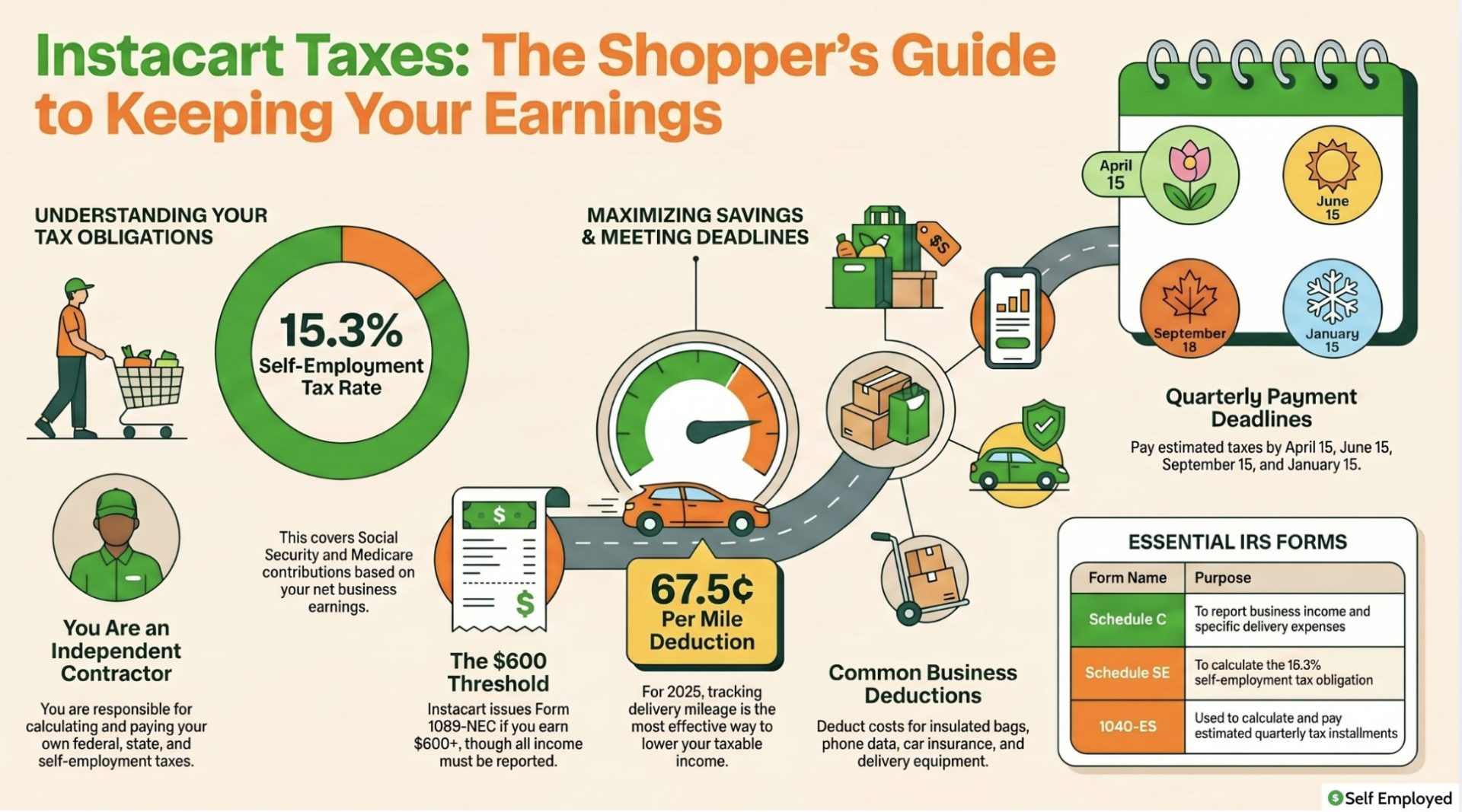
After advising dozens of Instacart shoppers, I’ve found that many underestimate their tax liability. Your instacart taxes include federal income tax, state income tax (depending on your location), and self-employment tax. Self-employment tax covers Social Security and Medicare contributions, which total 15.3% of your net earnings from self-employment.
The IRS requires you to report all income from gig work, including Instacart earnings. The good news is that instacart taxes can be managed strategically with proper planning and documentation. Understanding the rules now will save you significant money and stress come tax season.
How the 1099 form works for Instacart shoppers
Instacart will send you a Form 1099-NEC (Non-Employee Compensation) if you earned $600 or more during the tax year. This form documents your earnings for the IRS and should match your Instacart payment history. However, you must report all instacart taxes and income, even if you don’t receive a 1099 form.
From my work with gig economy professionals, I’ve learned that matching your records to the 1099 is essential. Keep detailed records of all payments, tips, and refunds. If there’s a discrepancy, contact Instacart’s support team immediately to request a corrected form.
The 1099-NEC shows your gross earnings, but when calculating your actual tax liability, you can deduct business expenses. This is where your instacart taxes can be significantly reduced through proper deduction planning.
Self-employment tax calculations for gig workers
Self-employment tax is perhaps the most misunderstood component of instacart taxes. This tax is in addition to your regular federal and state income taxes. To calculate your self-employment tax:
- Take your net earnings from Instacart (after deducting business expenses)
- Multiply by 92.35% (the self-employment income threshold)
- Multiply by 15.3% (the self-employment tax rate)
For example, if you earned $30,000 from Instacart and had $5,000 in deductible expenses, your net income is $25,000. Your self-employment tax would be approximately $3,438. This calculation is why understanding instacart taxes early is so valuable.
You can deduct half of your self-employment tax on your federal tax return, which provides some tax relief. However, the remaining half still represents a significant obligation that many shoppers don’t anticipate.
Deductions that reduce your instacart taxes
The primary advantage of working as an independent contractor is access to business deductions. When calculating what you owe in instacart taxes, you can reduce your taxable income by deducting legitimate business expenses. Common deductions include:
- Vehicle expenses (mileage at the IRS standard rate)
- Phone and internet expenses (business percentage only)
- Car insurance and maintenance
- Fuel and tolls
- Insulated bags and delivery equipment
- Vehicle registration and licensing
- Home office space (if applicable)
In my experience, the mileage deduction is the most valuable. For 2025, the IRS standard mileage rate is 67.5 cents per mile. If you drive 20,000 miles for Instacart in a year, you can deduct $13,500, which significantly reduces your instacart taxes liability.
Keep meticulous records of all deductions. The IRS requires documentation, especially for vehicle expenses and home office claims. Consider using a tracking app or spreadsheet to record mileage and expenses in real-time.
Quarterly estimated tax payments explained
One of the most critical aspects of managing instacart taxes is making quarterly estimated tax payments. Unlike traditional employees who have taxes withheld, you must pay taxes in four installments throughout the year: April 15, June 15, September 15, and January 15.
To calculate your quarterly payment, estimate your annual income and deductions, calculate your expected tax liability, and divide by four. If you underestimate, you may owe penalties, so it’s better to overestimate than underestimate.
The IRS provides Form 1040-ES to help calculate estimated taxes. You can also work with a tax professional who specializes in gig worker taxes to ensure your instacart taxes are calculated correctly and paid on time. Many shoppers find this investment worthwhile to avoid penalties and optimize their overall tax position.
State-specific instacart taxes and requirements
While federal instacart taxes are consistent nationwide, state requirements vary significantly. Some states have no income tax, while others have progressive tax systems. Additionally, some states impose gross receipts taxes on gig workers, which affects how you calculate instacart taxes.
For detailed guidance on your specific state, check our comprehensive self-employment tax guide for your state. If you’re in California, the rules are particularly complex due to Proposition 22 implications, assembly bill requirements, and AB5 classifications.
Understanding these state-level requirements is essential for calculating your true instacart taxes obligation. Some states also require quarterly reporting, which adds another layer of compliance beyond federal requirements.
Organizing your records for tax season
Proper record-keeping directly impacts how efficiently you can calculate and report your instacart taxes. Create a system before tax season arrives. I recommend:
- Download your Instacart earning statements monthly
- Track all business expenses in a dedicated spreadsheet or accounting app
- Record mileage using a dedicated app or written log
- Keep receipts for all expenses exceeding $75
- Separate instacart taxes records from other income sources
Many Instacart shoppers benefit from using accounting software designed for freelancers and gig workers. This approach reduces errors when calculating instacart taxes and makes tax preparation faster and less stressful.
For a step-by-step approach to organizing your finances, review our guide on self-employed bookkeeping. Proper bookkeeping practices make managing instacart taxes straightforward.
Essential forms for instacart shoppers
Beyond the 1099-NEC, several other forms relate to instacart taxes. Understanding these forms ensures you’re filing correctly:
- Schedule C (Form 1040): Where you report business income and deductions for instacart taxes purposes
- Schedule SE (Form 1040): Used to calculate your self-employment tax obligation
- Form 1040-ES: For calculating and paying estimated quarterly taxes
- Form 4562: Depreciation deductions if you claim a home office or vehicle depreciation
These forms work together to ensure you’re reporting your instacart taxes accurately. For more information on tax forms specific to self-employed professionals, see our resource on essential forms for self-employed professionals.
Working with a tax professional
While you can file your instacart taxes independently, many shoppers benefit from professional guidance. A tax professional familiar with gig economy work can:
- Identify deductions you might miss
- Optimize your quarterly payment strategy
- Ensure compliance with federal and state requirements
- Represent you if the IRS audits your returns
- Provide year-round planning strategies
The cost of professional tax preparation typically pays for itself through identified deductions and optimized instacart taxes strategies. Interview several professionals to find one experienced with 1099 income and gig workers.
Common mistakes when managing instacart taxes
From my years advising gig workers, I’ve observed recurring mistakes that complicate instacart taxes:
- Failing to report cash tips as income
- Not tracking vehicle expenses or mileage
- Mixing personal and business vehicle use without documentation
- Missing quarterly payment deadlines
- Overlooking state-level income tax requirements
- Claiming excessive deductions without supporting documentation
These mistakes can result in underpayment penalties, audit complications, and unnecessary stress. Start early, stay organized, and address instacart taxes systematically throughout the year rather than scrambling at tax time.
Resources and official guidance
The IRS provides official guidance on self-employment income and instacart taxes. Review the IRS website for Publication 334 (Tax Guide for Small Business) and Publication 587 (Business Use of Your Home). These resources clarify deduction rules and filing requirements.
The Small Business Administration also offers guidance on self-employment income and tax planning for independent contractors. Both resources provide authoritative information on instacart taxes and self-employment obligations.
FAQ about instacart taxes
Do I have to pay taxes on Instacart income?
Yes, the IRS requires you to report all income from Instacart, including tips. Even if you don’t receive a 1099 form, you must report your earnings. Failure to report income can result in penalties and interest charges.
When do I need to pay quarterly instacart taxes?
Quarterly estimated tax payments are due on April 15, June 15, September 15, and January 15. If you expect to owe $1,000 or more in taxes, quarterly payments are required.
What is the self-employment tax rate?
Self-employment tax is 15.3% – 12.4% for Social Security and 2.9% for Medicare. However, you can deduct half of your self-employment tax, which reduces your overall tax liability.
Can I deduct mileage as an Instacart shopper?
Yes, you can deduct mileage at the IRS standard rate. Track all miles driven for Instacart deliveries. The standard mileage rate changes annually, so verify the current rate on the IRS website.
What expenses can I deduct for instacart taxes?
You can deduct business expenses including vehicle costs, phone and internet, equipment, supplies, and home office space. Keep detailed records and receipts to support all deductions claimed.
Do I need to file if I made less than $400?
If your net self-employment income is less than $400, you may not need to file Schedule SE, but you should still file if you had other income or are eligible for refundable credits.
How do I report Instacart income on my tax return?
Report Instacart income and deductions on Schedule C (Form 1040), then calculate self-employment tax on Schedule SE. Include the results on your main tax return (Form 1040).
Should I hire a tax professional for instacart taxes?
A tax professional experienced with gig work can identify deductions you might miss and optimize your quarterly payments. For many shoppers, professional preparation pays for itself through increased deductions and reduced penalties.


