


South Dakota has always held a special appeal for independent professionals who want to keep their tax burden as simple and low as possible. Having worked with ranchers, consultants, and remote freelancers across the state, from Sioux Falls to Rapid City and the smaller communities in between, I have consistently seen how the absence of a state income tax lets self-employed workers reinvest more of their earnings directly into their businesses. This guide covers everything you need to know about self employment tax in South Dakota, including rates, deductions, quarterly payments, and how to file correctly.
Self employment tax calculator
What is self-employment tax in South Dakota?
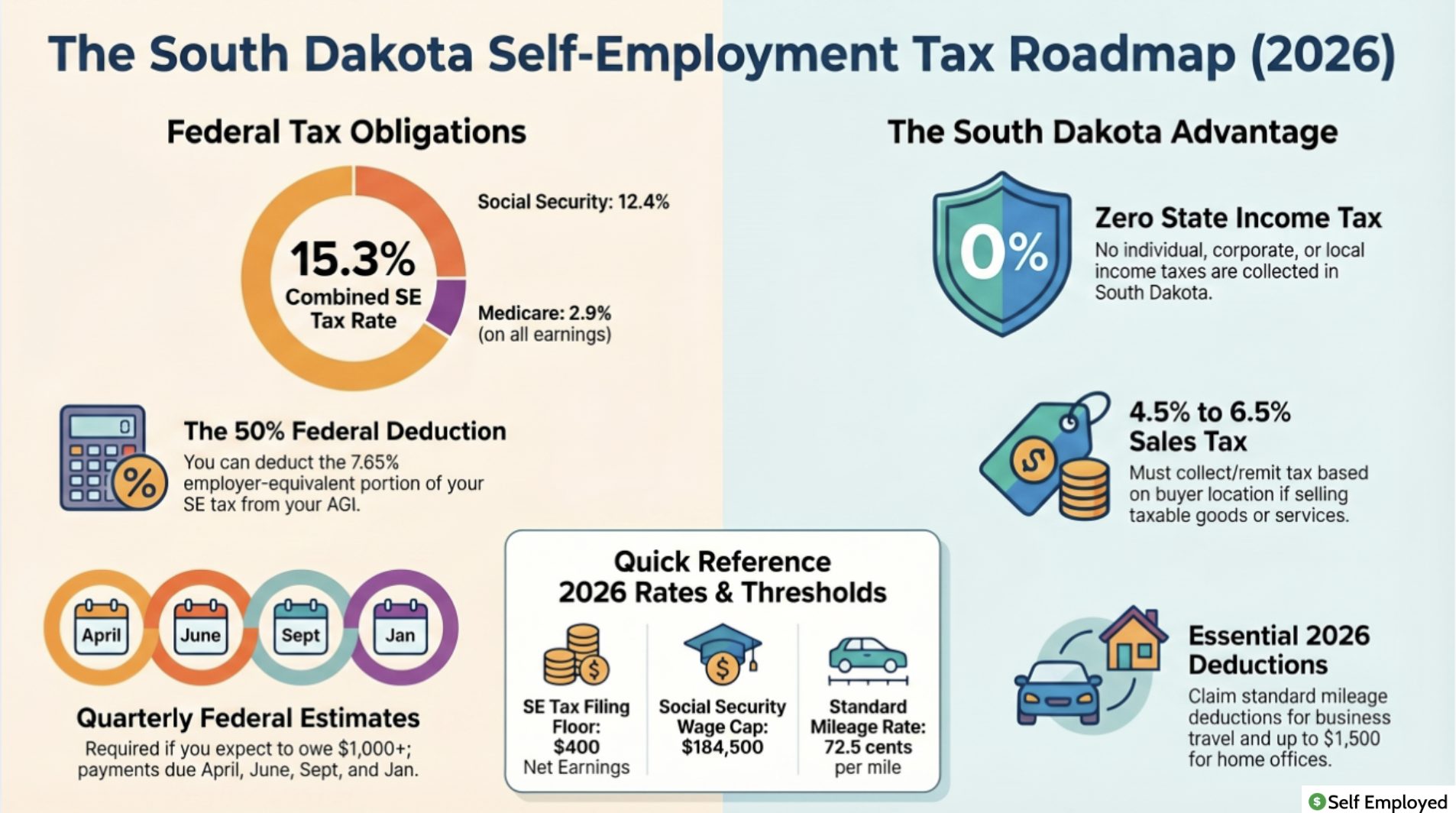
Self-employment tax is the federal tax that independent workers pay to fund Social Security and Medicare. When you work for an employer, the 15.3% combined tax is split evenly between you and your employer at 7.65% each. When you are self-employed, you are responsible for the full 15.3% yourself.
The 15.3% consists of two parts. The Social Security portion is 12.4% and applies to net self-employment earnings up to the annual wage base, which is $184,500 for 2026. Earnings above that threshold are exempt from the Social Security portion. The Medicare portion is 2.9% and applies to all net self-employment income with no cap. If your net earnings exceed $200,000 as a single filer or $250,000 filing jointly, an additional 0.9% Medicare surtax applies to income above that threshold.
An important benefit is that you can deduct the employer-equivalent portion of your self-employment tax, 7.65%, from your adjusted gross income on your federal return. This deduction is available whether or not you itemize. You must have net self-employment earnings of at least $400 before you are required to pay self-employment tax and file Schedule SE.
South Dakota state tax landscape for the self-employed
South Dakota is one of the few states that imposes no state income tax whatsoever. There is no individual income tax, no corporate income tax, and no local income taxes. This means your self employment tax obligations in South Dakota are limited entirely to federal taxes, making it one of the simplest states in the country for self-employed tax compliance.
South Dakota does rely heavily on its sales tax to fund state services. The state sales tax rate is 4.5%, and municipalities can add their own local sales taxes on top of that, bringing combined rates to as much as 6.5% in some areas. If your business involves selling taxable goods or certain services, you will need to register for a sales tax license and collect and remit sales tax. South Dakota is a destination-based sourcing state, meaning you collect sales tax based on the buyer’s location.
South Dakota also does not impose a franchise tax, personal property tax on business equipment, or business income tax. The state’s overall tax structure is designed to attract businesses and entrepreneurs, and it consistently ranks among the most tax-friendly states in the nation.
How to file self-employment taxes in South Dakota
Filing self-employment taxes from South Dakota is straightforward because you have no state income tax return to prepare. Your filing obligations are entirely at the federal level.
On the federal side, you report your business income and deductible expenses on Schedule C (Form 1040), which produces your net profit or loss. That net profit carries over to Schedule SE, where your self-employment tax is calculated. The resulting tax is added to your Form 1040, and the deductible half of the SE tax is subtracted from your adjusted gross income. The federal filing deadline is April 15. Review our guide on essential forms for self-employed professionals to make sure you have everything organized before filing.
If you received $600 or more from any single client, that client should provide a Form 1099-NEC documenting the payment. Keep these forms organized alongside your own records of income from all sources.
While there is no state income tax return, you may have state-level sales tax obligations if your business sells taxable goods or services. South Dakota sales tax returns can be filed online through the South Dakota Department of Revenue website, and filing frequency depends on your sales volume.
Quarterly estimated tax payments in South Dakota
Because South Dakota has no state income tax, your quarterly estimated payments are limited to federal obligations. You must make federal estimated payments if you expect to owe $1,000 or more in federal tax for the year.
| Payment period | Due date |
|---|---|
| January 1 – March 31 | April 15 |
| April 1 – May 31 | June 15 |
| June 1 – August 31 | September 15 |
| September 1 – December 31 | January 15 of the following year |
To calculate your quarterly payments, estimate your total annual net self-employment income, apply the 15.3% self-employment tax rate, calculate your expected federal income tax, add them together, subtract any credits, and divide by four. The safe harbor method of paying at least 100% of your prior year’s total federal tax liability (or 110% if your AGI exceeded $150,000) across four installments protects against underpayment penalties.
The absence of state estimated payments is one of the practical advantages of being self-employed in South Dakota. You have one set of quarterly payments to track rather than two. Good bookkeeping practices make calculating these payments much simpler.
Tax deductions and credits for South Dakota’s self-employed
While South Dakota’s lack of state income tax means deductions only affect your federal liability, maximizing those federal deductions remains critical. The deduction for 50% of your self-employment tax reduces your adjusted gross income automatically, lowering your federal income tax.
The home office deduction provides $5 per square foot under the simplified method up to 300 square feet for a $1,500 maximum. The regular method calculates actual expenses based on business-use percentage of your home.
Self-employed individuals who pay their own health insurance premiums can deduct medical, dental, vision, and qualifying long-term care coverage from AGI. Retirement contributions through a SEP-IRA (up to 25% of net self-employment earnings) or Solo 401(k) reduce taxable income dollar for dollar. Business expenses such as software, advertising, professional development, supplies, and professional fees are fully deductible. Vehicle use for business can be deducted at the IRS standard mileage rate of 72.5 cents per mile for 2026.
| Deduction category | Details |
|---|---|
| Self-employment tax deduction | 50% of SE tax, reduces AGI automatically |
| Home office | Simplified: $5/sq ft (max $1,500) or actual expenses |
| Health insurance premiums | Medical, dental, vision, long-term care |
| Retirement contributions | SEP-IRA (up to 25% of net SE income), Solo 401(k) |
| Business expenses | Supplies, software, advertising, professional fees |
| Vehicle/mileage | 72.5 cents/mile (2026) or actual vehicle expenses |
Avoiding common pitfalls
Overlooking sales tax obligations
The most common mistake self-employed South Dakotans make is assuming no state income tax means no state tax obligations at all. If you sell tangible goods or certain services, you must register for a sales tax license and collect and remit South Dakota sales tax. The state actively enforces compliance, and failing to register can result in penalties and back taxes.
Underestimating federal tax burden
Because there is no state income tax, some self-employed workers fail to set aside enough for federal taxes. The federal self-employment tax of 15.3% plus federal income tax still represent a substantial burden. A good rule of thumb is to set aside 25% to 30% of your net self-employment income for federal taxes, even in a no-income-tax state like South Dakota.
Poor recordkeeping
Maintain organized records of all income and expenses. Keep receipts for every business deduction, maintain mileage logs, and track income from all sources. Using accounting software and separate business bank accounts simplifies the process and provides a clear audit trail. Our state tax guide for California covers recordkeeping best practices that apply in any state.
Final thoughts on self-employment tax in South Dakota
South Dakota’s complete absence of state and local income taxes makes it one of the most attractive states for self-employed professionals. Your tax obligations are streamlined to federal self-employment tax and federal income tax, with no state return to file and no state estimated payments to manage. Focus your energy on maximizing federal deductions, making timely quarterly estimated payments to the IRS, and maintaining thorough records. If your business involves selling taxable goods, make sure you understand your South Dakota sales tax obligations. Those fundamentals will keep you in excellent shape in this tax-friendly state.
Frequently asked questions
Does South Dakota have a state income tax?
No. South Dakota does not impose any state income tax on individuals, including self-employment income. There is also no corporate income tax and no local income taxes. Self-employed workers in South Dakota are subject only to federal self-employment tax and federal income tax.
What is self-employment tax in South Dakota?
Self-employment tax in South Dakota is the federal tax that independent workers pay to fund Social Security and Medicare. The rate is 15.3% of net self-employment earnings, comprising 12.4% for Social Security (on income up to $184,500 in 2026) and 2.9% for Medicare on all earnings. Since South Dakota has no state income tax, this federal tax is your primary income-related obligation.
Do I need to make quarterly estimated tax payments in South Dakota?
You need to make federal quarterly estimated payments if you expect to owe $1,000 or more in federal tax, using Form 1040-ES. Payments are due April 15, June 15, September 15, and January 15 of the following year. You do not need to make any state estimated income tax payments since South Dakota has no income tax.
What about sales tax for self-employed workers in South Dakota?
South Dakota has a state sales tax of 4.5%, and local taxes can increase the combined rate to around 6.5%. If your business sells taxable goods or certain services, you must register for a sales tax license and collect and remit sales tax. Service-based businesses that do not sell tangible goods are generally not subject to sales tax.
What deductions can I claim as a self-employed person in South Dakota?
Self-employed individuals in South Dakota can claim all standard federal deductions including 50% of self-employment tax, health insurance premiums, home office expenses, retirement contributions to a SEP-IRA or Solo 401(k), business vehicle mileage at 72.5 cents per mile for 2026, and ordinary business expenses. Since there is no state income tax, these deductions apply only to your federal tax liability.
How much should I set aside for taxes as self-employed in South Dakota?
A good rule of thumb is to set aside 25% to 30% of your net self-employment income for federal taxes. This covers your 15.3% self-employment tax plus federal income tax. Because South Dakota has no state income tax, you may be able to stay closer to the 25% end of that range compared to self-employed workers in states with income taxes.


