

West Virginia self-employment tax has become increasingly competitive as the state continues cutting income tax rates. Having spent time advising independent workers in Charleston, Morgantown, and throughout the Mountain State, I have watched these rate reductions unfold with real enthusiasm. West Virginia has cut its income tax rates multiple times in recent years, and the 2025 rates bring the top rate down to 4.67%. For freelancers, contractors, and small business owners who call West Virginia home, these changes mean more money staying in your pocket. Understanding how these state changes interact with your federal self-employment tax is the key to making the most of this favorable trend.
Self Employment Tax Calculator
What is self-employment tax in West Virginia?
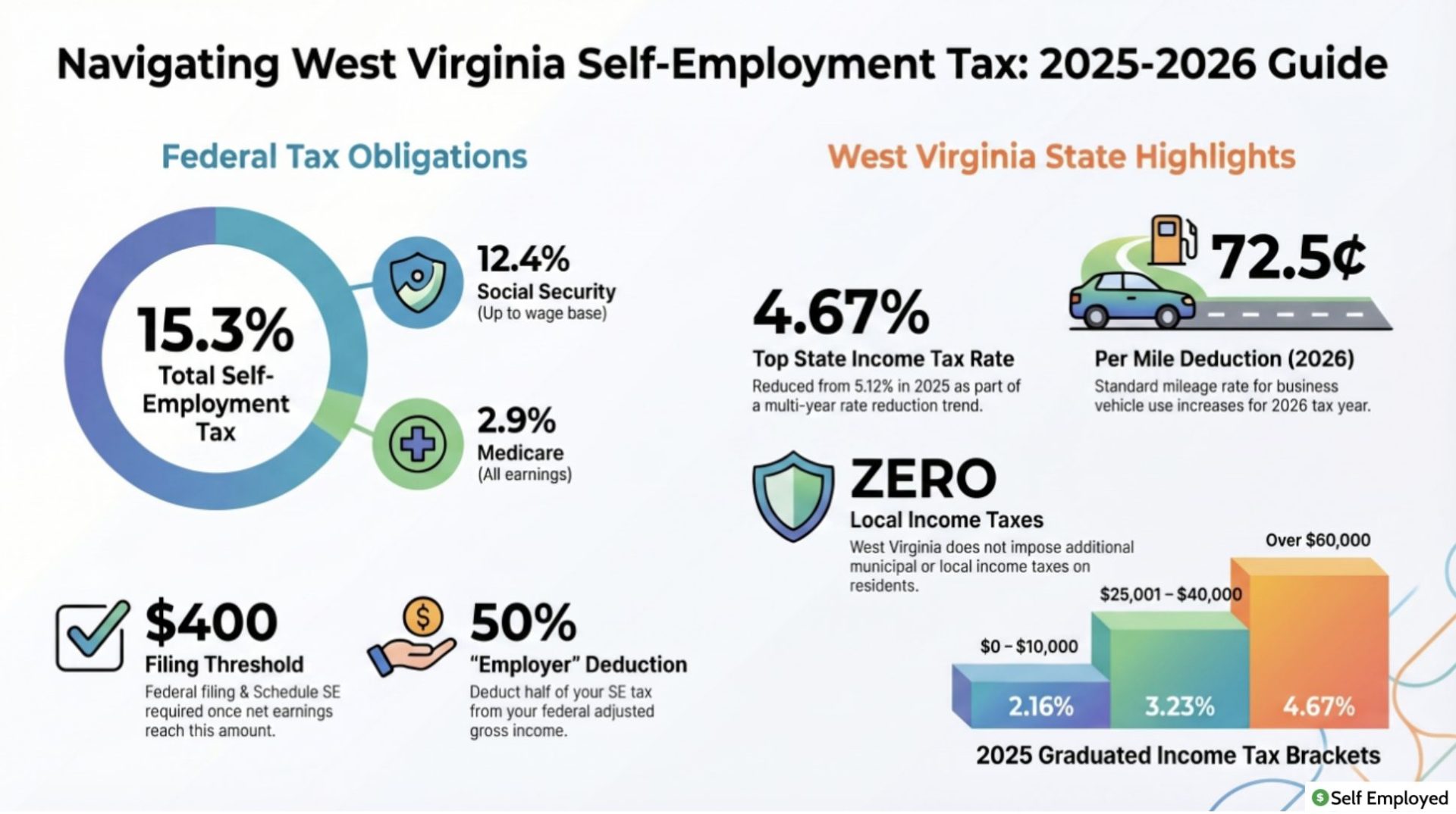
Self-employment tax is the federal tax that independent workers pay to fund Social Security and Medicare. When you work for an employer, the 15.3% combined tax is split at 7.65% each. When you are self-employed, you pay the full 15.3% yourself.
The 15.3% consists of two components. The Social Security portion is 12.4% and applies to net self-employment earnings up to the annual wage base of $176,100 for 2025, rising to $184,500 for 2026. The Medicare portion is 2.9% and applies to all net self-employment income with no cap. If your net earnings exceed $200,000 as a single filer or $250,000 filing jointly, an additional 0.9% Medicare surtax applies above that threshold.
You can deduct the employer-equivalent portion, 7.65%, from your AGI on your federal return regardless of whether you itemize. Self-employment tax and Schedule SE filing are required once net earnings reach $400.
West Virginia state income tax for the self-employed
West Virginia uses a graduated income tax system with five brackets. Thanks to S.B. 2033, signed into law in 2024, the rates were reduced effective January 1, 2025. The top rate dropped from 5.12% to 4.67%, continuing a multi-year trend of rate reductions.
| Taxable Income | 2025 Rate |
|---|---|
| $0 – $10,000 | 2.16% |
| $10,001 – $25,000 | 2.87% |
| $25,001 – $40,000 | 3.23% |
| $40,001 – $60,000 | 4.30% |
| Over $60,000 | 4.67% |
Future rate reductions are tied to revenue triggers that the Tax Commissioner assesses, with additional cuts possible as early as 2027 if revenue targets are met. West Virginia does not impose a separate state-level self-employment tax. Your self-employment income flows through to your West Virginia Form IT-140 and is taxed under the same graduated brackets as all other income.
West Virginia does not impose local or municipal income taxes, keeping the filing process straightforward with obligations only at the federal and state levels.
How to file self-employment taxes in West Virginia
Filing involves coordinating federal and state returns. On the federal side, report business income and expenses on Schedule C (Form 1040), carry the net profit to Schedule SE, and include both on Form 1040. The deductible half of SE tax is subtracted from your AGI. Good year-round bookkeeping for the self-employed makes this process significantly easier and reduces errors at filing time.
For West Virginia, file Form IT-140, the resident income tax return. Your federal adjusted gross income serves as the starting point, with West Virginia-specific adjustments applied. The filing deadline aligns with the federal deadline of April 15. You will also want to make sure you are filing the correct essential tax forms for self-employed professionals at both the federal and state level.
West Virginia supports electronic filing and the state encourages taxpayers to use it for faster processing. Keep your 1099-NEC forms organized alongside complete records of all income sources.
Quarterly estimated tax payments in West Virginia
Self-employed individuals must make estimated payments if they expect to owe state income tax. At the federal level, payments are required if you expect to owe $1,000 or more. West Virginia requires estimated payments if your expected tax liability exceeds your withholding and credits.
| Payment Period | Due Date |
|---|---|
| January 1 – March 31 | April 15 |
| April 1 – May 31 | June 15 |
| June 1 – August 31 | September 15 |
| September 1 – December 31 | January 15 of the following year |
The safe harbor of paying 100% of your prior year’s tax liability (or 110% if AGI exceeded $150,000) across four installments protects against underpayment penalties. Use Form 1040-ES for federal and West Virginia Form IT-140ES for state payments.
Tax deductions and credits for West Virginia’s self-employed
Maximizing deductions reduces both federal and West Virginia tax liability. The deduction for 50% of your self-employment tax reduces AGI automatically, providing savings at both levels.
The home office deduction provides $5 per square foot under the simplified method up to 300 square feet for a $1,500 maximum. Self-employed individuals who pay their own health insurance premiums can deduct medical, dental, vision, and long-term care coverage from AGI.
Retirement contributions through a SEP-IRA (up to 25% of net self-employment earnings) or Solo 401(k) reduce taxable income dollar for dollar. Business expenses including software, advertising, professional development, supplies, and professional fees are fully deductible. Vehicle mileage for business can be deducted at 72.5 cents per mile for 2026 (up from 70 cents in 2025).
| Deduction Category | Details |
|---|---|
| Self-Employment Tax Deduction | 50% of SE tax, reduces AGI automatically |
| Home Office | Simplified: $5/sq ft (max $1,500) or actual expenses |
| Health Insurance Premiums | Medical, dental, vision, long-term care |
| Retirement Contributions | SEP-IRA (up to 25% of net SE income), Solo 401(k) |
| Business Expenses | Supplies, software, advertising, professional fees |
| Vehicle/Mileage | 72.5 cents/mile (2026) or actual vehicle expenses |
Avoiding common pitfalls
Not updating for rate changes
With West Virginia actively reducing its tax rates, using last year’s rates for estimated payments can lead to overpayment. Make sure you apply the current year’s rates when calculating quarterly installments.
Misclassifying workers
Worker misclassification is a concern in West Virginia’s energy, construction, and healthcare sectors. The IRS and West Virginia State Tax Department look at the degree of control over the work to distinguish employees from contractors. Getting this wrong can result in back taxes and penalties.
Poor recordkeeping
Maintain organized records of all income and expenses. Keep receipts, maintain mileage logs, and use accounting software. Separate business and personal finances for clear audit trails. The IRS Self-Employed Individuals Tax Center provides authoritative guidance on record-keeping requirements.
Final thoughts on self-employment tax in West Virginia
West Virginia’s ongoing income tax rate reductions, bringing the top rate to 4.67% for 2025 with potential further cuts ahead, are making the Mountain State increasingly competitive for self-employed professionals. Combined with no local income taxes and the full range of federal deductions, the overall tax environment is favorable and improving. Stay current on your quarterly payments, take advantage of every available deduction, and keep organized records to make the most of West Virginia’s tax-friendly trajectory.
Frequently Asked Questions
What is self-employment tax in West Virginia?
Self-employment tax in West Virginia is the federal tax that independent workers pay to fund Social Security and Medicare at 15.3% of net earnings. West Virginia does not impose a separate state-level self-employment tax, but self-employment income is subject to the state’s graduated income tax with rates from 2.16% to 4.67% for 2025.
What are West Virginia’s income tax rates for 2025?
West Virginia has five brackets for 2025 with rates of 2.16%, 2.87%, 3.23%, 4.30%, and 4.67%. The top rate of 4.67% applies to income over $60,000. These rates were reduced from the prior year as part of ongoing legislative efforts to lower income taxes in the state.
When are quarterly estimated tax payments due in West Virginia?
Quarterly estimated payments are due April 15, June 15, September 15, and January 15 of the following year. Use Form IT-140ES for West Virginia and Form 1040-ES for federal payments.
Does West Virginia have local income taxes?
No. West Virginia does not impose local or municipal income taxes. Your self-employment income is subject only to federal taxes and the state’s graduated income tax.
What deductions can I claim as a self-employed person in West Virginia?
Self-employed individuals in West Virginia can deduct 50% of self-employment tax, health insurance premiums, home office expenses, retirement contributions to a SEP-IRA or Solo 401(k), business vehicle mileage at 72.5 cents per mile for 2026, and ordinary business expenses. These deductions reduce your federal AGI, which also lowers your West Virginia tax liability.


