


Why forming an LLC in Kansas makes sense for the self-employed
If you are self-employed in Kansas and still operating as a sole proprietor, you are leaving your personal assets exposed to unnecessary risk. Forming a Limited Liability Company separates your business obligations from your personal finances, and Kansas offers one of the more affordable and straightforward LLC formation processes in the country. I have helped dozens of entrepreneurs navigate this process, and the protection it provides is well worth the modest investment.
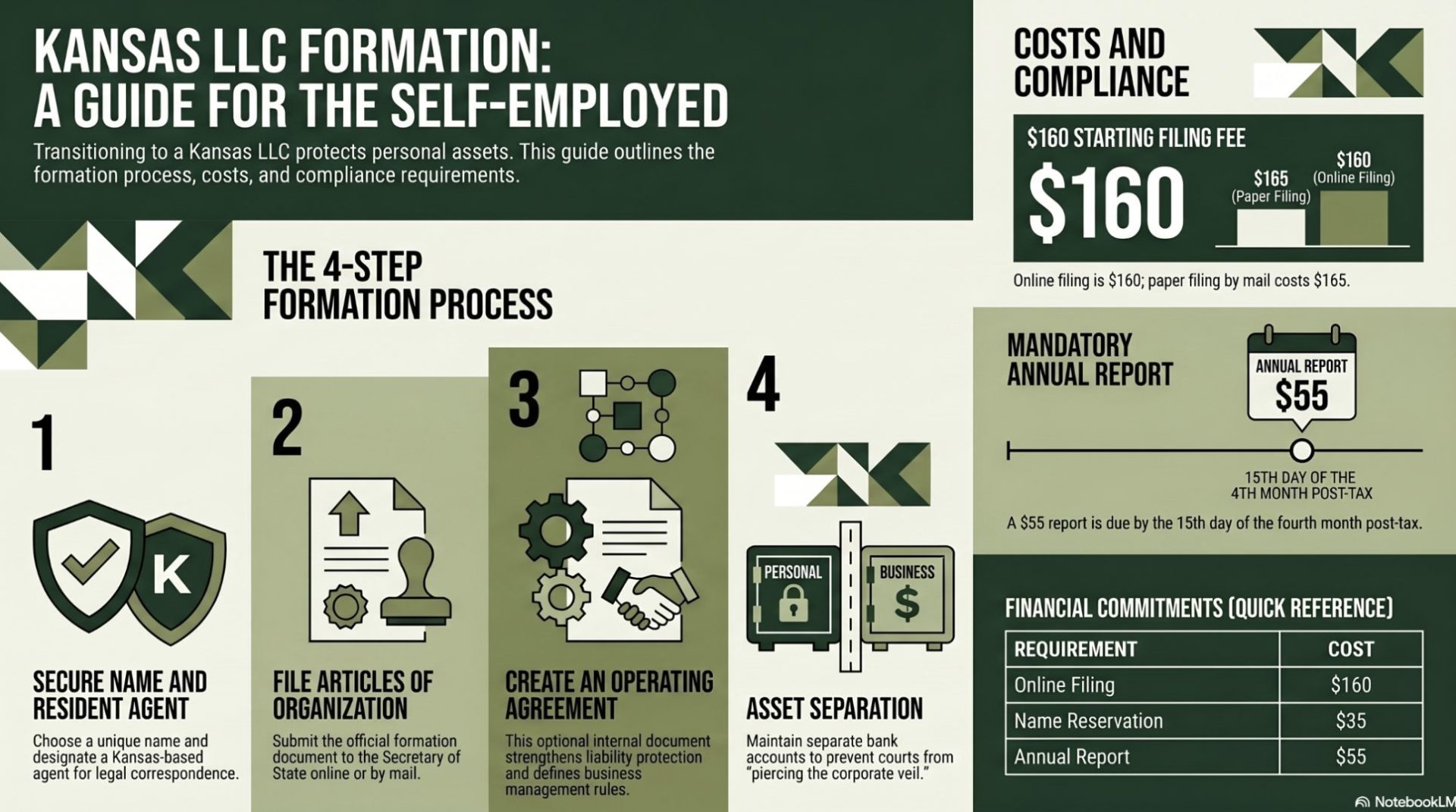
Kansas charges $165 to file Articles of Organization by mail or $160 online through the Secretary of State’s office. Compared to states like California, which imposes an $800 annual franchise tax on LLCs, Kansas keeps costs manageable for small business owners and freelancers. The state also allows single-member LLCs, which means solo entrepreneurs can access liability protection without needing a business partner.
How to start an LLC in Kansas: step by step
Choose a unique business name
Your LLC name must include “Limited Liability Company,” “LLC,” or “L.L.C.” as a designation. Kansas requires the name to be distinguishable from any existing business entity registered with the Secretary of State. You can verify name availability through the Kansas Business Entity Search at the Secretary of State website before filing.
If you find a name you want but are not ready to file immediately, Kansas allows you to reserve it for 120 days for a $35 fee. I recommend checking name availability early in the process since popular business names in growing industries tend to get claimed quickly.
Appoint a resident agent
Kansas requires every LLC to designate a resident agent (also called a registered agent in other states). This person or company accepts legal documents, tax notices, and official correspondence on behalf of your LLC. The resident agent must have a physical street address in Kansas and be available during normal business hours.
You can serve as your own resident agent if you have a Kansas address, but many self-employed professionals prefer hiring a professional registered agent service. These services typically cost between $50 and $300 per year and keep your personal address off public records. If you work from home or travel frequently, a professional service ensures you never miss important legal documents.
File articles of organization
The Articles of Organization is the official document that creates your LLC with the state of Kansas. You can file online through the Kansas Secretary of State’s business filing portal or submit a paper form by mail. The online filing costs $160 and typically processes faster, while the mail option costs $165.
Your Articles of Organization must include your LLC’s name, the name and address of your resident agent, the mailing address of your LLC, and at least one authorized signature. Kansas does not require you to list members or managers in the Articles of Organization, which provides an additional layer of privacy for business owners.
Create an operating agreement
Kansas does not legally require an operating agreement, but creating one is essential for protecting your LLC status. This internal document outlines ownership structure, member responsibilities, profit distribution, and procedures for adding or removing members. Without an operating agreement, your LLC defaults to Kansas state rules, which may not align with how you want to run your business.
I have seen situations where single-member LLC owners skipped the operating agreement and later faced challenges when banks or investors questioned the legitimacy of their business structure. Even as a solo operator, having a written operating agreement strengthens your liability protection and demonstrates that you treat your LLC as a separate legal entity.
Kansas LLC costs and ongoing requirements
Formation and annual fees
The initial costs for forming a Kansas LLC are relatively low compared to most states. Here is what you should budget for when getting started: the Articles of Organization filing fee runs $160 online or $165 by mail, the optional name reservation is $35, and professional registered agent services range from $50 to $300 annually. Kansas also requires an annual report filed with the Secretary of State, which costs $55.
One important detail that catches many new LLC owners off guard: Kansas changed from biennial to annual report filing. Missing this deadline can result in administrative dissolution of your LLC, so mark your calendar or set up a reminder system. The annual report is due on the 15th day of the fourth month after your tax closing date.
Tax obligations for Kansas LLCs
By default, a single-member LLC is treated as a disregarded entity for federal tax purposes, meaning business income passes through to your personal tax return. Multi-member LLCs are taxed as partnerships. However, you can elect to have your LLC taxed as an S-Corporation or C-Corporation if that structure better suits your financial situation.
Kansas imposes a state income tax with rates ranging from 3.1% to 5.7% on individual income. If your LLC has nexus in Kansas, you may also need to collect and remit sales tax on applicable goods and services. The current state sales tax rate in Kansas is 6.5%, though local jurisdictions can add additional percentages. Understanding self-employment tax obligations is critical for keeping your LLC in compliance and avoiding penalties.
You will need an Employer Identification Number from the IRS if your LLC has more than one member, if you plan to hire employees, or if you elect corporate taxation. Single-member LLCs without employees can use the owner’s Social Security number, but getting an EIN is free and adds a layer of separation between your personal and business identities.
Protecting your personal assets with a Kansas LLC
The primary reason most self-employed professionals form an LLC is liability protection. In Kansas, an LLC creates a legal barrier between your business debts and your personal property. If your business faces a lawsuit or cannot pay its debts, creditors generally cannot pursue your home, personal bank accounts, or other personal assets.
However, this protection is not absolute. Kansas courts can “pierce the corporate veil” if you fail to maintain proper separation between personal and business finances. To preserve your liability protection, you should maintain a separate business bank account, keep thorough financial records, avoid commingling personal and business funds, and ensure your LLC is properly capitalized for its operations.
I always advise self-employed clients to treat their LLC as a completely separate entity from day one. Our comprehensive LLC guide covers additional strategies for maintaining strong liability protection across all 50 states.
Kansas-specific advantages for self-employed LLC owners
Kansas offers several features that make it particularly attractive for self-employed professionals forming LLCs. The state does not impose a separate franchise tax on most LLCs (only those with assets exceeding $1 million in Kansas), which eliminates a cost that business owners in states like California or Texas face regardless of revenue.
The Kansas Small Business Development Center provides free consulting services to LLC owners, including business planning, financial projections, and marketing strategy. These resources are especially valuable for self-employed professionals exploring new business ideas who want expert guidance without the cost of hiring a consultant.
Kansas also participates in the Streamlined Sales Tax program, which simplifies sales tax compliance for businesses that sell across state lines. If your LLC operates an e-commerce business or provides services to clients in multiple states, this framework can reduce the administrative burden of multi-state tax obligations.
Common mistakes to avoid when forming a Kansas LLC
After working with hundreds of entrepreneurs on LLC formation, I consistently see the same preventable errors. The most common mistake is choosing a business name without checking availability first, which delays the entire process. Always search the Kansas Business Entity Database before committing to a name for marketing materials or domain registration.
Another frequent error is neglecting to obtain necessary business licenses and permits beyond the LLC formation itself. Depending on your industry and location within Kansas, you may need city or county business licenses, professional licenses, health permits, or zoning approvals. The Kansas Business One Stop portal can help you identify which permits apply to your specific situation.
Finally, many self-employed LLC owners fail to maintain proper ongoing compliance. Filing your annual report on time, keeping your registered agent information current, and maintaining your operating agreement are not optional tasks. Neglecting these requirements can result in losing your LLC status and the liability protection that comes with it.
Frequently asked questions
How much does it cost to start an LLC in Kansas?
Filing the Articles of Organization costs $160 online or $165 by mail through the Kansas Secretary of State. Additional costs may include a $35 name reservation fee and $50 to $300 annually for professional registered agent services. The annual report filing fee is $55.
Do I need an operating agreement for a Kansas LLC?
Kansas does not legally require an operating agreement, but having one is strongly recommended. An operating agreement defines your LLC’s management structure, profit distribution, and operating procedures. It also strengthens your liability protection by demonstrating that your LLC operates as a separate legal entity.
How long does it take to form an LLC in Kansas?
Online filings through the Kansas Secretary of State typically process within 2 to 3 business days. Mail filings can take 5 to 10 business days depending on current processing volumes. Expedited processing is available for an additional fee if you need faster turnaround.
Can I be my own registered agent in Kansas?
Yes, any individual with a physical street address in Kansas can serve as a registered agent for their own LLC. You must be available at that address during normal business hours to accept legal documents. Many self-employed professionals prefer hiring a professional service to keep their home address private and ensure documents are always received promptly.
What taxes does a Kansas LLC pay?
A Kansas LLC’s tax obligations depend on its structure. Single-member LLCs pay state income tax at rates between 3.1% and 5.7% on business income reported on the owner’s personal return. LLCs may also need to collect Kansas sales tax at 6.5% plus local rates on applicable transactions. There is no separate franchise tax for most Kansas LLCs unless business assets exceed $1 million.


