


I learned the hard way that getting a mortgage as a self‑employed buyer isn’t about how much you make. It’s about how well you can document it. My first offer almost fell apart because my tax write‑offs slashed my qualifying income on paper. Since then, I’ve helped many freelancers and small business owners compare loan programs, lenders, and documentation paths. I wanted a simple, affordable option that didn’t punish me for owning a business. I needed clarity on what underwriters actually care about.
What pushed me to research deeper was watching a close friend—also self‑employed—lose a great rate because they chose the wrong program. The lesson stuck: the “best” loan depends on your income pattern, credit, and how much you can put down. Finding the right fit is harder than it looks. Guidelines change. Some lenders allow bank statement loans, others don’t. And online advice often skips key tradeoffs like mortgage insurance or funding fees.
From what I’ve seen, the buyers who win keep it simple: pick the program that matches their documentation, plan for reserves, and work with a lender that knows self‑employed files cold. You don’t need the fanciest option—just the right one for your numbers. This guide breaks down the most affordable, self‑employed‑friendly loan paths, with clear pros, cons, and who each serves best. It’s straight advice based on research and real application experiences—no sponsored picks, just what I’d tell a friend.
Here’s a quick comparison before we dive into details.
Comparison of the 6 Top affordable home loan options in 2026 with pricing and recommended use cases
Scroll down for my detailed take on each option, including who I picked for my last purchase and where beginners can start with low or even zero down.
What is a home loan for self‑employed buyers?
A self‑employed home loan is a mortgage program or underwriting path tailored to people who earn income from a business, freelancing, or contract work. Its purpose is to translate non‑traditional income into an amount a lender can safely use to qualify you. There’s a saying in underwriting: “If it’s not documented, it didn’t happen.” For self‑employed borrowers, that means clear records—tax returns, bank statements, or CPA letters—can unlock better terms, more options, and less stress at closing.
Think of it this way: qualifying cleanly with the right program can save you points in fees or insurance over time. That can rival shaving years off your payoff through extra principal payments, without changing your lifestyle. At heart, these loans help entrepreneurs, freelancers, and small business owners present income from K‑1s, 1099s, or business accounts in a lender‑approved format so they can buy a primary home, second home, or (in some cases) investment property.
Most buyers pair the right loan program with smart prep: two years of tax returns, a year of clean bank statements, a profit‑and‑loss statement, and cash reserves. Some also use credit optimization and debt payoff strategies to improve approval odds. Not every option fits every file, though, so it pays to evaluate programs side by side before you lock a rate.
How to choose the best home loan as a self‑employed buyer
It can feel overwhelming. There are government‑backed programs, conventional routes, and non‑QM options with different paperwork and costs. Each promises “flexibility,” yet the details vary a lot. I wrote this specifically to help you find a program that matches your income profile, down payment, and goals—not what worked for someone with a W‑2.
Most “best of” mortgage lists are written by lenders or ad‑driven sites with sponsored placements. I’m not sponsored by any platform on this list. What follows is a straightforward overview based on real underwriting guidelines, lender sheets, and borrower experiences I trust.
Here are some questions you should ask when looking for a loan:
- How low can the down payment go for my credit and income?
- What documentation does this program accept for self‑employed income?
- How will my cost change if my credit score is higher or lower?
- What happens to the monthly cost if I hit the mortgage insurance thresholds?
- Are reserves required? How many months?
- What fees apply at closing (funding fees, guarantee fees, mortgage insurance)?
- Can I refinance into a lower‑cost program later without heavy penalties?
- Does the lender have deep experience with self‑employed files?
- Are there property, area, or income limits I must meet?
That’s a lot, I know. The picks below answer these questions in plain language so you can see the tradeoffs fast.
Okay, enough of me rambling, let’s get into the list.
6 Top affordable home loans in 2026
Here are my top picks for the best home loans for self‑employed buyers:
- FHA Loan (Federal Housing Administration)
- Fannie Mae HomeReady (Conventional)
- VA Loan (U.S. Department of Veterans Affairs)
- USDA Guaranteed Loan (Rural Development)
- Angel Oak Bank Statement Mortgage (Non‑QM)
- Better Mortgage (Online Lender)
Let’s see which one is right for you.
1. FHA Loan (Federal Housing Administration)
FHA is a government‑backed program designed to expand access to homeownership. It’s been around for decades and is widely accepted by lenders across the country. For self‑employed borrowers, its more flexible credit standards can make qualifying easier when write‑offs reduce taxable income.
Getting started usually means documenting two years of self‑employment, recent tax returns, and sometimes a year‑to‑date profit‑and‑loss statement. The process is familiar to most loan officers. Core strengths are the low minimum down payment, allowance for higher debt‑to‑income ratios, and options for gift funds.
Recent guideline clarifications have helped lenders interpret self‑employed income more consistently, which reduces surprises late in underwriting. Some lenders also accept automated verification tools that speed up income analysis.
On higher‑tier approvals, you may see better pricing adjustments for strong credit, which can offset insurance costs. FHA also allows non‑occupying co‑borrowers in some cases—useful if a family member wants to help.
I’ve used FHA for clients who had great cash flow but thin taxable income. The predictable underwriting made it less stressful, even if mortgage insurance stuck around longer than we’d hoped.
I also appreciate how many lenders know this program well. That experience matters when your income has many moving parts.
How it works and key features
FHA underwriting centers on verifiable, stable income. For self‑employed, underwriters average your net income from tax returns, add back eligible non‑cash expenses, and review business stability. Templates aren’t a thing here, but many lenders provide clear document checklists and portals to upload returns, bank statements, and P&L statements.
Technical flexibility includes gift funds, seller credits within limits, and allowances for lower credit scores than most conventional options. Lenders track debt‑to‑income, assets, and reserves with standard disclosures and automated underwriting systems. Automation speeds the approval while manual underwriting remains possible in edge cases.
Support quality depends on the lender you choose, but FHA itself offers consumer guides on hud.gov that explain mortgage insurance and property standards. In my experience, the overall feel is beginner‑friendly if you accept the extra insurance layer.
Who it’s for
Best for freelancers, sole proprietors, gig workers, and new business owners with limited taxable income but steady receipts. It also fits buyers rebuilding credit or those needing a small down payment with gift funds. If you have strong credit and larger reserves, a conventional program may cost less over time due to mortgage insurance differences. No advanced technical skill is required—just organized paperwork.
FHA Loan pricing
FHA’s cost structure includes a minimum down payment, upfront mortgage insurance, and ongoing mortgage insurance premiums. Rates and insurance vary by lender, credit profile, and loan features.
- Minimum Down Payment: 3.5%, with qualifying credit
- Upfront Mortgage Insurance: Required, financed or paid at closing
- Annual Mortgage Insurance: Required; duration depends on down payment and term
Compared with conventional loans, FHA can have higher insurance costs but easier qualification. If you plan to refinance into a conventional loan after your income seasonality stabilizes, FHA can be a helpful bridge. Ask about lender credits and whether paying points makes sense for your timeline.
Pros and cons
- Pros: Low down payment; flexible credit; widely available; allows gift funds and some higher debt ratios.
- Cons: Mortgage insurance adds cost; property standards can require fixes; loan limits may cap price range.
If you need flexible qualification today and can manage the insurance, FHA is a smart starting point. If you have strong credit and larger reserves, compare conventional first.
FHA Loan reviews
Government program—no conventional platform ratings. For official details, review resources on hud.gov or consult a HUD‑approved housing counselor.
2. Fannie Mae HomeReady (Conventional)
HomeReady is a conventional program from Fannie Mae designed to improve affordability with a low down payment and cancellable private mortgage insurance. Fannie Mae has long set standards for conventional underwriting, so lenders know how to process self‑employed income under its rules.
You’ll need recent personal and business tax returns, and underwriters will average income and review add‑backs per Fannie guidelines. The benefit is lower PMI once your equity grows, and often better long‑term costs for strong credit profiles.
Recent updates have emphasized income‑based eligibility and allowed for broader sources of down payment assistance. Desktop Underwriter (DU) findings help speed approvals when your file meets automated standards.
Premium features include cancellable PMI, competitive pricing for higher credit scores, and the ability to refinance to drop PMI as you reach 20% equity. That makes it attractive if you expect rising income or plan to pay down faster.
I often recommend HomeReady to self‑employed buyers with solid credit and at least a modest reserve cushion. The ability to remove PMI down the road is a real money saver.
Another plus: many lenders publish clear HomeReady checklists, so you know exactly which documents to prep before you apply.
How it works and key features
The lender runs your file through DU, then validates income with tax returns, 1099s, and sometimes business bank statements. PMI pricing is risk‑based and can be more favorable with strong credit and lower debt ratios. You can use gifts and certain grants within program rules. Lenders provide digital portals for uploads, status updates, and approval milestones.
Analytics here means watching loan‑to‑value and PMI thresholds as you build equity. Automations include appraisal waivers in eligible cases and streamlined verifications. Support varies by lender, but Fannie Mae’s public guides help you understand the process in advance.
Overall, it strikes a good balance: friendly enough for first‑timers, powerful enough for experienced buyers maximizing long‑term savings.
Who it’s for
Best for consultants, agency owners, and established freelancers with consistent earnings and good credit. It excels when you want a low down payment with the option to cancel PMI later. If your taxable income is very low due to write‑offs, FHA or a bank statement loan may fit better. Documentation discipline helps, but you don’t need special technical skill.
HomeReady pricing
HomeReady uses conventional pricing with risk‑based adjustments and private mortgage insurance. Your down payment can be as low as 3% if you meet eligibility rules. PMI can be canceled when you reach required equity.
- Minimum Down Payment: From 3% (eligibility and income limits apply)
- Private Mortgage Insurance: Required above 80% loan‑to‑value; cancellable
- Closing Costs: Standard third‑party fees; lender credits and grants may apply
Compared with FHA, the monthly cost can be lower over time for strong credit because PMI can drop off. Annual pricing may improve with lender‑paid credits or buying points. Always compare a conventional and an FHA quote side by side for your score and reserves.
Pros and cons
- Pros: From 3% down; PMI is cancellable; competitive for higher credit; digital processing via DU.
- Cons: Stricter credit standards than FHA; income limits in some areas; tighter debt‑to‑income tolerance.
Pick HomeReady if you have solid credit and want long‑term savings. If your taxable income is too low, consider an FHA or non‑QM loan.
HomeReady reviews
Program guidelines, not a consumer app—no third‑party ratings. See fanniemae.com for official eligibility and lender resources.
3. VA Loan (U.S. Department of Veterans Affairs)
The VA loan is a benefit for eligible veterans, active‑duty service members, and some surviving spouses. Its standout feature is 0% down with no monthly mortgage insurance. Lenders still underwrite self‑employed income, but the program’s structure can reduce monthly costs.
You’ll confirm eligibility with a Certificate of Eligibility (COE), then document income through tax returns and business records as needed. Many lenders have dedicated VA teams, which helps self‑employed buyers avoid delays.
Recent updates have focused on appraisal timelines and tech tools to speed up COE retrieval. Some lenders also streamline verification using digital income and asset checks.
Higher‑tier strengths include competitive pricing and seller-credit allowances within limits. Funding fees may apply unless you qualify for an exemption.
I’ve seen VA loans open doors for self‑employed veterans who lacked a big down payment. The savings from no monthly mortgage insurance can be significant.
Support from veteran‑focused lender teams is another plus. They understand the documentation quirks and move quickly once the COE is ready.
How it works and key features
After obtaining your COE, the lender verifies stable self‑employed income and calculates residual income, a VA‑specific affordability test. The platform experience depends on the lender, but most offer portals for documents, disclosures, and milestone tracking. VA allows 0% down for eligible borrowers, flexible credit guidelines, and seller credits within program caps.
Automation includes instant COE pulls for many applicants and digital asset verification. The main metrics to track are residual income, debt‑to‑income, and reserves. Overall, it’s friendly for qualified buyers who want low upfront cash demands.
Who it’s for
Best for self‑employed veterans, Guard/Reserve members, and eligible spouses seeking 0% down and lower monthly costs. It also fits buyers who expect variable income and want room in their budget. If you’re not eligible for VA benefits, consider FHA or HomeReady. Documentation is moderate; lender guidance helps a lot.
VA Loan pricing
VA loans feature no down payment for many eligible borrowers, no monthly mortgage insurance, and a one‑time funding fee unless you’re exempt. Closing costs include standard third‑party fees and allowed seller credits.
- Down Payment: Often 0% for eligible borrowers
- Funding Fee: May apply; exemptions exist for certain disabilities and service conditions
- Monthly Mortgage Insurance: Not required
Over time, the lack of monthly mortgage insurance can reduce total cost compared with FHA or conventional with PMI. If you qualify, always compare a VA quote—you may be pleasantly surprised at the savings.
Pros and cons
- Pros: $0 down for eligible borrowers; no monthly mortgage insurance; competitive pricing; veteran‑friendly underwriting.
- Cons: Eligibility required; funding fee may add to upfront/financed cost; property requirements apply.
If you’re eligible, VA is hard to beat on affordability. If not, FHA or a solid conventional path is next in line.
VA Loan reviews
Benefit program—no consumer review scores. For official guidance, see va.gov and consult VA‑approved lenders with strong self‑employed experience.
4. USDA Guaranteed Loan (Rural Development)
USDA’s guaranteed loan targets eligible rural areas and income limits, offering $0 down and competitive terms. For self‑employed buyers willing to consider qualifying locations, it can be one of the most budget‑friendly paths to homeownership.
You’ll need to verify that the property is in an eligible area and that your household income fits the program limits. Documentation for self‑employment mirrors that for other programs: tax returns, a possible P&L, and bank statements.
Recent tech improvements have made eligibility maps and income limit lookups easier online. Some lenders also handle the USDA guarantee submission in‑house to speed closing.
USDA allows $0 down and caps on seller credits. There is a guarantee fee and ongoing mortgage insurance, which should be factored into the monthly cost.
I’ve seen USDA make deals work for self‑employed families priced out of metro areas. The $0 down feature is a game-changer when cash is tied up in the business.
I also like the clear online tools for checking property eligibility before you fall in love with a house.
How it works and key features
Start with the USDA eligibility map for property and the income limit calculator for your county and household size. The lender underwrites self‑employed income and submits for a USDA guarantee. Portals make document uploads and status tracking straightforward. USDA allows 0% down, requires a guarantee fee, and includes monthly mortgage insurance.
Automations include lender systems that precheck eligibility and push updates as the file clears each milestone. The experience is friendly if you’re comfortable with the location rules.
Who it’s for
Great for self‑employed buyers open to rural or suburban areas who want $0 down and manageable monthly payments. Ideal for families with moderate income within the program limits. If you need to buy in a dense metro or your income exceeds limits, consider an FHA or conventional loan. Paperwork is standard; the main hurdle is location and income eligibility.
USDA Loan pricing
USDA’s structure features 0% down in many cases, a one‑time guarantee fee, and ongoing mortgage insurance. Standard closing costs apply, and seller credits are allowed within caps.
- Down Payment: Often $0 for eligible properties and incomes
- Guarantee Fee: Required; can be financed
- Annual Mortgage Insurance: Required
Compared with FHA, the upfront and monthly insurance premiums are often competitive, especially given the $0 down payment option. Be sure to confirm eligibility early to avoid delays.
Pros and cons
- Pros: $0 down; competitive monthly cost; helpful online eligibility tools; good for budget‑minded buyers.
- Cons: Location and income limits; mortgage insurance applies; processing can vary by lender and state.
If you’re flexible on location, USDA can be the most affordable path. If not, weigh FHA or conventional instead.
USDA Loan reviews
Program, not a product with app‑store ratings. Use rd.usda.gov for official maps and guidelines, and ask your lender about USDA processing timelines in your state.
5. Angel Oak Bank Statement Mortgage (Non‑QM)
Angel Oak Home Loans focuses on non‑QM mortgages, including bank statement loans designed for self‑employed buyers. The company is a major player in this space and is known for underwriting income using business or personal bank statements instead of tax returns.
Getting started usually means providing 12–24 months of bank statements, a business license if applicable, and a CPA letter. The core experience is about documenting cash flow rather than taxable income, which helps buyers with heavy deductions.
Non‑QM has grown as more entrepreneurs need alternatives to traditional underwriting. Angel Oak has expanded its product menu to include options for second homes and investment properties, increasing flexibility.
Premium features can include interest‑only options, no mortgage insurance, and higher loan amounts than many standard programs, depending on your profile. These features are less common with agency loans.
I’ve recommended bank statement loans when a buyer’s tax returns simply don’t reflect true cash flow. The tradeoff is a larger down payment and typically higher rates than agency loans.
I also like that Angel Oak provides clear guidance on acceptable deposits and add‑backs, which reduces back‑and‑forth late in underwriting.
How it works and key features
Underwriters analyze deposits on 12–24 months of bank statements and apply an expense factor to calculate qualifying income. You’ll upload statements through a secure portal and may connect accounts for verification. Customized options include personal or business statements, interest‑only features, and alternative documentation like CPA letters.
There’s no PMI, but pricing reflects the added flexibility. Lenders track loan‑to‑value, reserves, and property type closely. Support is lender‑driven; experienced non‑QM teams make a big difference in speed and clarity.
Overall, it’s powerful for advanced self‑employed scenarios. Not the cheapest, but it gets tough deals done.
Who it’s for
Best for entrepreneurs with strong cash flow, heavy write‑offs, and healthy reserves. Works well for primary homes, second homes, and sometimes investment properties. Unique features include bank statement income and interest‑only options. If you can qualify for an FHA or conventional loan, those may be cheaper. Expect more paperwork up front.
Angel Oak pricing
Non‑QM pricing is risk‑based with larger down payments and no mortgage insurance. Loan features, credit, reserves, and property type affect terms.
- Down Payment: Often 10%–20%+ depending on profile
- Mortgage Insurance: Not required
- Program Options: Bank statement income, interest‑only in some cases
Compared with agency loans, payment may be higher, but you gain flexibility when tax returns don’t tell the full story. If your goal is approval with realistic cash flow, this can be worth it.
Pros and cons
- Pros: Qualify using bank statements; no PMI; flexible features; handles complex files.
- Cons: Higher rates and down payments; tighter reserves; fewer lender credits than agency loans.
Choose this if traditional underwriting blocks you. If you qualify for an FHA or conventional loan, compare the total cost first.
Angel Oak reviews
Public ratings vary by branch and state. Check recent borrower feedback on consumer sites and ask your loan officer for non‑QM references.
6. Better Mortgage (Online Lender)
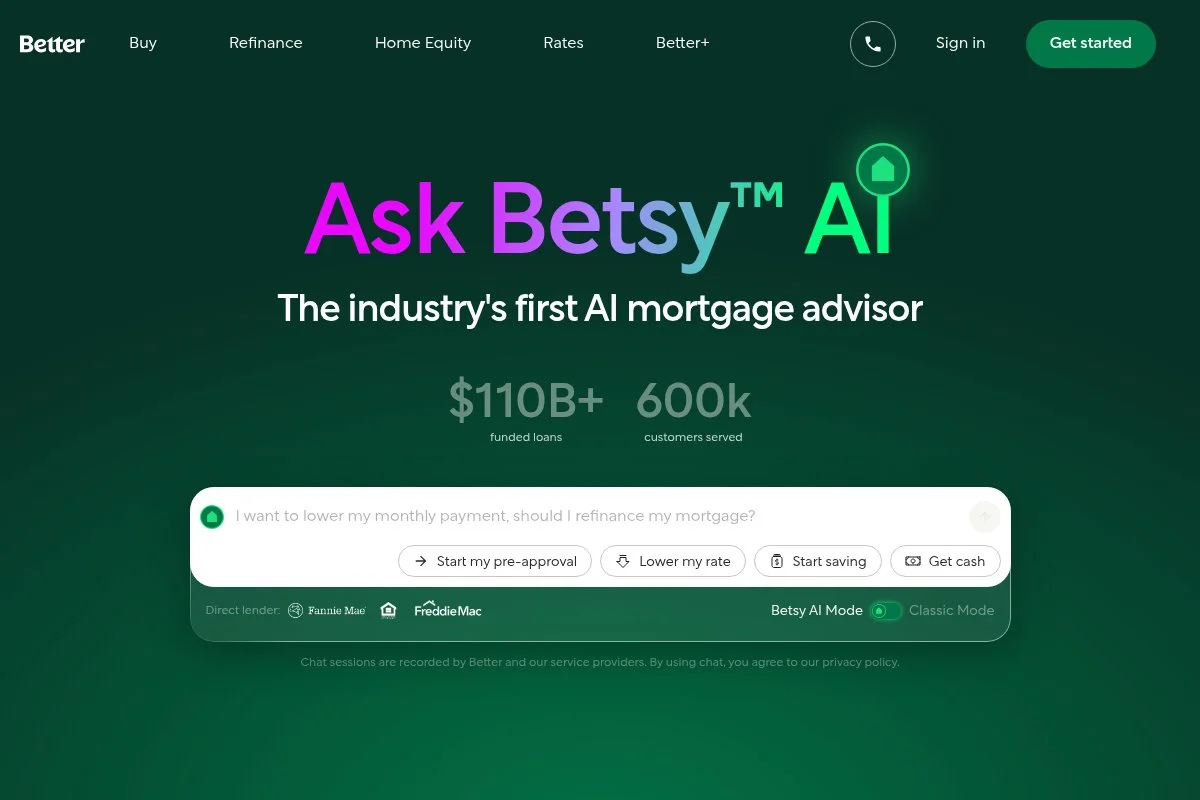
Better Mortgage is an online lender focused on a quick, digital process. It offers conventional and government‑backed options through a streamlined application and advertises no lender fees on many loans. For self‑employed buyers, the appeal is speed and transparent estimates.
You start with a fast rate quote, then connect accounts or upload documents through a clean portal. The interface tracks milestones from pre‑approval to clear‑to‑close. Self‑employed borrowers can expect detailed document requests, which the platform organizes well.
Better has continued investing in automation for verifications and disclosures. That can cut days off the process compared to paper‑heavy lenders, especially when your file has many moving parts.
Higher‑tier strengths include competitive credits, appraisal waivers when eligible, and varied program options. The digital experience stands out among direct lenders.
I like Better for organized self‑employed clients who want clear timelines. If you prefer face‑to‑face service or have a complex file that needs niche programs, a boutique lender might be better.
The document portal is one of the smoothest I’ve used. It reduces email back‑and‑forth and version mix‑ups.
How it works and key features
Apply online, link income and asset accounts, and securely upload business returns. The dashboard shows underwriting stages, conditions, and closing dates. Better offers conventional, FHA, and other program options depending on eligibility. Analytics here means real‑time quote updates as you change points, credits, and down payments. Automations include digital disclosures and e‑signing.
Support is via loan officers and online chat. Response times have been good in my experiences, but complex self‑employed scenarios still benefit from proactive document prep.
Overall, it’s beginner‑friendly for tech‑savvy buyers and fast enough for competitive markets.
Who it’s for
Ideal for freelancers and small business owners who are comfortable uploading documents and managing tasks online. Works well for straightforward FHA or conventional needs. If you need a bank statement or niche non‑QM program, look to a specialized lender. No special technical skill required—just basic portal use and organized files.
Better Mortgage pricing
Better advertises no lender fees on many loans, with costs centered on third‑party fees, points (if chosen), and standard closing expenses. Down payment varies by program.
- Conventional: From 3%–5% down (program dependent) + PMI if applicable
- FHA: From 3.5% down + mortgage insurance
- VA/USDA: Eligibility and program rules apply; potential $0 down
Value can be strong due to the fee structure and digital efficiency. Always compare a loan estimate from at least two lenders on the same day to judge apples to apples. Annual percentage rate (APR) is a helpful tie‑breaker.
Pros and cons
- Pros: Fast digital process; clear portal; often no lender fees; competitive quotes.
- Cons: Limited face‑to‑face service; niche non‑QM options may require another lender; availability varies by state and program.
Choose Better for speed and transparency. If your file needs specialty underwriting, pair it with a non‑QM lender for a backup path.
Better Mortgage reviews
Public reviews are mixed across markets and over time. Check current ratings on sites like Trustpilot and BBB, and always compare recent borrower comments specific to self‑employed files.
What is the best home loan right now?
My top choices today are FHA for flexible qualification, Fannie Mae HomeReady for long‑term savings with strong credit, and VA for eligible veterans who want $0 down. Each serves a different self‑employed profile, and that’s the point—you pick the one that fits your documents and timeline.
HomeReady is my personal go‑to when the credit and reserves line up. I use it myself when I can because PMI can be canceled as equity grows, and that keeps long‑term cost in check. No sponsorship here—just years of comparing real loan estimates. I first leaned into HomeReady after a lender showed me how quickly PMI could drop with planned prepayments. The clear path to lower monthly costs sold me.
From a scaling perspective, HomeReady’s economics make sense if your credit is strong. Compared to FHA, you avoid lifetime mortgage insurance in many cases. Over a few years, dropping PMI can save thousands without a refinance. If cash flow matters later, that flexibility is gold.
FHA is my close second because it helps more self‑employed buyers qualify today. If your tax returns are tight or credit is rebuilding, FHA gets you in the door. Recent guideline clarity and broad lender familiarity reduce friction, which matters in a busy market.
The unique strength of FHA is predictable approvals and friendly rules on gifts and debt ratios. If I were starting over with limited taxable income, I’d likely choose FHA first, then refinance to conventional once my equity and credit improved.
My third pick is VA for those who qualify. $0 down and no monthly mortgage insurance can make the payment very friendly. If you can use this benefit, it’s hard to beat. If you don’t qualify, USDA can be an affordable alternative if the location fits.
In practice, I often compare two paths at once: one agency loan (FHA or HomeReady) and one non‑QM backup if my buyer’s income is complex. That way, we don’t lose the house waiting for surprises in underwriting.
Choosing between these is genuinely tough. I stick with HomeReady when the long‑term math works, but I won’t hesitate to use FHA for a cleaner approval or VA when a buyer is eligible.
I hope this helped you cut through the noise. If you’re self‑employed, prep your documents early, get two same‑day quotes, and go win that offer.
Frequently Asked Questions
Q: How many years of self‑employment do I need to qualify?
Most lenders require 2 years, but some allow 1 year with strong compensating factors. I still advise gathering two years of returns and year‑to‑date financials to be safe.
Q: Which loan is cheapest for self‑employed buyers?
It depends on credit, down payment, and eligibility. For many, HomeReady is the cheapest long-term due to cancellable PMI. If you qualify, VA’s lack of a monthly mortgage insurance requirement is hard to beat.
Q: Can I use business funds for my down payment?
Sometimes. Lenders often allow it if you document that removing the funds won’t harm the business. Expect to provide business bank statements and possibly a CPA letter.
Q: Should I choose a bank statement loan?
Only if you can’t qualify with tax returns or agency programs. Bank statement loans help complex files, but they usually require more down and carry higher rates. I compare both paths before deciding.
Photo by Jakub Żerdzicki: Unsplash


