

If you follow S&P 500 news as a self-employed professional, you already know that market movements affect more than just stock portfolios. Interest rates, consumer spending patterns, and economic growth signals all shape the environment in which independent workers operate. After years of tracking these connections for my own freelance income planning, I have found that paying attention to the S&P 500 news cycle helps me make better business decisions about pricing, savings, and investment timing.
In a recent morning session, the S&P 500 edged higher in early trading as Wall Street processed fresh data on growth and inflation. The move reflected a cautious appetite for risk among investors awaiting clearer signals on the path of interest rates and corporate earnings.
What the latest S&P 500 news means for markets
A modest rise in the index often signals guarded confidence. Buyers are present, but conviction is limited. That dynamic usually reflects uncertainty around monetary policy, earnings expectations, or macroeconomic data. Small daily gains can also hint at sector rotation, where investors shift their exposure between industries without driving broad swings in either direction.
Daily moves of less than 1% are common for the S&P 500. These quiet sessions often serve as staging points before larger moves around key data releases or corporate earnings updates. For self-employed professionals managing retirement accounts or business investment decisions, understanding these patterns provides useful context.
Interest rate expectations still drive sentiment
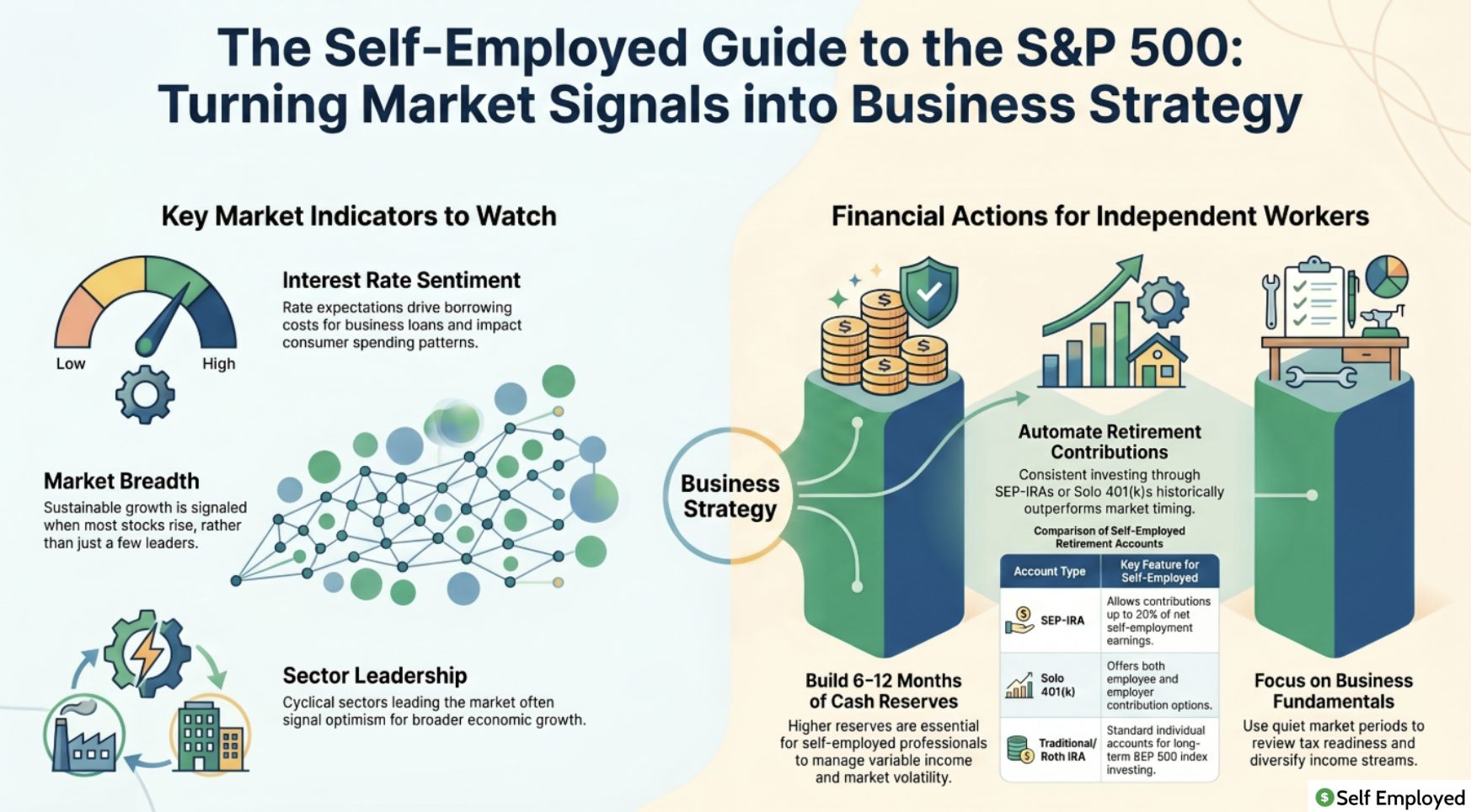
Interest rates remain the central driver behind much of the S&P 500 news cycle. When investors believe the Federal Reserve is more likely to hold steady or cut rates, equities tend to receive support, especially interest-sensitive sectors like real estate and technology.
If inflation data surprises to the upside, rate-cut hopes fade and stocks can stall. The push and pull between inflation readings and rate expectations keeps day-to-day moves measured until the next major catalyst arrives. For self-employed borrowers considering business loans or lines of credit, these rate signals directly affect borrowing costs.
Corporate earnings shape the market tone
Company results and management guidance are the other major force behind S&P 500 news. When corporate outlooks show stable demand and costs under control, investors are more willing to add risk. Weak guidance or margin pressure can cap advances even when the broader economic picture looks reasonable.
Modest index gains may mask larger moves under the surface. Some companies can rally sharply on strong results while others lag. That mixed action produces a mild net change for the broader benchmark while individual sectors tell very different stories.
Sector analysis and what to watch
Market breadth helps explain quiet sessions. If more stocks rise than fall, even small gains can feel healthier and more sustainable. Narrow gains led by a few large-cap technology names can appear fragile. Traders monitor sector leadership for clues about the durability of any advance.
- Stronger breadth across sectors often signals improving confidence in the broader economy
- Narrow leadership concentrated in a few stocks can point to concentration risk
- Defensive sectors like utilities and consumer staples rising may reflect underlying caution
- Cyclical sectors like industrials and materials leading can signal growth optimism
Technology continues to command attention as the largest sector by market weight. Healthcare remains a steady performer, while financials benefit when rate expectations support wider lending margins. Consumer discretionary spending trends provide a direct read on the health of the customers many self-employed professionals serve.
Historical context and ongoing risks
The S&P 500 has weathered rate cycles, inflation scares, and earnings recessions throughout its history. Over long periods, the index has delivered positive returns, though with frequent small daily fluctuations that can feel unsettling in the moment. Modest sessions like the one described here are a normal part of market rhythm.
Key risks remain on the radar. Sticky inflation could delay the policy easing that markets have been hoping for. Slowing consumer demand could weigh on corporate profits. Geopolitical tensions and supply chain pressures can surprise investors at any time. Any of these factors can turn a calm market open into a volatile close.
What self-employed investors should consider
As a self-employed professional, your investment strategy likely differs from someone with a steady paycheck and employer-matched 401(k). Here are some practical considerations when interpreting S&P 500 news for your own financial planning.
First, maintain adequate cash reserves before increasing market exposure. The SEC’s investor education resources recommend keeping three to six months of expenses accessible. For self-employed individuals with variable income, I recommend extending that to six to twelve months.
Second, automate your retirement contributions through a SEP-IRA or Solo 401(k). Consistent investing, regardless of daily market movements, has historically outperformed attempts to time the market. If you need help tracking these alongside your bookkeeping, a systematic approach pays off.
Third, use quiet market periods to review your overall financial picture. Are your tax forms in order? Is your business generating enough revenue to support both operating costs and long-term savings? Sometimes the best response to market news is strengthening your business fundamentals rather than adjusting your portfolio.
Building multiple income streams through your self-employment work is another form of diversification. Exploring new self-employment ideas can reduce your dependence on any single client or revenue source, which parallels the diversification principle behind index investing.
Looking ahead
Today’s early gain in the S&P 500 points to a steady but cautious market. Traders are weighing the next inflation reading, the tone of corporate earnings updates, and any signals from the Federal Reserve about future rate decisions.
A modest rise can build into a stronger move if economic data align with expectations for rate relief and solid consumer demand. It can also fade quickly if inflation disappoints or corporate earnings come in below expectations. Watching market breadth, bond yields, and sector leadership will provide the clearest clues on the next major leg of market direction.
For self-employed professionals, the message is to stay informed without overreacting. Use S&P 500 news as one input among many when making financial decisions, and keep building the business fundamentals that create lasting wealth regardless of what the market does on any given day.
Frequently asked questions
What is the S&P 500 and why does it matter?
The S&P 500 is a stock market index tracking 500 of the largest publicly traded companies in the United States. It serves as a benchmark for the overall health of the U.S. stock market and the broader economy, making it relevant for anyone with retirement savings, investment accounts, or a business affected by economic conditions.
How do interest rate changes affect the S&P 500?
When the Federal Reserve lowers interest rates, borrowing becomes cheaper, which tends to boost corporate profits and stock prices. When rates rise, borrowing costs increase and stocks may decline, particularly in rate-sensitive sectors like real estate and technology. Self-employed professionals feel these effects through business loan rates and consumer spending patterns.
Should self-employed people invest in the S&P 500?
Many financial advisors recommend broad index funds, including those tracking the S&P 500, as a core component of a long-term investment strategy. Self-employed individuals can invest through SEP-IRAs, Solo 401(k) plans, or individual brokerage accounts. The key is maintaining adequate cash reserves for business operations before committing funds to the market.
What causes the S&P 500 to edge higher in morning trade?
Modest morning gains typically result from positive overnight developments, favorable economic data, strong corporate earnings reports, or expectations that interest rates will remain stable or decrease. Light news flow and a wait-and-see posture ahead of key data can also produce small positive moves.
How often should I check S&P 500 news?
For long-term investors, checking market news weekly or monthly is generally sufficient. Daily monitoring can lead to emotional decision-making. Self-employed professionals benefit most from tracking broader trends rather than reacting to individual trading sessions.
What retirement accounts can self-employed people use for S&P 500 investing?
Self-employed individuals can invest through SEP-IRAs, which allow contributions of up to 25% of net self-employment earnings, Solo 401(k) plans with both employee and employer contribution options, traditional and Roth IRAs, and taxable brokerage accounts. Each has different contribution limits and tax implications.
What is market breadth and why does it matter?
Market breadth measures how many stocks are participating in a market move. When most stocks rise together, the advance is considered healthy and sustainable. When gains are concentrated in just a few large companies, the rally may be more fragile. Breadth helps investors assess whether market strength is broad-based or narrow.
How do S&P 500 movements affect small business owners?
S&P 500 trends can signal changes in consumer confidence and spending, which directly impacts demand for small business products and services. Rising markets often correlate with stronger consumer spending, while declining markets can signal belt-tightening. Business owners can use these signals to adjust inventory, pricing, and marketing strategies.


