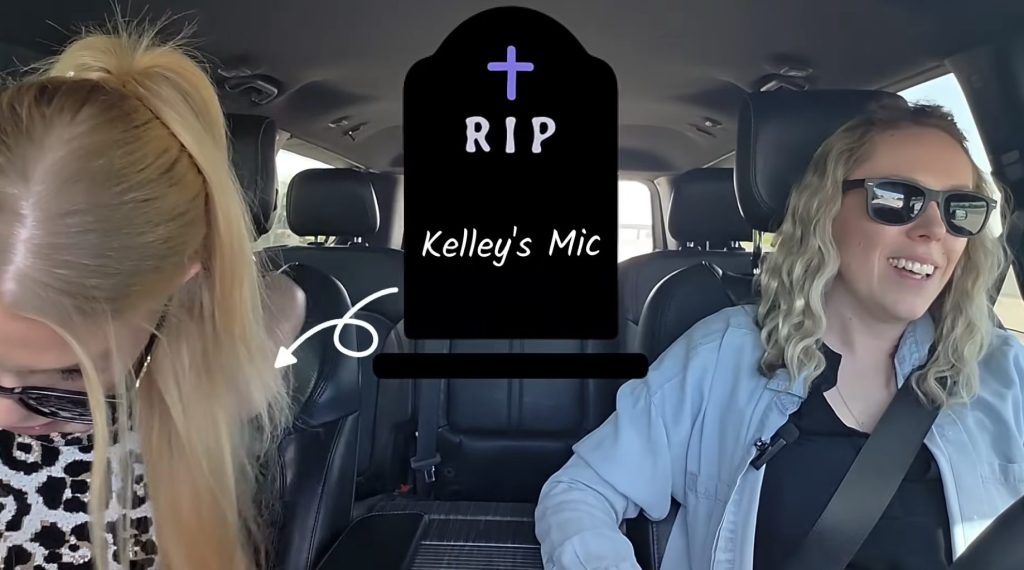
Let me paint you a picture: My co-host and I were filming the first episode of our new podcast. Thirty minutes into recording one of the first episodes of our podcast, I got warm, took off my jacket, and tossed it into the back seat of the car.
Unfortunately, my lapel microphone went with it.
My co-host and I kept talking, completely unaware that my audio was now coming from somewhere behind me. By the time we realized what had happened, the episode was already recorded. We salvaged the audio, published the episode anyway, and learned an important lesson: perfection isn’t a prerequisite for podcasting.
In fact, most successful podcasters start with a long list of mistakes, awkward recordings, and technical mishaps. The difference is that they start.
For self-employed professionals, podcasting has become one of the most effective ways to build authority, deepen trust with potential clients, and create content that works across multiple platforms. Whether you’re a consultant, coach, freelancer, agency owner, or entrepreneur, a podcast can help you establish expertise in a way that few other marketing channels can.
The good news? You don’t need a studio, expensive equipment, or years of broadcasting experience to launch one.
In this guide, I’ll walk through exactly how to start a podcast in 2026, including how to choose a format, what equipment you actually need, where to publish your show, and how to grow an audience without burning yourself out.
Why Start a Podcast in 2026?
Here is what nobody tells you when you are scrolling past yet another “start a podcast!” ad: podcasting is genuinely one of the best moves a self-employed person can make right now. Not because it is trendy. Because it works.
Nearly 584 million people worldwide are tuning in to podcasts, and in the US alone, 55% of the population listens to them every month. Think about what that means for you. How many content formats ask your audience to spend 45 minutes alone with your voice while they drive to work or fold laundry? None. That kind of intimacy builds trust faster than any blog post, Instagram reel, or cold email ever will.
My co-host Kate Shaw, who has built content-driven businesses online for years, says it better than I do: “Podcasting is one of the few places left on the internet where you can build genuine trust with an audience at scale. Google rewards it, listeners reward it, and if you’re self-employed, your future clients are absolutely listening to podcasts right now. You just need to be the one they find.”
She is annoyingly right about most things, which is why I co-host a show with her.
For us, Carpool Confessions started because we wanted people to feel less alone in the hard stuff: trauma, mental health, faith, relationships, modern life. Turns out “authentic conversations about difficult things” is also a solid SEO strategy, but we did not know that at the time. We just wanted to show up honestly and see who showed up back.
Spoiler: people showed up.
Beyond the community-building side, podcasting opens real doors for self-employed people:
- Authority in your niche that no amount of social media posting can replicate
- Sponsorships and income streams that grow as your audience does
- A content engine that feeds your blog, your social, and your YouTube all at once
- Inbound leads from people who already trust you before they ever reach out
The barrier to entry has never been lower. You do not need a studio, a production team, or even a particularly good jacket. You need a clear idea, decent audio, and the willingness to keep showing up.
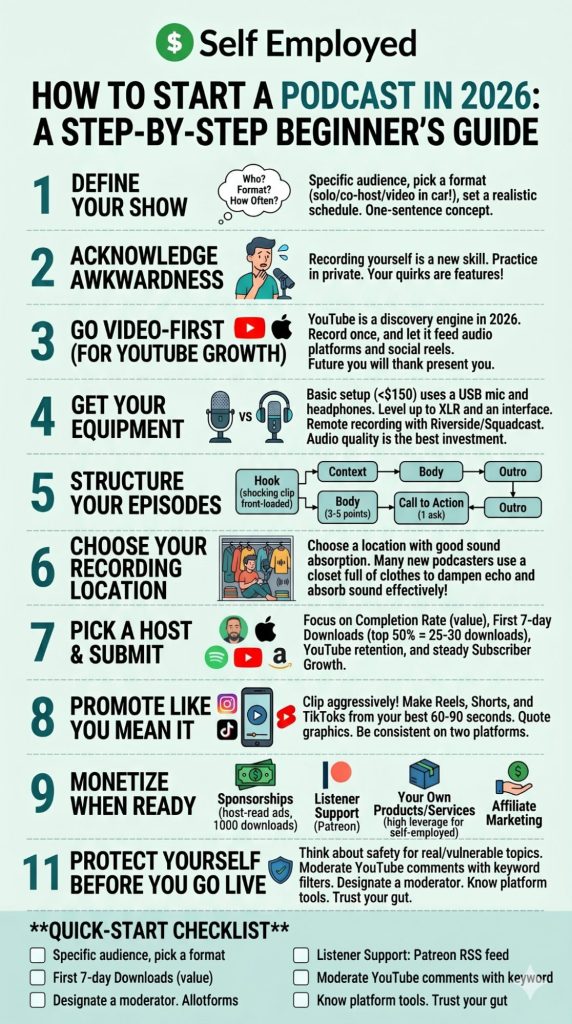
Step 1: Define Your Show Before You Buy Anything
I know you want to skip straight to the microphone recommendations. I see you. But do this part first, or you will end up with great equipment and no idea what to say into it.
Before you record a single word, get clear on three things:
Who Is This Actually For?
“Everyone” is not an answer. For example, the aforementioned Carpool Confessions Podcast exists to help people navigate the messy overlap of trauma, healing, faith, and modern life. That specificity is what makes someone hear the title and immediately think “that is for me.” Vague shows attract vague audiences. Get specific.
What Is Your Format?
Solo commentary, co-hosted banter, interviews, narrative storytelling — pick one and commit to it for at least your first ten episodes before you start experimenting. Better yet, pick a unique format: our podcast is filmed in the car! Unexpected settings tend to interrupt the scroll and make people curious.
Co-hosted shows are easier to sustain because you have someone to play off of and someone to guilt into showing up on recording day. Solo shows build a more intimate one-on-one connection with your audience. Neither is wrong. Just pick.
How Often Are You Actually Going To Publish?
Be honest with yourself here. A weekly show you can genuinely maintain beats a daily show that burns you out in two months. If weekly feels like too much, start bi-weekly. Your listeners will respect a reliable schedule a lot more than an ambitious one you quietly abandon.
Write your show concept in one sentence. If you cannot summarize it in a sentence, the algorithm cannot figure it out either, and neither can a potential listener scrolling past your thumbnail at 7 am.
Step 2: Nobody Talks About How Awkward It Is to Record Yourself
Can we just acknowledge this for a second? Because it is a real thing and every podcast guide skips right past it.
The first time you sit down in front of a microphone and hit record, something weird happens. You forget how to talk like a normal human being. Your laugh sounds strange to you. You say “um” forty times in four minutes. You become acutely aware of every breath, every pause, every weird thing your voice does when you are nervous. It is uncomfortable in a way that is hard to describe until you experience it.
Here is what I want you to know: that feeling does not mean you are bad at this. It means you are new at this. There is a difference.
Recording yourself is a skill, and like every skill, it gets easier with repetition. The first few episodes of Carpool Confessions were a masterclass in audible awkwardness. We stumbled over words, laughed at the wrong moments, and sounded like two people who had never spoken before despite being friends for years. And then, gradually, we stopped hearing the microphone and started just having the conversation.
A few things that actually helped us:
Record Practice Episodes You Never Publish
Just you, your mic, talking about your day or explaining something you know well. Play it back. Cringe. Do it again. Getting comfortable with the sound of your own voice in a no-stakes environment makes a real difference.
Stop Trying To Sound Like A Podcast Host
The goal is to sound like yourself, not a radio announcer. Listeners connect with real people, not polished performances. Your quirks are features, not bugs.
Leave The Mistakes In Sometimes
A genuine laugh at something that went sideways, a stumble you recover from gracefully, a moment where you say, “Okay, that came out completely wrong, let me try that again.” These make you human. Listeners love humans.
The awkwardness passes. I promise. Just keep recording.
Step 3: Go Video-First (Future You Will Thank Present You)
Here is the thing most podcast guides are still sleeping on: YouTube is where new podcasts actually grow in 2026.
We made the decision early on to record the podcast as a video podcast and syndicate the audio elsewhere. It was one of the smartest calls we made. YouTube now has the largest podcast audience globally, with over one billion monthly users, and its algorithm will actively surface your show to people who have never heard of you. Spotify and Apple will not do that at the same scale. They are libraries. YouTube is a discovery engine.
The best part: going video-first does not require a production studio or a camera crew. Decent lighting, a clean background, and good audio are all you genuinely need to get started. Record once and let it feed everything else. The video goes to YouTube. The audio goes to Spotify, Apple, and Amazon. The best sixty seconds become a Reel. One recording session, a full week of content.
Your future self, the one with actual subscribers, will be very smug about this decision.
Step 4: Get Your Equipment Together
Good news: you do not need to spend a lot of money to sound like you know what you are doing. You do, however, need to learn from my lapel mic incident and think through your setup before you hit record.
The Bare Minimum (under $150)
A USB condenser microphone is your starting point. The Audio-Technica ATR2100x and the Samson Q2U are both excellent for beginners and run under $100. Add headphones so you can actually hear what you sound like while recording, and download Audacity (PC) or GarageBand (Mac) for free. That is a complete recording setup. You can launch a podcast with this today.
Our situation is unique because we are mobile with our podcast. So if you’re planning on a different format that requires you to move around more, there’s nothing wrong with recording on your phone and using lapel mics.
A Solid Mid-Range Setup ($300 To $500)
When you are ready to level up, move to an XLR microphone with an audio interface. This gives you more control over your sound and more room to grow. For remote co-host recording, Riverside.fm and Squadcast both record each person’s audio locally, so you are not stuck with the tinny quality you get from a standard video call. Throw in some basic acoustic treatment — or just record in a closet surrounded by clothes, which works surprisingly well and also doubles as a cry corner on hard days.
The single most important investment you can make is your microphone. Listeners will forgive a lot. They will not forgive audio that sounds like you recorded it inside a coffee can during a thunderstorm.
Step 5: Structure Your Episodes So People Actually Finish Them
Here is a hard truth: nobody owes you their attention for 45 minutes. You have to earn it, and you have to keep earning it throughout the episode.
A simple framework that works for almost any format:
- Hook (first 60 seconds): The opening moments of your episode matter more than almost anything else. Industry podcast analytics consistently show that most listener drop-off happens within the first 30 to 60 seconds of an episode, making your opening one of the biggest factors in retention.
A best practice we use in our production is to pick a very high-interest or shocking part of the podcast and front-load it in the episode, ahead of the intro music. When people see it, they are immediately hooked and will [hopefully] watch the whole episode for full context.
- Context (1 to 3 minutes): Brief background on the topic, the guest, or whatever you are about to dig into. Do not divert from the topic or take a long time to ramp up the conversation, or you will lose listeners here.
- Body: Your main content. Three to five clear points, a natural conversational arc, or a structured interview flow. Remember, be YOU. People sense things that are forced.
- Call to action: One ask. Subscribe, leave a review, share the episode. Not five asks. One.
- Outro: Short. Say goodbye. Do not summarize everything you just said. They were there.
For Carpool Confessions, we keep a loose script for the intro and outro, letting the middle breathe naturally. It sounds more real because it is more real. Listeners can absolutely tell the difference between two people having a genuine conversation and two people reading to each other.
Step 6: Find the Right Place to Record
Before you hit record on anything, you need to figure out where you are going to record because your environment shapes your audio just as much as your microphone does.
The biggest enemy of good podcast audio is not background noise. It is echo. Hard surfaces like bare walls, wooden floors, and glass windows bounce sound around the room and give your voice that hollow, “recorded in a bathroom” quality that makes listeners reach for the skip button. What you want are soft, irregular surfaces that absorb sound rather than reflect it.
“Ever hear a podcast where one person sounds like they are 30 feet down a hallway? Well, they’re most likely in a room with bare walls, hardwood floors and lots of hard surfaces.”
Chris Curran, founder of Podcast Engineering School and host of The Podcast Engineering Show
Which brings us to one of the best-kept secrets in podcasting: the humble clothes closet.
Seriously. Walk-in closets packed with hanging clothes are genuinely excellent recording environments, and thousands of podcasters, including some fairly well-known ones, have launched their shows from exactly this setup. The clothing acts as natural acoustic treatment, absorbing sound from every direction and giving your voice a warm, close quality that sounds far more professional than your living room. Bonus: no setup required, no money spent, and your podcast equipment is always ready to go.
If a closet is not an option, look for rooms with carpet, upholstered furniture, bookshelves full of books, or heavy curtains. A bedroom with a made bed and soft furnishings works surprisingly well. So does a car, which is how podcasting inside a vehicle ended up sounding the way it does. There is something about the close quarters and the soft seats that just works for audio.
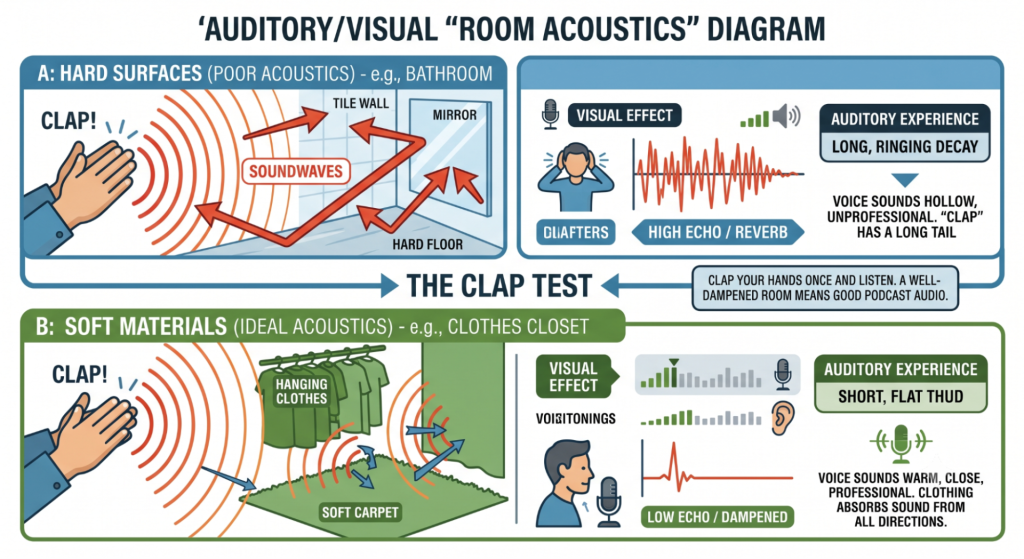
A few things to listen for when testing a new space:
- Clap test: Clap your hands once and listen to the tail of the sound. A long, ringing decay means too much echo. A short, flat thud means the room is well-dampened.
- HVAC hum: Heating and air conditioning systems produce a low, constant background noise that is almost invisible to your ears in the moment but shows up clearly on a recording. Record a few seconds of silence and play it back before you commit to a space.
- Outside bleed: Traffic, neighbors, lawnmowers. Record at the time of day you plan to actually record your episodes and see what sneaks in.
You do not need to soundproof a room. You just need to find the right one, or the right closet full of clothes, and your audio will thank you.
Step 7: Get Your Show on Major Platforms
Your podcast files need to live somewhere before Spotify and Apple can find them. This is where a podcast hosting platform comes in. It stores your audio and generates your RSS feed, the technical mechanism that lets every platform automatically pull your new episodes whenever you publish.
Beginner-friendly options include Buzzsprout, Podbean, and Transistor. Most have free or low-cost tiers. Pick one and stop overthinking it. They are all comparable for a new show, and you can always switch later. I will point out that some of the more budget-friendly options do not push full video files to YouTube; rather, they push audio plus a static image. If you’re using a platform like that, it’s worth taking the extra step to upload your YouTube video directly to maintain it.
Podcast Host Platform Comparison
| Host / Option | Pricing (2026) | Native video support | RSS feed & auto-distribution |
| Buzzsprout | Free tier (2 hrs/mo, episodes expire after 90 days). Paid audio from $19/mo (4 hrs), $39/mo (15 hrs), $79/mo (35 hrs). Video distribution add-on around $30/mo (up to 6 hrs of content). | Add-on only. Can push video to Apple and Spotify, but budget tiers often send audio plus a static image, not true video. | Generates your RSS feed and auto-pushes new episodes to Spotify, Apple, Amazon and more. Monthly uploads are capped by your plan’s hours. |
| Podbean | Free tier (5 hrs storage, 100 GB/mo bandwidth). Unlimited Audio: $9-$12/mo (annual). Video hosting requires Unlimited Plus (around $29/mo annual) or higher. | Yes, but only on Unlimited Plus and above. The audio-only plans will not host video. | Generates your RSS feed and auto-distributes to all major apps. Unlimited storage on paid audio plans; video is gated to higher tiers. |
| YouTube native uploads | Free. | Full native video. This is the video platform, so quality and discovery are the entire point. | No outgoing RSS. YouTube can import an RSS feed to build episodes, but it will not distribute your show to Spotify or Apple. You still need a dedicated host for that. |
Pricing reflects each provider’s publicly listed rates as of 2026 and can change, so confirm current plans before you commit. For a video-first show, the practical takeaway is simple: use a dedicated host (Buzzsprout or Podbean) for RSS distribution to Spotify and Apple, and upload your video to YouTube directly.
Once you have a hosting platform, submit to these four first:
- Spotify (largest podcast audience on the planet)
- Apple Podcasts (massive on iPhone, very influential for discovery)
- YouTube (upload your video version manually here)
- Amazon Music / Audible (growing fast, easy to add, worth the ten minutes it takes)
Most hosts make platform submission a guided, mostly one-click process after your initial setup. Get live on Spotify and Apple first. Everything else is a bonus.
Step 8: Pay Attention to the Right Numbers
Once you are live, the temptation to refresh your download stats every twenty minutes is real. I am not here to judge you. I have done it. It does not help.
Here is what to actually track:
Episode completion rate: Are people finishing your episodes? This is the strongest signal that your content is landing. A high completion rate means listeners found value throughout, not just in the first five minutes.
Downloads in the first seven days: The standard benchmark for how well you promoted a new episode at launch. If this number keeps dropping, your promotion strategy needs attention, not your content. For context, if your episodes get around 25 to 30 downloads in the first week after release, you are already in the top 50% of podcasters. So breathe.
YouTube audience retention: YouTube shows you exactly where people stopped watching, which is genuinely invaluable for figuring out where your episode loses steam. Use it.
Subscriber growth over time: Slow and steady is completely normal. A plateau is a signal to try something different, not a sign to quit.
Two hundred engaged listeners who share your show and send you voice memos about how much an episode meant to them are worth more than two thousand passive ones who never make it past the intro.
Step 9: Promote It Like You Mean It
Publishing and praying is not a strategy. I say this with love.
The shows that grow are the ones that clip aggressively and show up consistently on short-form video. Take your best 60 to 90-second moments from each episode, add captions, and post them to Instagram Reels, TikTok, and YouTube Shorts. That content feeds the algorithm and funnels new people to your full episodes.
One thing we did to gain early traction on our channel was to start recording about a month before our release date. From there, we started publishing daily YouTube Shorts of our first episode to help with discovery and to train YouTube ahead of time on our target audience and how we fit within the algorithm. Our first episode gained over 1,000 views in the first week, and we attribute that in part to the upfront prep work and additional content.
A realistic promotion checklist per episode:
- Two to three short clips for Reels, Shorts, and TikTok
- A quote graphic for your static feed
- A behind-the-scenes post or story while you are recording
- A direct ask for your audience to share it
The best thing is, today, it is extremely easy to do this with AI-powered content repurposing platforms like OpusClip or CapCut. Simply load your full video, and the platform will handle the rest.
Pick two platforms, show up consistently, and do that well before you try to be everywhere at once.
Step 10: Monetize When You Are Ready (Not Before)
Do not let monetization stress you out in month one. Build the show first, grow a real audience, and the income opportunities follow. That said, knowing your options early means you can build toward them on purpose.
- Sponsorships are the most familiar route. Brands pay for host-read mentions in your episodes. Most deals open up around 1,000 downloads per episode, but niche shows with highly engaged audiences can land them earlier. Host-read ads achieve 71% higher brand recall than pre-produced spots, which is exactly why advertisers pay a premium for them and why your authentic voice is the asset here.
- Listener support via Patreon or Buy Me a Coffee lets your audience fund the show directly. This works especially well when listeners feel a genuine personal connection to you and what you are making.
- Your own products and services are often the highest-leverage path for self-employed podcasters. A podcast builds the kind of trust that converts. When you eventually point that audience toward a course, coaching, or consulting work, they already believe in you before you say a word.
- Affiliate marketing lets you recommend products you actually use and earn a commission when listeners buy. The keyword there is actually use. Your audience will notice if you do not mean it.
How to Monetize on YouTube Specifically
If you’re following the video-first strategy we discussed earlier, YouTube can become its own revenue stream in addition to sponsorships and affiliate partnerships.
The platform’s YouTube Partner Program (YPP) now offers two monetization tiers:
- Entry: creators can unlock features like Channel Memberships, Super Chats, and Super Thanks with 500 subscribers, three public uploads in the last 90 days, and either 3,000 watch hours or 3 million Shorts views.
- Full ad revenue sharing: you’ll need 1,000 subscribers and either 4,000 watch hours in the past 12 months or 10 million Shorts views in 90 days.
For self-employed podcasters, this is another reason to record video from day one. Every episode you publish is working toward audience growth on Spotify and Apple Podcasts while simultaneously building a monetizable asset on YouTube. Even if ad revenue isn’t significant at first, YouTube’s discovery engine can help you reach listeners who may never have found your show otherwise.
Think of YouTube monetization as a bonus, not the primary goal. Focus on creating valuable episodes consistently, and the subscriber and watch-time milestones will come much faster than if you’re obsessing over the numbers from day one.
Step 11: Protect Yourself Before You Go Live
This is the section most podcast guides leave out entirely, and it is one of the most important ones, especially if your content touches anything real, vulnerable, or remotely controversial.
We knew going into Carpool Confessions that our topics of trauma, mental health, faith, and relationships were going to attract an audience that felt things deeply. That is exactly what we wanted. But it also meant we needed to think about safety before we ever hit publish, not after.
Here is what that looked like for us practically:
Moderate Your YouTube Comments
YouTube lets you set up keyword filters that automatically hold comments for review before they go live. Use this. You can upload a custom list of words, phrases, and patterns you want blocked outright. Set it up before your first video goes up, not after you have already read something that ruined your Tuesday.
To save yourself the setup, copy and paste this starter blocklist into YouTube Studio under Settings › Community Moderation › Content Controls. YouTube accepts a comma-separated list, so you can drop the whole thing in at once as a starting point (yes, this is super sad, but you have to be proactive here):
| sub4sub, sub 4 sub, subscribe to my channel, check my channel, check my profile, click my name, view my videos, promo sm, promosm, free followers, free subscribers, buy followers, dm me, message me, telegram, whatsapp, cash app, cashapp, investment opportunity, guaranteed returns, crypto, bitcoin, forex, trading signals, make money online, earn from home, work from home, you won, claim your prize, gift card, hot singles, onlyfans, http, https, www., bit.ly, tinyurl, t.me, wa.me, .ru, .xyz, kys, kill yourself, you should die, nobody asked, you suck, shut up, loser, trash channel, this is trash |
Then add common profanity and any identity-based slurs relevant to your audience, plus a few names or topics specific to your show. Revisit the list every couple of months as new spam patterns appear.
Designate A Moderator
Eventually, you will not want to be the person reading every comment yourself. Whether that is a co-host, a trusted friend, or a community manager down the road, having someone else as the first line of defense protects your mental health and keeps you focused on making the show instead of managing its fallout.
Know The Platform Tools Available To You
Spotify, YouTube, and Apple all have reporting and blocking features. Learn where they are before you need them. It is much easier to find the fire extinguisher before a fire breaks out.
Trust Your Gut On What To Engage With
Not every comment deserves a response, and not every critic deserves your energy. We once got a comment telling us we needed to drive and not record a podcast. For context: Carpool Confessions is recorded during our actual commute to work. Everything is completely hands-free, and anything that might require a hand? That is the passenger princess’s duty. We laughed, we moved on, and we kept recording.
Your safety and peace of mind are not optional. Build them into your process from day one.
The Real Talk Section
Starting is easy. Showing up for episode fourteen when your download numbers are still modest, and your mom is still your most loyal listener, that is the actual work.
What kept us going in the early days had nothing to do with metrics. It was the DMs from people saying, “I cried in my car and needed that,” or “I have never heard anyone say out loud what you just said.” No other content format does that. A blog post does not make someone pull over on the highway because they need a minute. A podcast can.
Start before you feel ready. Your first episodes will not be your best episodes. Mine had a traveling lapel mic, a lot of nervous energy, and audio that required more than a little cleanup. They still went up. The better episodes came after, and they only exist because the awkward ones happened first.