


If you are wondering how to become self-employed, you are asking one of the most consequential questions of your professional life. I am Elliot, founder of selfemployed.com, and after helping thousands of people make the transition over the past decade, I know what separates those who thrive from those who struggle. It comes down to preparation, honest self-assessment, and understanding a handful of business fundamentals before you make the leap.
This guide covers how to become self-employed in a way that gives you the best possible foundation – from choosing your niche and setting up your business structure to managing taxes and landing your first clients.
Why self-employment is growing – and why now is a good time
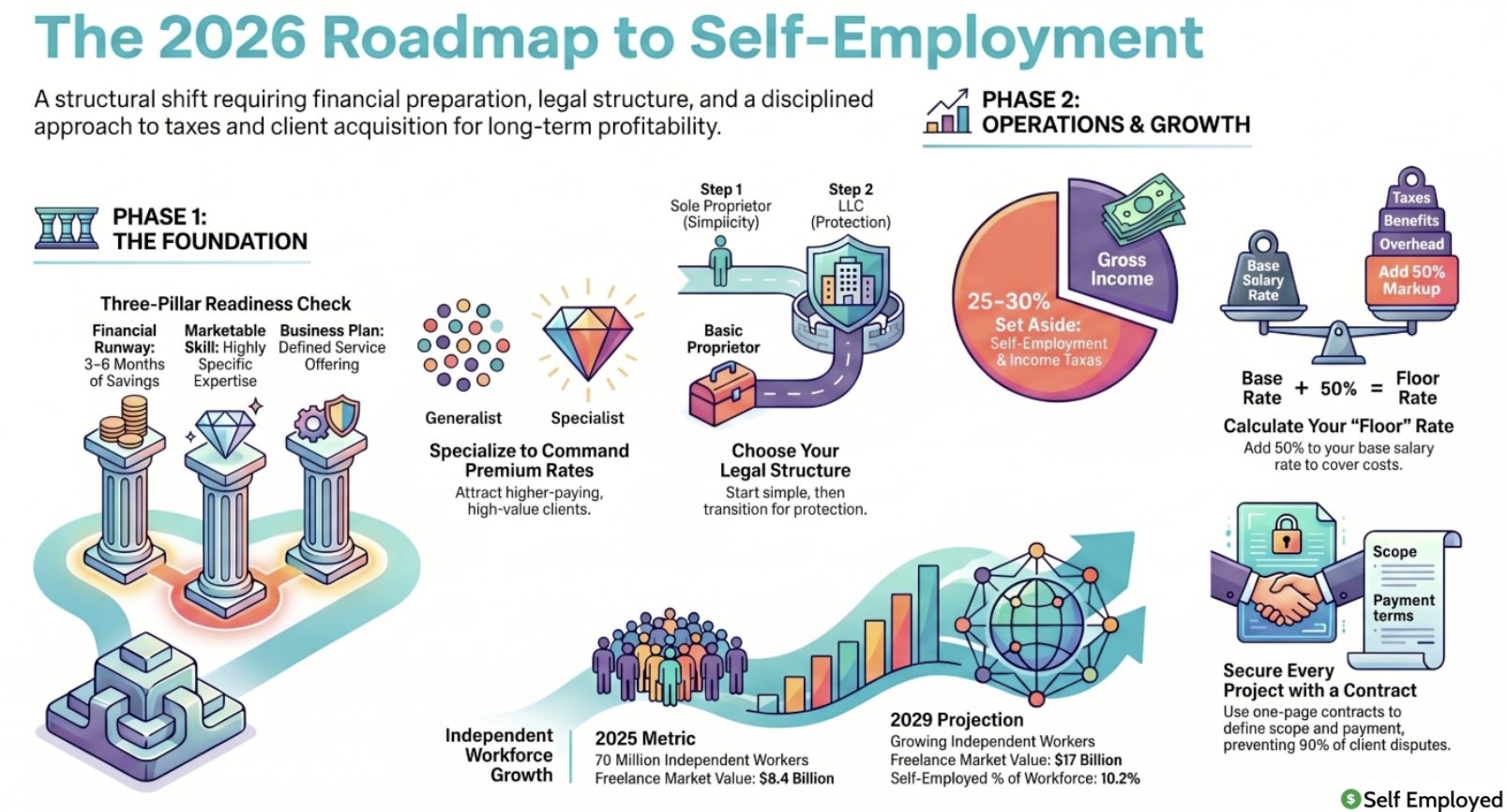
As of late 2025, approximately 16.6 million Americans are self-employed, representing about 10.2% of the workforce. When you include all independent workers – freelancers, contractors, and gig economy participants – the number exceeds 70 million. The freelance market is projected to grow from $8.4 billion in 2025 to nearly $17 billion by 2029.
The shift is real and structural. Businesses have reduced full-time headcount and increasingly rely on independent professionals for specialized skills. If you have expertise worth paying for, there is more demand for your work than at any previous point in history.
Step 1: Honestly evaluate your readiness
Knowing how to become self-employed starts with knowing yourself. Before you resign or reduce your hours, honestly assess three things:
Financial readiness: Do you have three to six months of living expenses saved? Self-employed income is irregular, especially in the first year. Without a cushion, you will accept bad clients and undercharge out of desperation.
Skill marketability: Is your skill set something people will pay for without the backing of an employer’s brand behind you? Be specific about what you offer and who would hire you.
Administrative tolerance: Self-employment means handling invoicing, bookkeeping, taxes, and client management on top of your actual work. Some people love this. Others find it draining. Know which camp you are in before you commit.
Step 2: Define your niche and ideal client
The biggest mistake I see from people learning how to become self-employed is trying to serve everyone. Generalists struggle. Specialists thrive. Instead of “I offer writing services,” become “I write technical documentation for SaaS companies.” Instead of “I do web design,” become “I build e-commerce sites for boutique retailers.”
Once you define your niche, describe your ideal client in detail: their industry, company size, the problems they face, and their budget. This specificity lets you price at a premium and attract clients who value your expertise rather than shopping purely on price.
Step 3: Choose your business structure
Most people becoming self-employed start as a sole proprietor – you and your business are legally the same entity, and it requires no formal registration in most states. It is simple, but it offers no personal liability protection.
An LLC (Limited Liability Company) is a step up. It creates legal separation between your personal assets and business liabilities, and it takes a single afternoon to set up in most states. I recommend transitioning to an LLC once you have consistent clients and are earning meaningful income. See our self-employment ideas and structures guide for a full comparison of business types.
You will also need a separate business bank account, and in many cases, an EIN (Employer Identification Number) from the IRS – free and takes 15 minutes online. An EIN lets you open business accounts and avoids sharing your Social Security number with clients.
Step 4: Understand your tax obligations before you earn a dollar
Taxes are the biggest financial shock for people who are new to self-employment. Here is what you need to know before you become self-employed:
You will pay self-employment tax of 15.3% on net earnings – 12.4% for Social Security (on the first $184,500 of earnings in 2026) and 2.9% for Medicare on all earnings. On top of that, you owe federal income tax based on your bracket, plus any applicable state income tax.
Most self-employed professionals should set aside 25 to 30% of gross income for taxes. If you expect to owe $1,000 or more in federal taxes for the year, the IRS requires quarterly estimated tax payments due in April, June, September, and January. Missing these results in underpayment penalties.
Use accounting software (QuickBooks, FreshBooks, Wave) from day one. Track every dollar coming in and every business expense going out. In my experience, working with a CPA for your first year – even if it costs $1,000 to $2,000 – typically saves far more in avoided mistakes and missed deductions. Our complete self-employed bookkeeping guide walks you through exactly how to set this up.
Step 5: Set your rates correctly from the start
Undercharging is the most common and most damaging mistake in early self-employment. Most new self-employed workers set rates based on what they think clients will accept rather than what they actually need to earn.
Work backward from your income goal. If you want $6,000 per month and charge $100 per hour, you need 60 billable hours – which is only feasible if 60% or more of your working time is actually billable. Factor in taxes (25 to 30% of income), health insurance, retirement contributions, business expenses, and unpaid time spent on marketing and administration. Your rate needs to cover all of it.
A good rule of thumb: take your equivalent salaried rate, add 30% for self-employment tax and benefits, and add another 20% for administrative overhead and business costs. That is your floor, not your ceiling.
Step 6: Build a client acquisition system
Knowing how to become self-employed means knowing how to find clients consistently. The most reliable early-stage strategy is personal outreach and referrals. Tell everyone in your professional network what you do. Post on LinkedIn. Reach out directly to people who work in companies that could use your services.
Create a simple website that clearly explains what you do, who you serve, and how to hire you. Include portfolio samples and one or two brief testimonials if you have them. You do not need a polished brand or a complex website – you need a credible home base that a potential client can visit to decide whether to reach out.
Content marketing builds long-term authority. Publishing useful articles, guides, or insights in your area of expertise consistently attracts clients who find you through search, which means they come to you already convinced of your value. Our high-income self-employment strategies guide covers how to layer multiple income streams as your business matures.
Step 7: Protect yourself with the right contracts and insurance
Before you start work with any client, have a signed contract. It should cover scope of work, deliverables, timeline, payment terms, revision limits, and intellectual property ownership. Most disputes between freelancers and clients come from one thing: unclear expectations at the outset. A one-page contract prevents 90% of those problems.
Depending on your industry, consider professional liability insurance (also called errors and omissions insurance), general liability insurance, or both. The Small Business Administration provides guidance on what types of insurance self-employed workers need based on their industry and risk exposure.
Step 8: Build sustainable systems and set boundaries
The hardest transition for most new self-employed workers is from employment structure to self-directed structure. Without a manager, a team, or office hours, it is easy to either work constantly or drift without focus.
Set defined work hours – even if they are not 9 to 5. Create a dedicated workspace. Use a project management tool (Asana, Notion, Trello) to track what you are working on and when things are due. Schedule time for business development and administrative tasks, not just client work. Take real time off. Burnout is the most common reason self-employed professionals return to employment within two years.
Common challenges when becoming self-employed
In my experience, these are the issues that catch most new self-employed professionals off guard:
Income instability: Your emergency fund is not just a safety net – it is what allows you to be selective about clients and patient about deals. Keep three to six months of expenses in a separate savings account you do not touch for non-emergencies.
Isolation: Working alone can be motivating for some people and deeply draining for others. Join online communities in your niche, attend local meetups, or work from a coworking space a few days per week. Connection is not a luxury – it directly affects the quality of your work and your decision-making.
Inconsistent marketing: The biggest pipeline mistake self-employed workers make is marketing only when they need clients. Market consistently, even when you are busy. The outreach you do today generates leads three months from now.
Frequently asked questions
Save three to six months of living expenses before making the leap to full-time self-employment. This cushion lets you be selective about clients and gives you runway to build your pipeline without taking on projects that undermine your rates or sanity. If you are going part-time first, you may be able to start with less, but three months is an absolute minimum.
No. You can become self-employed as a sole proprietor without forming an LLC. However, an LLC provides personal liability protection and looks more professional to clients. Most self-employed professionals start as sole proprietors and transition to an LLC once income is consistent. See our guide to self-employed vs LLC for a full comparison.
When you are self-employed, no employer withholds taxes from your pay. You are responsible for paying self-employment tax (15.3% of net earnings), federal income tax, and applicable state taxes yourself. If you expect to owe more than ,000 in federal taxes, you must make quarterly estimated payments to the IRS in April, June, September, and January. Set aside 25 to 30% of every payment you receive.
Your professional network is the fastest source of early clients. Tell everyone what you do, reach out directly to potential clients at companies you want to work with, and ask existing contacts for introductions. Create a simple website and LinkedIn profile. Provide genuine value in online communities related to your niche. Referrals from your first satisfied clients will then become your most reliable source of new business.
The most significant risks are income instability (especially in the first year), the lack of employer-provided benefits like health insurance and retirement contributions, and the administrative burden of running a business. All three are manageable with proper preparation: a financial cushion, a plan for benefits and retirement, and systems for taxes and bookkeeping before you start.
Most self-employed professionals reach consistent profitability within six to twelve months of going full-time, though this varies widely by industry, skill level, and how aggressively you pursue clients. Those who prepare a financial cushion, start marketing before leaving employment, and price their services correctly tend to reach profitability much faster than those who make the transition without preparation.


