


The entrepreneurial operating system, commonly known as EOS, is a business management framework that has transformed how thousands of entrepreneurs operate their companies. In my experience working with self-employed professionals and small business owners, I’ve found that EOS provides a practical, implementable system for bringing clarity and accountability to every level of your organization. Unlike theoretical business models, the entrepreneurial operating system focuses on real-world execution – helping you clarify your vision, align your team, and drive measurable results.
If you’re struggling to scale your business, manage team accountability, or feel like you’re wearing too many hats, this guide will walk you through the core principles of EOS and how to implement them in your own organization. After helping dozens of entrepreneurs integrate these systems, I’ve seen firsthand how the entrepreneurial operating system creates the structure that separates thriving businesses from those stuck in chaos.
What is the entrepreneurial operating system?
The entrepreneurial operating system is a business execution framework developed by Gino Wickman. It’s designed to help business leaders vision, clarify, and align their entire organization around a common set of goals and values. The system provides tools, processes, and disciplines that entrepreneurs can implement immediately to see tangible improvements in business performance.
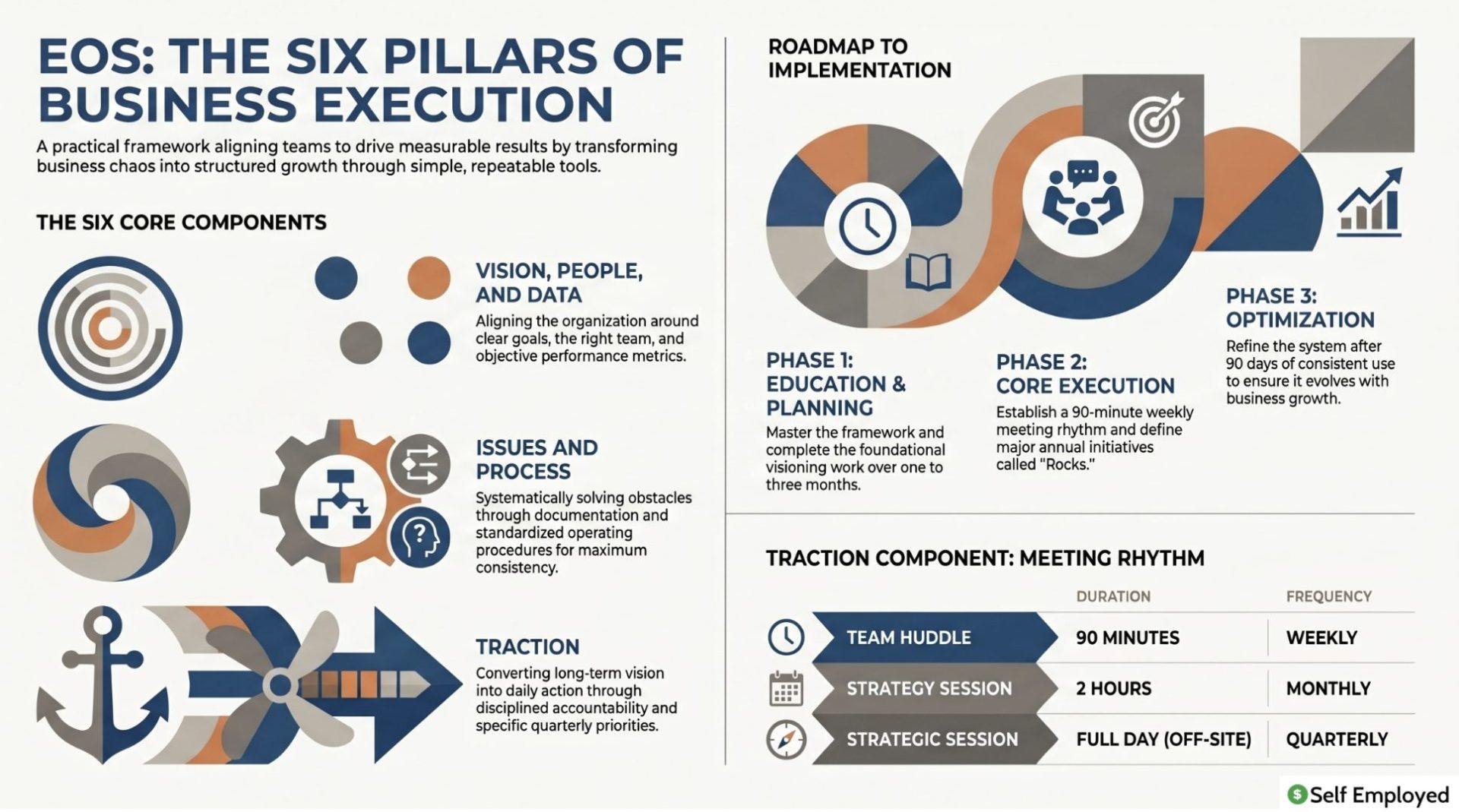
In my experience, what makes the entrepreneurial operating system unique is its focus on simplicity. Rather than overwhelming you with complex corporate structures, EOS distills business management into six key components that work together seamlessly. These six components create a cohesive system that helps owners and teams operate at peak efficiency.
The beauty of implementing an entrepreneurial operating system in your business is that it’s not revolutionary – it’s evolutionary. It takes proven business principles and packages them into a system that actually works for small businesses and self-employed professionals who don’t have the resources of a Fortune 500 company.
The six key components of EOS
Understanding the entrepreneurial operating system starts with knowing its six foundational components. These components work together to create a complete operating system for your business. Let me break down each one based on what I’ve seen work best for self-employed professionals:
Vision
The first component of any entrepreneurial operating system is a clear, compelling vision. This isn’t just a mission statement – it’s a detailed picture of where your business is headed and why it matters. Your vision should answer critical questions: Where will your business be in three to five years? What impact will you have on your customers? What culture are you building?
After working with entrepreneurs at all stages, I’ve found that those who invest time in clarifying their vision are 10 times more likely to achieve their goals. Your vision becomes the north star for every decision your business makes.
People
The people component of your entrepreneurial operating system focuses on hiring the right team, assigning them to the right roles, and developing them continuously. This component recognizes that your business is only as strong as your people.
In my experience, many entrepreneurs underestimate how much their team impacts business performance. If you’re self-employed and eventually plan to scale, investing in the right people early becomes critical. The entrepreneurial operating system framework helps you identify what roles you need and find people who fit well with your organization.
Data
Your entrepreneurial operating system needs reliable data to function effectively. This means tracking key performance indicators, metrics that tell the story of your business health. Without data, you’re making decisions based on gut feeling, which is a recipe for inconsistent results.
From a self-employment perspective, this might mean tracking revenue, customer acquisition cost, profit margins, and project pipeline. The data component of EOS forces you to measure what matters most and address problems before they become crises.
Issues
Every business has issues – problems, obstacles, and challenges that need solving. The entrepreneurial operating system provides a systematic way to identify, discuss, and solve issues at all levels of your organization.
This component includes tools like the IDS (Identify, Discuss, Solve) process that helps teams tackle problems efficiently. Instead of letting issues fester or spiral into bigger problems, you address them immediately. In my experience, this is where many businesses see the fastest ROI from implementing an entrepreneurial operating system.
Process
The process component of your entrepreneurial operating system documents how you actually do the work. This includes standard operating procedures, workflows, and best practices that ensure consistency across your business.
For self-employed professionals, this might seem unnecessary at first – after all, you’re the only one doing the work. But documented processes become critical when you eventually hire team members or want to systematize your service delivery. The entrepreneurial operating system approach is to document your processes before they become problems.
Traction
Traction is about execution and accountability. It means everyone in your organization has clear priorities, goals, and rock-solid accountability for results. The traction component includes tools for setting annual plans, quarterly goals, and weekly priorities.
This is where the entrepreneurial operating system moves from planning to doing. It ensures that vision translates into action and that team members know exactly what success looks like and when they’ve achieved it.
How the entrepreneurial operating system works in practice
Understanding the theory of the entrepreneurial operating system is one thing. Implementing it is another. Let me share what I’ve seen work best when entrepreneurs start applying these principles in their own businesses.
Start with your vision
The first step is to get crystal clear on your vision. This involves defining your core values, your reason for existing beyond making money, your 10-year picture, and your three-year picture. This foundational work takes time, but it’s the most important investment you’ll make in your entrepreneurial operating system implementation.
In my experience, entrepreneurs who skip this step often lose momentum later. Your vision becomes the anchor that keeps your business on track when things get challenging.
Build your rocks and priorities
Once your vision is clear, you translate it into annual goals called “Rocks.” These are typically three to seven major initiatives you want to accomplish in the next 12 months. Your entrepreneurial operating system then breaks these down into quarterly priorities and weekly tasks.
This cascading approach to goal-setting is one of the most powerful aspects of the entrepreneurial operating system. It ensures that everyone’s daily work ladder up to the broader vision.
Establish your meeting rhythm
A critical component of implementing an entrepreneurial operating system is establishing a regular meeting rhythm. This typically includes a weekly 90-minute team meeting, a monthly two-hour meeting, and a quarterly off-site strategic session.
These meetings aren’t busywork. They’re the heartbeat of your entrepreneurial operating system. In my experience, teams that stick to this rhythm see dramatic improvements in communication, accountability, and results.
Use tools and disciplines
The entrepreneurial operating system comes with specific tools to facilitate this work: scorecards for tracking metrics, status sheets for communication, the IDS process for problem-solving, and the L10 meeting agenda for your weekly huddles.
What I appreciate about the entrepreneurial operating system approach is that these tools are simple enough for small teams to implement immediately, but robust enough to scale as your business grows.
Benefits of implementing the entrepreneurial operating system
After helping numerous entrepreneurs implement the entrepreneurial operating system, I’ve observed consistent benefits across different industries and business stages. Here’s what you can expect when you commit to this system:
First, clarity. Your team knows where the business is headed and how they contribute to that vision. This alone eliminates so much confusion and wasted effort.
Second, alignment. When everyone is working toward the same goals using the same system, your business operates like a well-oiled machine instead of a collection of people pulling in different directions.
Third, accountability. The entrepreneurial operating system creates a culture of accountability where people own their commitments and address problems quickly.
Fourth, scalability. By documenting processes and distributing authority through clear frameworks, you create a business that can grow without requiring you to personally manage every detail.
Fifth, reduced stress. Entrepreneurs implementing the entrepreneurial operating system report feeling less overwhelmed because they have systems managing the business rather than constantly fighting fires.
Sixth, better financial results. When you combine clarity, alignment, accountability, and execution, your financial performance improves. Many entrepreneurs see revenue growth accelerate after implementing EOS.
Implementing the entrepreneurial operating system in your business
Ready to implement the entrepreneurial operating system? Here’s a practical roadmap based on what I’ve seen work best for self-employed professionals and small business owners:
Phase one: education and planning
Start by reading the core EOS book or taking an online course to understand the framework thoroughly. Then do the visioning work outlined earlier. This phase typically takes one to three months.
Phase two: core implementation
Begin executing the six components. Start your meeting rhythm, define your rocks for the next year, and introduce the tools and disciplines of the entrepreneurial operating system to your team.
Phase three: refinement and optimization
After 90 days of implementation, refine what’s working and adjust what isn’t. The entrepreneurial operating system is designed to evolve with your business, not be a rigid static system.
One practical approach many entrepreneurs use is working with a certified EOS implementer who can guide them through the process. However, if you have the discipline and basic business acumen, you can implement the entrepreneurial operating system independently.
The entrepreneurial operating system and self-employment
If you’re self-employed, you might wonder how the entrepreneurial operating system applies to a solo operation. The answer: incredibly well. In fact, many of the benefits are even more pronounced when you’re running a solo business.
A self-employed professional implementing the entrepreneurial operating system gains profound clarity on what they should be doing to grow. You can use the vision component to crystallize exactly what kind of business you want to build. Will you remain solo, or is scaling to an agency or team part of your vision?
The entrepreneurial operating system provides the framework to make that decision intentionally rather than reactively. If you want to expand beyond self-employment, you’ll have the structure in place to onboard and scale your team.
For resources specific to self-employment, check out our comprehensive guide on self-employment ideas and strategies that complements the entrepreneurial operating system framework.
Connecting EOS to your business fundamentals
The entrepreneurial operating system works best when your business fundamentals are strong. This includes understanding your bookkeeping and financial position. You can’t make data-driven decisions through the data component of EOS if you don’t have accurate financial information.
Our self-employed bookkeeping guide provides the foundation for the data component of your entrepreneurial operating system. Clean bookkeeping means clean data, which means better decisions.
The entrepreneurial operating system and professional requirements
Depending on your business type, the entrepreneurial operating system works alongside professional and tax requirements. For example, if you’re operating as a self-employed professional or contractor, you’ll need to ensure your entrepreneurial operating system implementation accounts for compliance and administrative requirements.
Our resource on essential forms for self-employed professionals addresses some of the administrative foundations that the entrepreneurial operating system assumes are already in place.
Common challenges when implementing the entrepreneurial operating system
In my experience helping entrepreneurs implement the entrepreneurial operating system, I’ve identified several common challenges:
Challenge one: Inconsistency
The biggest threat to successful entrepreneurial operating system implementation is inconsistency. You establish your meeting rhythm, then skip meetings because you’re busy. You identify rocks, then don’t review them quarterly. The entrepreneurial operating system only works if you stick with the disciplines.
My recommendation: commit to 90 days of consistent implementation before deciding whether it’s working. Most entrepreneurs see results within this window.
Challenge two: Oversimplification
Some entrepreneurs try to oversimplify the entrepreneurial operating system, stripping away components they think they don’t need. This usually backfires. The six components work together – skip one and the system becomes less effective.
Challenge three: Resistance to change
Implementing the entrepreneurial operating system requires changing how you work. If you’ve been flying by the seat of your pants, having structured meetings and clear accountability might feel restrictive at first. Push through this phase – most people find it liberating once they adjust.
The entrepreneurial operating system beyond year one
The entrepreneurial operating system is designed to be your permanent operating system, not a temporary initiative. After your first year of implementation, you’ll deepen and refine your practice.
In year two and beyond, the entrepreneurial operating system typically focuses on optimizing the system itself. You might add new tools, deepen your people development practices, or enhance your process documentation. The framework remains consistent while the execution evolves.
Resources for implementing the entrepreneurial operating system
If you’re serious about implementing the entrepreneurial operating system in your business, here are the primary resources:
The official EOS website at www.eosworldwide.com offers training, certified implementer directories, and official tools. The Small Business Administration at sba.gov provides complementary resources on business planning and management for self-employed professionals.
Final thoughts on the entrepreneurial operating system
The entrepreneurial operating system represents a fundamental shift in how entrepreneurs operate their businesses. Rather than relying on intuition and scrambling to handle whatever comes up, you operate from a system that brings clarity, alignment, and accountability to every level of your organization.
In my experience, entrepreneurs who implement the entrepreneurial operating system don’t go back. Once you’ve experienced the clarity of knowing exactly where your business is headed and how you’ll get there, once you’ve felt the relief of having accountability systems that work, the entrepreneurial operating system becomes non-negotiable.
Whether you’re just starting your self-employed journey or managing a growing team, the entrepreneurial operating system provides the framework you need to take your business to the next level. The investment in learning and implementing this system pays dividends for years to come.
Frequently asked questions about the entrepreneurial operating system
How long does it take to implement the entrepreneurial operating system?
Most businesses see initial results within 90 days, but full implementation typically takes six months to a year. The timeline depends on your team’s size, complexity of your business, and consistency of execution. Solo entrepreneurs often move faster than larger teams.
Can a solo entrepreneur use the entrepreneurial operating system?
Absolutely. The entrepreneurial operating system works exceptionally well for self-employed professionals. You benefit from the vision clarity, process documentation, and accountability systems. Many solo entrepreneurs use simplified versions of the tools, particularly if they don’t have a team yet.
How much does it cost to implement the entrepreneurial operating system?
You can implement the entrepreneurial operating system for minimal cost if you do it independently – just the cost of books and online resources. Professional implementation with a certified EOS implementer typically ranges from five thousand to twenty thousand dollars depending on your business size and complexity. The ROI usually justifies the investment within the first year.
What’s the difference between the entrepreneurial operating system and other business frameworks?
The entrepreneurial operating system is designed specifically for implementation by business owners and entrepreneurs. Unlike some frameworks focused primarily on corporate environments, EOS works for companies from three people to three hundred people. It’s practical, not theoretical, and includes specific tools you can use immediately.
Do I need a certified EOS implementer to make it work?
No, you don’t need a certified implementer, though they can accelerate your progress. Many entrepreneurs successfully implement the entrepreneurial operating system using the books, online courses, and community resources available. A certified implementer is particularly valuable if you want expert guidance, accountability, and faster results.
How does the entrepreneurial operating system handle remote or distributed teams?
The entrepreneurial operating system works well with remote teams. The meeting rhythm, communication tools, and accountability systems adapt to virtual environments. Many fully remote companies use the entrepreneurial operating system successfully, though virtual implementation requires extra intentionality around communication and connection.
What happens if the entrepreneurial operating system doesn’t feel right for my business?
The entrepreneurial operating system isn’t for every business, though it’s broadly applicable. If after honest 90-day trial you find it doesn’t resonate with your business style, other frameworks exist. However, most entrepreneurs who experience initial resistance discover it’s actually resistance to the discipline required, not the system itself.


