


After building multiple self-employed businesses over 15 years, I’ve discovered that the best self employment ideas combine market demand with your unique skills. Whether you’re seeking financial independence or launching your first venture, understanding which self employment ideas align with your strengths is crucial for success.
Best self employment ideas
The landscape of self employment ideas has expanded dramatically with digital tools and remote opportunities. Today’s market offers flexibility that didn’t exist a decade ago, making it easier than ever to turn skills into sustainable income. Let me share the most profitable and accessible categories I’ve seen work consistently.
Online and digital self employment ideas
Freelance Writing remains one of the most accessible self employment ideas for those with strong communication skills. Content agencies pay $25-150 per article, while retainer clients offer $2,000-5,000 monthly income. Startup costs are minimal – just a laptop and basic software.
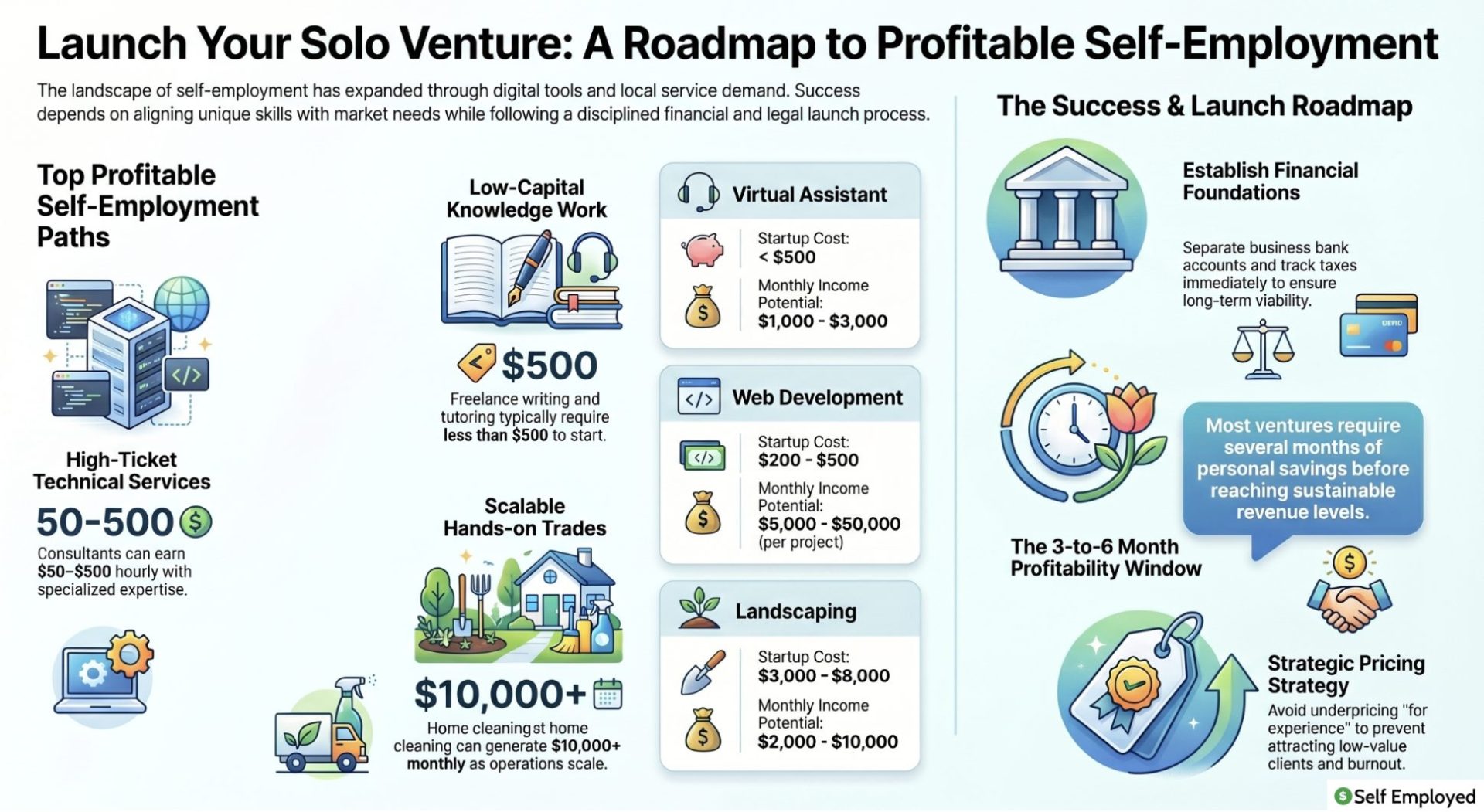
Web Development and Design generates substantial income for skilled professionals. Freelance developers charge $50-150 hourly or $5,000-50,000 per project. Initial investment includes learning platforms ($200-500) and portfolio hosting ($10-20 monthly).
Digital Marketing Consulting appeals to those with SEO, social media, or PPC expertise. Monthly retainers range from $2,000-10,000+ depending on client size and results. This self employment idea requires minimal startup costs beyond certification courses ($300-1,000).
Online Tutoring and Teaching connects educators with global students through platforms and private arrangements. Tutors earn $15-100 hourly, while course creators generate $500-5,000 monthly passively. You’ll need quality video equipment ($200-500) and microphone setup.
Virtual Assistant Services offer recurring income for organized, detail-oriented professionals. Virtual assistants earn $15-50 hourly or package services at $1,000-3,000 monthly. Startup investment is typically under $500 for software subscriptions and communication tools.
Graphic Design and Brand Identity services appeal to businesses upgrading their visual presence. Design projects fetch $500-5,000 while monthly retainers reach $1,500-8,000. Professional design software subscriptions ($20-55 monthly) and training ($0-300) are your primary costs.
Professional service self employment ideas
Bookkeeping and Accounting Services provide consistent income for detail-oriented professionals with financial knowledge. Monthly clients generate $1,500-5,000 in recurring revenue, while tax season creates income spikes. Check out our comprehensive self-employed bookkeeping step-by-step guide for detailed strategies. Startup costs include accounting software ($20-100 monthly) and certification ($500-2,000).
Business Consulting leverages your industry expertise to guide entrepreneurs and established companies. Consultants charge $150-500 hourly or $10,000-50,000+ per project. Minimal startup costs apply, mainly for marketing and office setup ($1,000-3,000).
Financial Planning and Advisory attracts those with investment or wealth management background. Advisors earn $2,000-10,000 monthly through fees or commissions. Licensing and certification costs range $2,000-5,000, with compliance software adding $100-300 monthly.
Real Estate Services extend beyond traditional brokering – include property management, investment analysis, and staging. Income ranges dramatically from $3,000-50,000+ monthly depending on market and specialization. License costs ($300-1,000) and marketing investments ($500-2,000) are your primary expenses.
Professional Photography covers portrait, wedding, commercial, and product photography niches. Wedding photographers earn $2,000-10,000 per event while commercial work generates $1,000-5,000 daily. Equipment investment starts at $2,000-5,000 for quality camera systems.
Skilled trade and hands-on self employment ideas
Home Cleaning and Organizing Services rank among the most scalable self employment ideas. Solo operators earn $2,000-4,000 monthly while eventually delegating to teams for $5,000-15,000+ monthly income. Startup costs remain low at $500-2,000 for supplies and marketing.
Handyman and Home Repair Services serve homeowners needing maintenance and upgrades. Skilled handymen charge $50-150 hourly, generating $3,000-8,000 monthly with consistent scheduling. Initial tool investment ($1,500-3,000) is your primary startup cost.
Landscaping and Lawn Care provide seasonal and year-round opportunities depending on climate. Operators earn $2,000-10,000 monthly based on service volume and pricing. Equipment costs range $3,000-8,000 for mowers, trimmers, and trailers.
Personal Training and Fitness Coaching appeal to health-focused professionals with certification. Trainers earn $50-200 hourly for sessions or $1,000-5,000 monthly for coaching clients. Certification ($500-2,000) and basic equipment ($500-1,500) are primary startup expenses.
Pet Services and Care include dog walking, pet sitting, grooming, and training. Pet professionals earn $15-50 per walk, $30-100 daily for pet sitting, or $500-3,000 monthly for training programs. Startup investment stays minimal at $200-1,000 for supplies and insurance.
Creative self employment ideas
Content Creation and Influencer Work build income through sponsorships, affiliate marketing, and brand deals. Creators with engaged audiences earn $500-5,000+ monthly once established. Initial investment focuses on quality equipment ($500-2,000) and content tools ($20-100 monthly).
Handmade Goods and Etsy Shop Ownership allows crafters to monetize their talents globally. Etsy shop owners report $500-5,000+ monthly revenue depending on product type and marketing. Startup costs include inventory ($200-1,000), shop setup ($0-20), and supplies ($200-500).
Food Truck and Catering Business combine culinary skills with entrepreneurial opportunity. Food entrepreneurs generate $3,000-15,000+ monthly depending on location and menu. Vehicle lease/purchase ($10,000-50,000+) and licensing ($1,000-3,000) represent significant startup investment.
Event Planning and Coordination serve couples, businesses, and organizations planning celebrations and conferences. Event planners earn $1,500-10,000+ per event or $3,000-8,000 monthly for ongoing clients. Startup costs focus on marketing ($500-1,500) and basic office setup ($1,000-2,000).
How to choose the right self employment idea
Finding the perfect self employment idea requires honest assessment of multiple factors. Don’t chase what’s trending without evaluating whether it fits your circumstances. Take time to answer these core questions before launching.
Evaluate Your Existing Skills and Experience honestly. The easiest business launches leverage what you already know. Review your previous jobs, hobbies, and natural talents – these form your competitive advantage and reduce startup time dramatically.
Research Market Demand and Competition in your potential niche. Use Google Trends, industry reports, and customer search data to validate that people actively seek these services. Avoid oversaturated markets unless you have a unique angle.
Calculate Realistic Startup Costs and Runway for your chosen path. Factor in equipment, licensing, marketing, and 3-6 months of personal living expenses before profitability. Many self employment ideas fail because founders underestimate cash requirements.
Project Income Potential Honestly based on market rates, your efficiency, and realistic client acquisition. Avoid inflation bias – most self-employed professionals take 3-6 months to reach sustainable income. Build conservative financial projections accounting for slower growth initially.
Assess Lifestyle Compatibility and Flexibility before committing. Some self employment ideas demand evenings and weekends (event planning, wedding photography), while others offer schedule control. Ensure the business model matches your desired lifestyle and family commitments.
Getting started with self employment
Launching successfully requires systematic planning beyond inspiration. Follow these proven steps to establish your foundation properly and avoid costly mistakes.
Register Your Business Properly with appropriate legal structure and documentation. Choose between sole proprietorship, LLC, S-corp, or C-corp based on liability protection and tax implications. Visit the SBA business launch guide for comprehensive registration requirements by state.
Set Up Separate Business Finances Immediately using dedicated bank accounts and accounting systems. This separation protects your personal finances, simplifies tax preparation, and demonstrates professionalism to clients. Open a business checking account ($0-200 setup) and select accounting software ($20-100 monthly).
Understand Self-Employment Tax Obligations including quarterly estimated payments and deductible expenses. Review the essential forms for self-employed professionals to ensure compliance. Our self-employment tax guide for California provides state-specific strategies. The IRS self-employed tax center offers official guidance on obligations and deductions.
Build a Professional Online Presence starting with a simple website and active social media profiles. Potential clients research self-employed professionals online before hiring – make finding you easy. Invest $100-500 in professional branding and domain registration.
Create a Client Acquisition System combining direct outreach, referral incentives, and content marketing. Most successful self-employed professionals build sustainable income through referrals rather than constant advertising. Document your process and systematize what works.
Common mistakes new self-employed professionals make
Recognizing common pitfalls helps you avoid them entirely. I’ve watched talented entrepreneurs struggle unnecessarily by repeating preventable errors.
Underpricing Services to Build “Experience” sets a terrible precedent that’s difficult to raise later. Your time has value from day one – charge appropriately from launch even as you’re building your portfolio. Underpricing attracts price-sensitive clients who drain your time without building sustainable income.
Failing to Track Time and Expenses Accurately creates tax nightmares and prevents profitability analysis. Implement time tracking software immediately and maintain meticulous expense records. You’ll pay substantially more to accountants sorting chaotic records than investing in proper systems upfront.
Attempting Services Outside Your Core Expertise to capture more revenue dilutes your brand and stretches resources thin. Build reputation in your specialty before expanding. Trying to be everything to everyone guarantees mediocrity in all areas.
Neglecting Contract and Payment Protection leaves you vulnerable to client disputes and unpaid invoices. Every project needs written agreement on deliverables, timeline, and payment terms. Require deposits and have a payment collection process before providing services.
Isolating Yourself Without Networking or Community limits business growth and increases burnout risk. Connect with other self-employed professionals, join industry groups, and build community. The accountability and support prevent the loneliness that sabotages many independent businesses.
Frequently asked questions
What self employment idea requires the least startup capital?
Freelance writing, virtual assistant services, and online tutoring require minimal startup investment under $500. These knowledge-based self employment ideas use skills as your primary asset rather than equipment or inventory. Start immediately with just a computer and internet connection.
How long before a new self employment idea becomes profitable?
Most self employment ideas require 3-6 months to generate sustainable income, though some reach profitability faster. Service-based businesses typically show revenue quicker than product-based ventures. Plan for 6-12 months of personal expenses from savings before relying on business income.
Do I need an LLC for self employment ideas?
While not legally required for most self employment ideas, an LLC provides liability protection and tax benefits. Sole proprietorships work for low-risk services, but LLCs ($100-500 formation cost) protect personal assets. Consult a business attorney or accountant for your specific situation.
Which self employment ideas have the highest income potential?
Consulting, real estate, high-ticket digital products, and service-based businesses with scalable delivery generate six-figure incomes. Income potential depends on expertise, market positioning, and business scaling strategy. Focus on high-value services rather than commodity offerings for maximum earning power.
Can I test a self employment idea before fully committing?
Absolutely – test your concept through side projects before transitioning full-time. Freelance platforms, part-time schedules, and pilot projects validate demand with minimal risk. Testing reveals actual earning potential, client acquisition ease, and whether you genuinely enjoy the work.
What self employment ideas work best for people with limited experience?
Virtual assistant, freelance writing, tutoring in your academic strength, and personal services (dog walking, cleaning) suit those with limited professional background. These self employment ideas value reliability and communication over advanced expertise. Build your track record and gradually transition to higher-value services.
How do self employment ideas differ from side hustles?
Self employment ideas become your primary income source requiring full-time commitment and business infrastructure, while side hustles generate supplemental income with minimal structure. The distinction matters for tax treatment, liability protection, and success expectations. Both paths work – choose based on your financial needs and lifestyle goals.
Should I use affiliate programs with my self employment ideas?
Affiliate programs add income without creating additional service delivery or product. They work best when recommended products genuinely help your audience. Learn more about high-ticket affiliate programs that align with your professional positioning.


