

I’ve spent years working with self-employed entrepreneurs in specialized industries, and I can tell you that how to start a distillery ranks among the most complex business ventures you can attempt. Unlike launching a typical service business, building a whiskey brand requires navigating federal regulations, significant capital investment, years of production time, and a deeply saturated market. But if you’re passionate about spirits and prepared for a genuine long-term commitment, the rewards can be substantial.
In this guide, I’ll walk you through the complete process of starting your own distillery operation, from initial concept through scaling production. This knowledge comes from researching dozens of craft distillery founders and understanding the operational, financial, and regulatory realities that separate successful launches from cautionary tales.
Understanding the whiskey and spirits market landscape
Before investing a single dollar, you need to understand the market you’re entering. The spirits industry has experienced a whiskey boom over the past decade, particularly in craft and premium categories. However, this boom has also created intense competition.
The American whiskey market is dominated by major producers like Jack Daniel’s, Jim Beam, and Maker’s Mark. These established brands control shelf space, pricing power, and consumer mindshare. For anyone learning how to start a distillery as an independent operator, this reality shapes every strategic decision you’ll make.
I’ve observed that successful craft distilleries typically occupy one of three market positions: ultra-premium positioning (small batches, aged products, $50+ price point), experiential positioning (tasting room destination, tourism revenue), or niche positioning (unique flavor profiles, regional identity, specific consumer demographic).
Spend time researching your local market, studying competitor pricing, visiting existing distilleries, and understanding distribution channels in your region. This market research will inform whether you’re positioned for success or walking into an oversaturated space.
Developing your whiskey brand and positioning strategy
Your brand is not just your logo and label design. It’s the entire story, values, and positioning that explains why consumers should choose your whiskey over thousands of alternatives.
I recommend starting with clarity about your brand origin story. Craft consumers in the spirits category are exceptionally conscious of authenticity. Are you a multi-generational family operation? A former distiller striking out independently? A group of friends obsessed with a specific whiskey style? Your genuine story becomes your competitive advantage.
Next, define your whiskey profile distinctly. Will you focus on bourbon, rye, single malt, or blended whiskey? What flavor characteristics will define your brand? High-rye content? Wheated bourbons? Peated or unpeated expressions? This production philosophy shapes your entire distillery design and should be genuine to your vision.
Develop a comprehensive brand guide that covers:
- Brand values and distillery mission
- Target consumer demographics and psychographics
- Flavor profile and production philosophy
- Pricing strategy and market positioning
- Visual identity and packaging design
- Storytelling framework for marketing
Your brand positioning should differentiate you meaningfully. “Premium craft whiskey” describes hundreds of operations. What makes yours different? Can you credibly own a specific positioning in your market?
Navigating legal and regulatory requirements
This section deserves serious attention because regulatory non-compliance can result in significant fines, license revocation, or even criminal penalties. The alcohol industry is among the most heavily regulated business sectors in the United States.
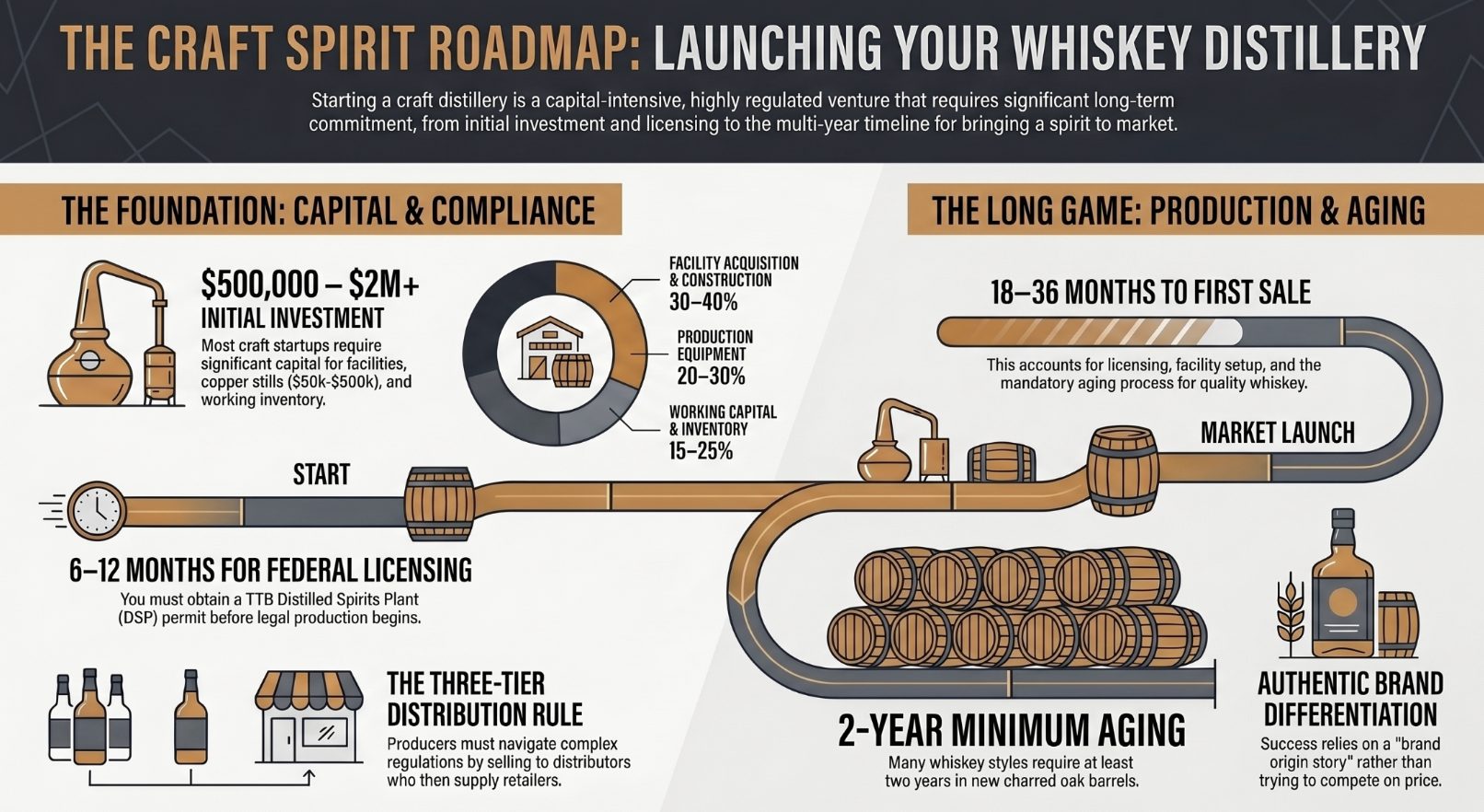
Federal regulations fall under the Alcohol and Tobacco Tax and Trade Bureau (TTB). Before you can legally produce whiskey, you must obtain a Distilled Spirits Plant (DSP) permit from the TTB. This process typically takes 6-12 months and requires detailed facility blueprints, production processes, security protocols, and operational procedures.
Key federal requirements include:
- TTB Distilled Spirits Plant permit
- Federal Fuel Alcohol Permit (if applicable)
- Environmental Protection Agency (EPA) compliance
- OSHA workplace safety compliance
- Occupational Safety and Health Administration regulations
- Firearm and explosives handling protocols (ethanol is flammable)
State and local regulations vary dramatically by location. Some states prohibit distilling entirely. Others have prohibitive tax rates or strict facility requirements. I strongly recommend consulting with an alcohol industry attorney in your state before proceeding with facility planning.
You’ll also need state distillery licenses, local zoning compliance, building permits, and potentially special use permits depending on your location. Many craft distilleries operate attached tasting rooms, which introduces additional licensing layers.
Budget 10-15% of your startup capital for legal and compliance work. Working with experienced alcohol industry counsel is not a luxury; it’s essential infrastructure.
Setting up production facilities and equipment
Your distillery facility is the physical heart of your operation. Building appropriate facilities represents the largest capital expense when learning how to start a distillery.
Basic facility requirements include:
- Production area with milling, fermentation, and distillation equipment
- Barrel storage and aging facilities (climate controlled)
- Quality control and testing laboratory
- Bottling and packaging area
- Administrative offices
- Security systems and fire suppression
Equipment represents 20-30% of startup costs. Copper pot stills range from $50,000 to $500,000+ depending on size and customization. Fermentation tanks, pumps, chillers, and bottling equipment add substantially to this investment.
Many new distilleries start with contract production, leasing equipment or partnering with established distilleries to produce initial batches while they build permanent facilities. This approach reduces upfront capital requirements and lets you test your product before major facility investment.
Location selection is critical. You’ll need access to water (spirits production is water-intensive), reliable utilities, proximity to key transportation routes, and labor availability. Climate matters too, affecting aging rates and seasonal production considerations.
Developing your production process and sourcing ingredients
Your production process is proprietary knowledge that becomes part of your brand identity. How you source grain, manage fermentation, select still types, control temperature, and age your product all contribute to final whiskey character.
Grain sourcing is foundational. Will you source local grain, regional suppliers, or national commodity markets? Many craft distilleries emphasize local or heritage grain varieties as part of their brand narrative. Develop relationships with grain suppliers before you’re in production. Consistency matters significantly for product quality.
Water sourcing and treatment is equally important. Some distilleries build identity around their specific water characteristics. You’ll need adequate water supply for production, cleaning, and potentially power generation.
Fermentation management defines flavor development. Will you use commercial yeast strains or wild fermentation? How long will fermentation run? What temperature controls will you maintain? These decisions reflect both practical concerns and your production philosophy.
Distillation methodology is where craft distilleries often differentiate. Pot still vs. column still, continuous vs. batch distillation, cut management, and proof levels all affect final spirit character. These are areas where experienced distillery operators or consulting distillers add value.
Barrel selection and aging conditions require advance planning. American whiskey must age in new charred oak barrels (federal requirement). Sourcing consistent barrels, managing inventory, and controlling aging environments is an ongoing operational challenge.
Managing finances and securing startup capital
Distillery startups typically require $500,000 to $2 million+ in startup capital depending on facility scope and location. This is not a bootstrapped business model for most operators.
Typical startup cost breakdown:
- Facility acquisition/construction: 30-40%
- Production equipment: 20-30%
- Working capital and inventory: 15-25%
- Professional services (legal, accounting, consulting): 5-10%
- Licensing and permits: 2-5%
- Initial marketing and branding: 5-10%
Capital sources typically include personal investment, bank loans (often requiring SBA backing), angel investors, or venture capital. Most lenders require 20-30% personal capital commitment and substantial collateral.
Create detailed financial projections covering at least five years. Banks and investors will scrutinize assumptions about production capacity, pricing, distribution, and market penetration. Be conservative with revenue projections; this industry is capital-intensive with long cash flow cycles.
I strongly recommend working with a CPA experienced in alcohol production. Tax implications are complex, and proper structure can significantly impact your bottom line. You’ll also benefit from reading our guide on self-employed bookkeeping to understand fundamental financial management even as you work with professional accountants.
Consider exploring our article about what no one tells you when starting a business, which covers cash flow management and capital planning relevant to capital-intensive ventures.
Building your distribution and sales strategy
Production excellence means nothing without sales. Distribution is often the limiting factor for craft spirits businesses.
Alcohol distribution is heavily regulated with three-tier systems in most states. You produce and sell to distributors, who sell to retailers, who sell to consumers. Direct consumer sales online vary dramatically by state.
Your initial distribution strategy likely focuses on:
- Direct sales through your tasting room (if available)
- Local and regional distributor partnerships
- On-premise accounts (bars, restaurants, cocktail establishments)
- Online sales (where state law permits)
- Special events and spirits festivals
Building distributor relationships requires visiting distributors with your product, providing marketing support materials, and demonstrating consumer demand. Distributors handle hundreds of brands; you need visibility and compelling reasons for retailers to stock your product.
On-premise accounts (bars and restaurants) provide crucial brand exposure and consumer trial. These accounts are often your most effective marketing channel early in operations.
Consider your pricing strategy carefully. Premium positioning requires consistent quality and authentic storytelling. Competing on price is a losing game against established brands.
Creating your marketing and brand awareness strategy
Craft spirits marketing succeeds through authentic storytelling, experiential marketing, and community building rather than mass advertising.
Effective marketing channels include:
- Tasting room experiences and distillery tours
- Spirits industry competitions and awards
- Media relations and spirit writer coverage
- Social media storytelling (Instagram particularly important)
- Local and regional events sponsorship
- Consumer education content and whiskey writing
- Bartender and retailer education
I recommend allocating 8-12% of revenue to marketing initially, transitioning to 5-8% as brand awareness grows. Early marketing is essentially education and relationship building.
Your website should serve multiple audiences: consumers learning about your brand, potential retail partners, and industry professionals. Include your origin story, production philosophy, product lineup, and tasting room information prominently.
Build email lists from tasting room visitors and direct consumers. This becomes your most valuable marketing asset, providing direct communication without algorithm dependency.
Consider content marketing through your website and social channels. Educational content about whiskey, distilling processes, or industry trends positions you as a credible voice in the category.
Scaling from startup phase to established operation
Successfully scaling how to start a distillery into a thriving long-term business requires strategic thinking beyond initial launch.
Early phase (years 1-3) focuses on production consistency, relationship building, and cash flow management. You’re proving your concept and establishing product-market fit.
Growth phase (years 3-7) involves expanding production capacity, building regional distribution, and developing product line extensions. This phase typically requires additional capital investment.
Mature phase (year 7+) involves either stabilizing as a successful regional brand or pursuing further expansion into new markets and product categories.
Common scaling challenges include:
- Managing consistent quality as production volume increases
- Securing adequate working capital for inventory growth
- Building management team and operational infrastructure
- Navigating distributor consolidation and retailer pressure
- Maintaining brand authenticity as you grow
Plan for these challenges early through conservative growth, strong operational systems, and maintaining clear brand identity through expansion.
You might also explore the free LLC formation guide to ensure your business structure supports scaling and provides appropriate liability protection.
Building your startup team and advisory network
You cannot build a successful distillery alone. Identify the gaps in your expertise and fill them deliberately.
Core team needs typically include:
- Master distiller or production lead (this might be you)
- Operations manager
- Sales and marketing lead
- Accounting and finance manager
Advisory support should include:
- Alcohol industry attorney
- CPA with spirits industry experience
- Business mentor or advisor with startup experience
- Master distiller consultant (if not your core strength)
Recruiting team members early is difficult when cash is limited, but early team quality significantly impacts success probability. Consider equity arrangements or convertible notes to attract talent beyond what you can afford in salary.
Managing risks and planning for sustainability
Distillery operations involve multiple risk categories:
- Regulatory risk: License loss, compliance failures, regulatory changes
- Production risk: Contamination, fermentation failure, equipment breakdowns
- Market risk: Changing consumer preferences, distributor consolidation
- Financial risk: Inadequate capitalization, cash flow challenges, market saturation
- Operational risk: Key person dependency, supply chain disruption
Develop specific mitigation strategies for each risk category. Maintain compliance obsessively. Build supplier relationships and backup suppliers. Develop multiple revenue streams (tasting room, events, merchandise). Cross-train team members. Maintain adequate cash reserves for unexpected challenges.
Sustainability in the distillery business often means accepting that profitability may take years. Budget conservatively and plan for extended runway. Many successful distilleries operated at losses through initial growth phases before reaching profitability in years 4-6.
Frequently asked questions
How much capital do I need to start a distillery?
Most craft distilleries require between $500,000 and $2 million in startup capital depending on facility scope, equipment choices, and location. This includes facility costs (largest expense), production equipment, working capital, permits, and initial marketing. Smaller operations using contract production may start lower, while larger facilities exceed $2 million easily.
How long does it take to get my first product to market?
Plan on 18-36 months minimum from concept to first sales. This includes 6-12 months for licensing and facility setup, 3-6 months for initial production runs, and 6-12 months for aging (minimum, whiskey must age at least 2 years for many styles). Some distilleries offer unaged or briefly aged spirits to accelerate revenue, but this limits premium positioning.
Do I need distilling experience to start a distillery?
You don’t need personal distilling experience, but you need someone on your team with strong technical production knowledge. Many successful founders hire experienced master distillers or consulting distillers to oversee production while they focus on business operations, marketing, and distribution. Your personal expertise matters less than your ability to build a capable team.
What are the key regulatory hurdles?
The largest hurdles include obtaining your Distilled Spirits Plant permit from the TTB (6-12 month process requiring detailed facility plans and operational procedures), securing state distillery licenses, achieving local zoning compliance, meeting EPA environmental requirements, and managing federal excise tax obligations. Work with an alcohol industry attorney in your state from the beginning; this is non-negotiable.
Can I sell directly to consumers online?
Direct consumer shipping varies dramatically by state. Some states prohibit all interstate shipping of spirits, while others allow it. You’ll likely use the three-tier distribution system (you to distributor to retailer to consumer) for most sales, but explore your state’s regulations and your specific opportunities. A liquor law attorney can clarify your options.
How do I differentiate my distillery in a crowded market?
Successful craft distilleries differentiate through authentic brand positioning, distinctive product characteristics, experiential marketing (tasting rooms and tours), strategic pricing, local/regional focus, or niche consumer targeting. Competing on price against established brands is losing strategy. Focus on owning a meaningful position in your market supported by genuine product quality and authentic storytelling.
Starting your distillery journey
Learning how to start a distillery is complex, capital-intensive work requiring expertise across production, business operations, regulatory compliance, and marketing. Success requires ruthless honesty about your strengths and weaknesses, adequate capitalization, experienced team building, and long-term commitment.
But if you’re genuinely passionate about creating exceptional whiskey and building a brand that endures, the work of building a successful distillery offers rewards beyond financial return. You’re creating something tangible, building community, and potentially establishing a legacy business.
Start with thorough market research and candid self-assessment. Consult with legal and financial professionals immediately. Visit existing distilleries and learn from founders willing to share their experiences. Build your team deliberately around your knowledge gaps.
The spirits industry rewards authenticity, consistency, and genuine passion. If you bring all three, you have a genuine chance at building something meaningful. Visit the Small Business Administration website for general startup resources and funding options that may support your venture.
Your distillery journey begins with clarity about why you’re building this business and what you’re willing to sacrifice to make it succeed. Answer those questions honestly, and you’ll know whether you’re ready to move forward with how to start a distillery.


