


I know the first question most entrepreneurs ask is: can I actually form an LLC without spending hundreds of dollars? The answer is yes, and I’m going to walk you through exactly how to start an LLC for free or with minimal costs. I’ve helped dozens of self-employed professionals navigate this process, and I’ve learned which strategies work best and where you can safely cut corners. In this complete formation guide, I’ll share the exact steps I recommend, along with honest details about what costs are truly avoidable and what expenses actually matter for your long-term success.
Understanding LLC basics and why they matter
Before diving into how to start an LLC for free, let me explain what an LLC actually does for your business. An LLC, or Limited Liability Company, is a business structure that separates your personal assets from your business assets. This separation protects your personal savings, home, and belongings if something goes wrong with your business.
I’ve seen self-employed professionals lose personal assets because they didn’t properly structure their business. When you operate as a sole proprietor without an LLC, your personal and business finances blend together. A lawsuit or debt related to your business can put your personal property at risk. An LLC changes this dynamic by creating a legal entity that stands separate from you as an individual.
Beyond liability protection, an LLC offers tax flexibility. Many small business owners appreciate that LLCs don’t pay corporate income taxes at the federal level. Instead, the business’s income “passes through” to your personal tax return, where you pay taxes at your individual rate. This setup often results in lower overall tax burden compared to a traditional corporation.
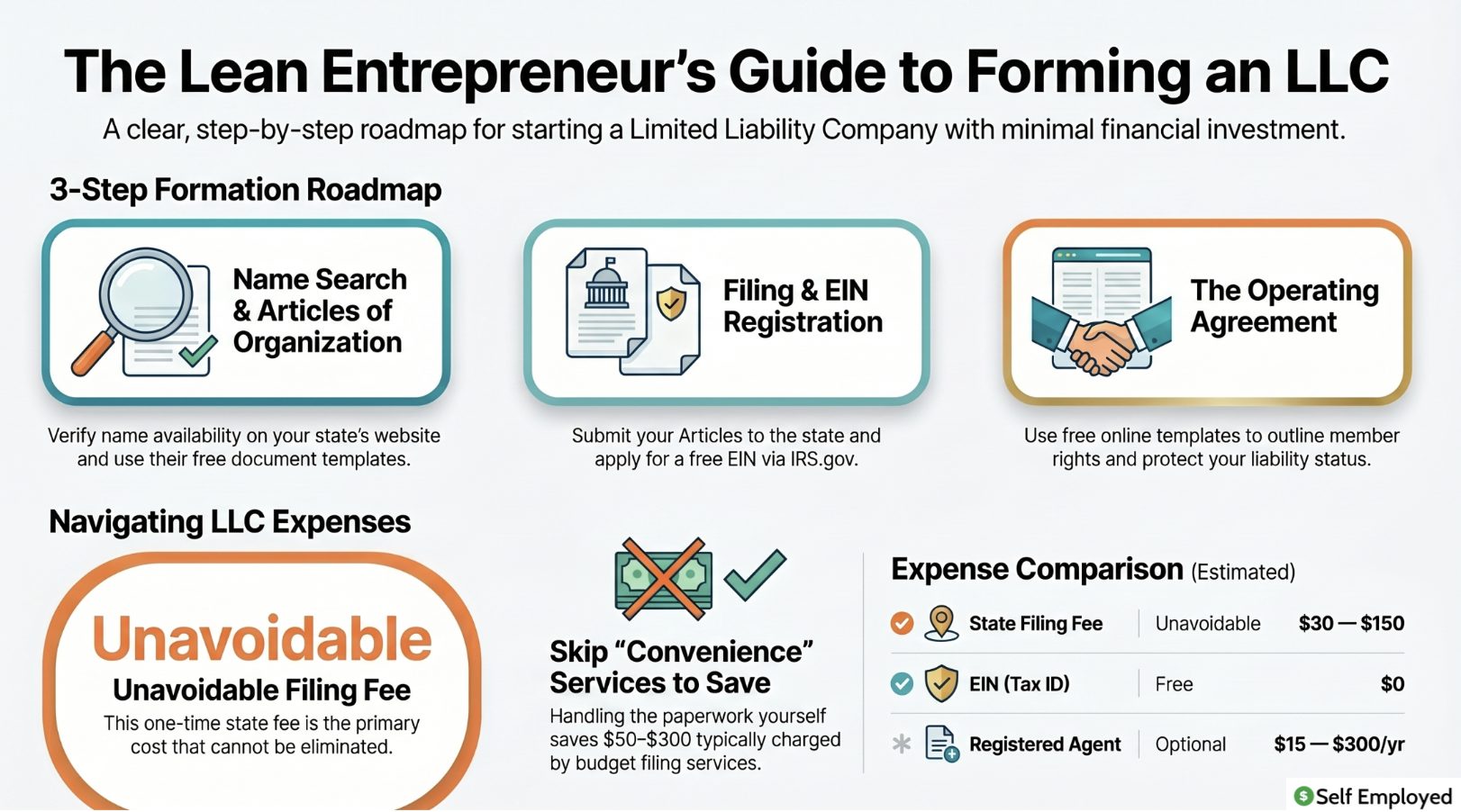
Step-by-step formation process for free
Here’s the process I recommend for forming an LLC with minimal or no fees. The key is understanding which steps you can handle yourself and which ones genuinely require professional help.
Step 1: Choose your LLC name and verify availability
Your LLC name must include “LLC,” “L.L.C.,” or similar designation. The name should be unique within your state and not confusingly similar to existing businesses. You can search availability free on your state’s Secretary of State website. Most states offer searchable online databases where you can instantly check if your desired name is available.
I recommend choosing a name that’s professional, easy to spell, and ideally includes keywords related to your business. However, don’t overthink this step. Your business name doesn’t have to be trendy or clever. It just needs to clearly communicate what you do.
Step 2: Prepare your Articles of Organization
The Articles of Organization is the main document filed with your state to officially create your LLC. This is where many people get nervous about costs, but here’s the reality: you can write this document yourself. Your state’s Secretary of State website provides templates, often for free or at minimal cost.
The Articles typically include your LLC’s name, address, principal place of business, registered agent information, and management structure. A registered agent is someone authorized to receive legal documents on behalf of your LLC. You can be your own registered agent in most states, though some charge a small fee for this privilege. If you want to keep your personal address private, you can hire a registered agent service, but this isn’t essential for how to start an LLC for free.
Step 3: File Articles with your state
File your prepared Articles of Organization with your state’s Secretary of State office. Most states now accept online filing, which is faster and often cheaper than mail filing. Filing fees vary by state, typically ranging from thirty to one hundred fifty dollars. Some states occasionally offer free filing periods or have no filing fee for certain entity types, though these are rare.
This is the one expense that’s genuinely hard to avoid. However, it’s important to note that filing fees are one-time costs and often tax-deductible as business expenses. The filing fee is the price of legal entity creation, not the price of learning how to start an LLC for free.
Step 4: Create an operating agreement
An operating agreement outlines how your LLC will be managed and operated. Many solo entrepreneurs skip this step, but I strongly recommend creating one. An operating agreement doesn’t need to be complex or expensive. You can find free templates online or write one yourself based on your specific needs.
Your operating agreement should cover member rights, profit distribution, decision-making procedures, and what happens if a member leaves. For a single-member LLC, this might be brief. For multi-member LLCs, it becomes more important for protecting all partners.
Step 5: Apply for an EIN
An EIN (Employer Identification Number) is a nine-digit number the IRS uses to identify your business. You need an EIN even if you’re the only employee. The good news: applying for an EIN is completely free. You can apply online at the IRS website, and you typically receive your EIN immediately or within a few business days.
State-specific requirements and considerations
Every state handles LLC formation slightly differently. Most follow the same basic process I outlined above, but some charge different fees or require specific documentation. Texas, Wyoming, and Nevada have particularly business-friendly LLC laws and lower formation costs. Other states may charge additional fees for annual reports or franchise taxes.
I recommend checking your specific state’s Secretary of State website for the exact requirements. The good news is this information is freely available online. Don’t let anyone convince you that you need to pay for professional guidance just to find this information. It’s public and accessible.
Some states require publishing a notice of your LLC formation in a local newspaper. This is an expense that varies widely by state and location. Check your state’s requirements before filing to understand all costs involved in how to start an LLC for free in your specific location.
Breaking down the actual costs
Let me be honest about costs associated with how to start an LLC for free or nearly free. There are genuinely unavoidable expenses and strategic optional expenses.
Unavoidable costs
State filing fees range from thirty to one hundred fifty dollars depending on your state. This is the primary cost that cannot be eliminated. Some states offer expedited processing for additional fees, but standard filing is usually available at the base rate.
Newspaper publishing, if required in your state, typically costs fifty to three hundred dollars. This is avoidable only by choosing a state without this requirement or living in a state that waived this requirement.
Optional strategic expenses
A business bank account usually requires no monthly fee but makes accounting cleaner. A registered agent service costs fifteen to three hundred dollars annually but protects your privacy. Accounting software like Wave or ZipBooks offers free tiers for basic bookkeeping needs.
If you use my recommended approach of doing everything yourself, your total initial cost to form an LLC can be as low as thirty to fifty dollars plus your state’s filing fee. This is genuinely affordable for most entrepreneurs.
Tax benefits and advantages of LLC formation
The tax benefits of an LLC often justify the modest formation costs. When you form an LLC instead of operating as a sole proprietor, you gain several advantages. First, you can elect to be taxed as an S-Corporation, which often saves self-employment taxes for higher-income entrepreneurs.
Self-employment taxes are approximately 15.3% on your net earnings. If your net profit exceeds a certain threshold, electing S-Corporation taxation through your LLC can save thousands of dollars annually in self-employment taxes. This is why understanding how to start an LLC for free is actually an incomplete question. The real question is how to start an LLC affordably so you can capture these tax benefits.
As an LLC member, you can also deduct business expenses directly against your business income. Common deductions include office supplies, software subscriptions, professional development, and a home office. Learn more about tax deductions for self-employed workers to maximize your LLC’s benefits.
I also recommend keeping detailed records of all business income and expenses. Follow my step-by-step bookkeeping guide to maintain proper records from day one. Good bookkeeping makes tax time dramatically simpler and often reveals deductions you might otherwise miss.
Maintaining compliance after formation
Forming an LLC is the beginning, not the end, of your business responsibilities. Maintaining compliance protects your liability protection and keeps your business in good standing with your state.
Annual reporting
Most states require annual reports from LLCs. These reports confirm that your LLC still exists and that the information on file remains current. Filing fees for annual reports typically range from zero to two hundred dollars depending on your state. Some states don’t require annual reports at all, while others charge substantial fees. Check your state’s specific requirements.
Registered agent maintenance
Your registered agent must receive and forward legal documents to you. If you’re your own registered agent, ensure you maintain a physical business address and check mail regularly. If you hire a registered agent, keep their contact information current with your state.
Member meetings and documentation
Even solo LLC owners should document major business decisions. Keep records of meetings, especially those involving major purchases, loans, or structural changes. This documentation protects your liability protection if your LLC is ever questioned in a legal proceeding.
Essential documents and filings
Understanding what documents you need is part of maintaining compliance. Review essential forms for self-employed professionals to stay organized and compliant throughout your LLC’s lifetime.
Free vs. paid LLC formation services
Many companies advertise cheap or free LLC formation services. Let me explain what these services actually do and whether they’re worthwhile when learning how to start an LLC for free.
Free online services
Several websites offer free LLC formation guides and templates. These services provide legitimate value by organizing information and offering templates you could otherwise find separately. Free services typically don’t fill out documents for you but provide the tools to do so yourself.
Budget-friendly paid services
Companies like LegalZoom, Rocket Lawyer, and Bizfilings charge fifty to three hundred dollars for LLC formation. These services prepare your Articles of Organization and handle filing with the state. The value comes from their experience with state-specific requirements and reduced risk of filing errors. However, they charge for convenience, not necessity.
Full-service law firms
Hiring a business attorney to form your LLC costs anywhere from five hundred to two thousand dollars. An attorney can advise you on the best LLC structure for your specific situation, draft custom operating agreements, and provide ongoing legal guidance. This option makes sense if you have complex business structures or multiple members.
My recommendation: if you’re technical and detail-oriented, handle formation yourself using free state templates. If you value convenience and want professional verification of your documents, a budget service is worth the investment. If you have complex business situations, hiring an attorney is the right choice.
Common mistakes to avoid
After helping many entrepreneurs through LLC formation, I’ve noticed patterns in mistakes that create headaches later. Here are the errors I most often see.
First, entrepreneurs sometimes skip the operating agreement. Without one, state default rules apply to your LLC, which may not match your preferences. Writing a simple operating agreement takes a couple hours and prevents future disputes.
Second, many people choose their LLC name without checking if the associated domain and social media handles are available. While you can rebrand later, doing so early saves time and confusion. Check domain and social media availability before finalizing your LLC name.
Third, some entrepreneurs don’t separate business and personal finances. Opening a business bank account and using it exclusively for business transactions is essential. Mixing personal and business finances can jeopardize your liability protection if your LLC is challenged.
Fourth, people forget to apply for an EIN or assume they can use their Social Security Number. While sole proprietors can technically use their SSN for tax purposes, LLCs require an EIN. Getting an EIN is free and takes minutes, so there’s no reason to skip this step.
Fifth, entrepreneurs in states with publication requirements sometimes skip this step to save money, only to discover later that their LLC formation is invalid. Check your state’s specific requirements before filing, and follow them completely.
Frequently asked questions about free LLC formation
Can I really start an LLC for completely free?
Nearly free is more accurate than completely free. State filing fees range from thirty to one hundred fifty dollars and are unavoidable for legal entity creation. However, you can minimize other costs by doing the work yourself. Total costs can be fifty to one hundred fifty dollars depending on your state, which is significantly less expensive than hiring professionals.
How long does LLC formation take?
If you file online, most states process LLC formation within one to five business days. Some states offer expedited processing for additional fees, completing formation in twenty-four hours. Gathering documents and preparing your Articles typically takes two to four hours of your time.
What happens if I make a mistake on my Articles of Organization?
Minor mistakes can usually be corrected by filing an amendment with your state. Amendment fees typically range from twenty to one hundred dollars depending on your state. Major errors might require dissolving and reforming your LLC, which is more costly. This is why careful review before filing is important, even when doing it yourself.
Do I need a business license in addition to my LLC?
An LLC is a state-level business structure registration, but you may need additional licenses depending on your industry and location. Some businesses require professional licenses, health permits, or municipal business licenses. Check with your city and county government for industry-specific requirements.
Can I form an LLC in a different state than where I live?
Yes, you can form an LLC in any state regardless of where you live. However, you’ll typically need a registered agent in that state and must file a foreign LLC registration in your home state if you conduct business there. This adds complexity and cost, so most entrepreneurs benefit from forming in their home state.
What’s the difference between a single-member and multi-member LLC?
A single-member LLC has one owner while a multi-member LLC has two or more owners. Multi-member LLCs typically need more formal operating agreements and clearer management structures. For tax purposes, single-member LLCs are taxed as sole proprietorships by default, while multi-member LLCs are taxed as partnerships by default, unless you elect otherwise.
Key takeaways on how to start an LLC for free
Learning how to start an LLC for free or nearly free is absolutely achievable if you’re willing to do the work yourself. The process involves choosing a name, preparing Articles of Organization using free state templates, filing with your Secretary of State, creating an operating agreement, and applying for an EIN. Your total cost can be as low as fifty to one hundred fifty dollars depending on your state.
The liability protection, tax flexibility, and professional credibility an LLC provides make this modest investment worthwhile for most self-employed professionals. Even if you pay for professional services instead of doing it yourself, the total cost remains reasonable compared to the long-term benefits.
The most important step is to actually take action. Many entrepreneurs delay forming an LLC because they overestimate the complexity or expense. Once you understand how to start an LLC for free through this guide, you have all the information you need to move forward.
Remember that forming your LLC is just the beginning. Maintaining proper records, separating business and personal finances, and staying compliant with annual requirements protects the benefits your LLC provides. Pair your LLC formation with proper bookkeeping practices and you’ll have a solid foundation for business growth and financial security.
The investment of time and modest money in how to start an LLC for free pays dividends through liability protection, tax efficiency, and professional credibility. Take action today and get your business properly structured.


