


Utah has earned its reputation as one of the best states in the country for business, and having worked with self-employed professionals in Salt Lake City, Provo, Park City, and St. George, I can confirm that the Beehive State delivers on that promise. Utah’s flat income tax keeps things simple, the rate has been steadily declining over the past several years, and the state’s booming economy provides abundant opportunities for freelancers and independent contractors. With the flat rate dropping to 4.50% for 2025, there has never been a better time to understand your full tax picture as a self-employed Utahn.
Self Employment Tax Calculator
What Is Self-Employment Tax in Utah?
Self-employment tax is the federal tax that independent workers pay to fund Social Security and Medicare. The 15.3% combined tax is split at 7.65% each between employees and employers, but self-employed individuals pay the full 15.3%.
The Social Security portion is 12.4% on net earnings up to $176,100 for 2025 and $184,500 for 2026. The Medicare portion is 2.9% on all net income with no cap. An additional 0.9% Medicare surtax applies above $200,000 (single) or $250,000 (joint).
You can deduct the employer-equivalent 7.65% from your AGI on your federal return. Self-employment tax and Schedule SE filing are required once net earnings reach $400.
Utah State Income Tax for the Self-Employed
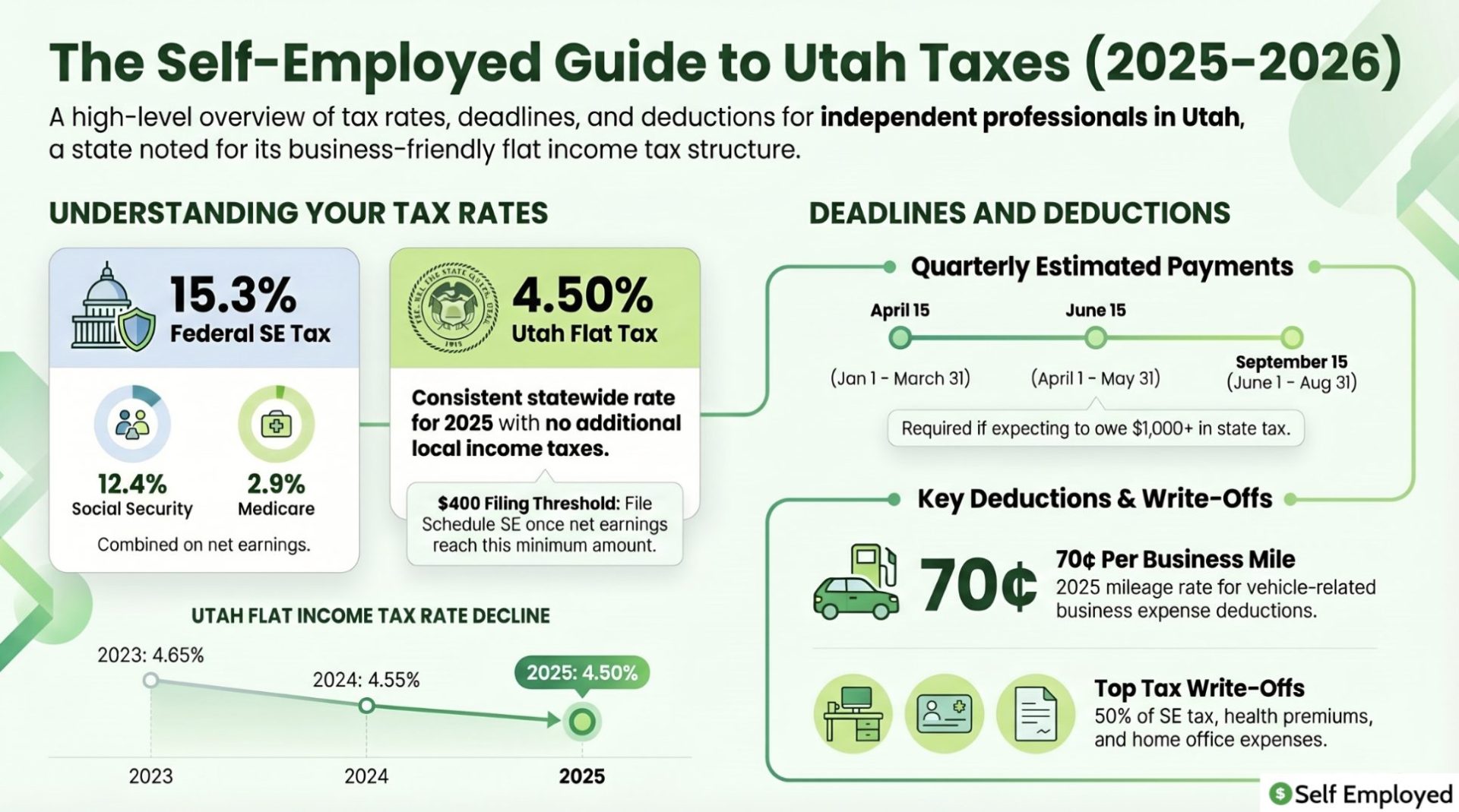
Utah uses a flat income tax that applies the same rate to all taxable income. For tax year 2025, the flat rate is 4.50%, reduced from 4.55% in 2024. This continues a multi-year trend of incremental rate reductions, down from 4.95% in 2021.
| Tax Year | Utah Flat Rate |
|---|---|
| 2023 | 4.65% |
| 2024 | 4.55% |
| 2025 | 4.50% |
Utah does not impose a separate state-level self-employment tax. Your self-employment income flows through to your Utah Form TC-40 and is taxed at the flat rate along with all other income. The state also does not impose local or municipal income taxes.
Utah uses federal taxable income as its starting point for calculating state tax, which means your federal standard deduction or itemized deductions carry through to your state return. Utah then provides a taxpayer credit that effectively creates a zero-tax bracket for lower-income filers.
How to File Self-Employment Taxes in Utah
Filing involves coordinating federal and state returns. Report business income on Schedule C, carry net profit to Schedule SE, and include both on Form 1040. For Utah, file Form TC-40. Your federal taxable income is the starting point, and Utah provides specific credits and adjustments.
The filing deadline aligns with the federal April 15 deadline. Utah supports electronic filing through its Taxpayer Access Point. Keep 1099-NEC forms organized alongside all income records.
Quarterly Estimated Tax Payments in Utah
Self-employed individuals must make estimated payments if they expect to owe $1,000 or more in state tax. Federal estimated payments are also required at the $1,000 threshold.
| Payment Period | Due Date |
|---|---|
| January 1 – March 31 | April 15 |
| April 1 – May 31 | June 15 |
| June 1 – August 31 | September 15 |
| September 1 – December 31 | January 15 of the following year |
Because Utah uses a flat rate, estimating your state tax is straightforward: multiply your projected federal taxable income (after Utah adjustments) by 4.50%, subtract any credits, and divide by four. The safe harbor of paying 100% of prior year liability (or 110% if AGI exceeded $150,000) protects against penalties. Use Form 1040-ES for federal and Utah Form TC-546 for state payments.
Tax Deductions and Credits for Utah’s Self-Employed
Since Utah starts with federal taxable income, every federal deduction directly reduces your Utah liability. The 50% SE tax deduction reduces AGI automatically. The home office deduction provides up to $1,500 under the simplified method. Health insurance premiums, retirement contributions (SEP-IRA up to 25%, Solo 401(k)), and ordinary business expenses are all deductible. Vehicle mileage: 70 cents per mile for 2025.
| Deduction Category | Details |
|---|---|
| Self-Employment Tax Deduction | 50% of SE tax, reduces AGI automatically |
| Home Office | Simplified: $5/sq ft (max $1,500) or actual expenses |
| Health Insurance Premiums | Medical, dental, vision, long-term care |
| Retirement Contributions | SEP-IRA (up to 25% of net SE income), Solo 401(k) |
| Business Expenses | Supplies, software, advertising, professional fees |
| Vehicle/Mileage | 70 cents/mile (2025) or actual vehicle expenses |
Avoiding Common Pitfalls
Not Updating for Annual Rate Changes
Utah has reduced its flat rate every year recently. Use the current year’s rate (4.50% for 2025) when calculating estimated payments to avoid overpaying or underpaying.
Misclassifying Workers
Worker misclassification is a concern in Utah’s construction, tech, and outdoor recreation industries. The IRS and Utah State Tax Commission evaluate the degree of control over the work to distinguish employees from contractors.
Poor Recordkeeping
Maintain organized records of all income and expenses. Use accounting software and separate bank accounts for business and personal finances.
Final Thoughts on Self-Employment Tax in Utah
Utah’s declining flat income tax rate of 4.50% for 2025, combined with no local income taxes and a strong business environment, makes it one of the best states for self-employed professionals. Federal deductions reduce both your federal and state liability since Utah starts with federal taxable income. Stay current on quarterly payments, keep thorough records, and take advantage of every deduction to maximize your earnings.
Frequently Asked Questions
What is self-employment tax in Utah?
Self-employment tax in Utah is the federal tax at 15.3% of net earnings. Utah does not impose a separate state self-employment tax, but self-employment income is subject to the state’s flat 4.50% income tax for 2025.
What is Utah’s income tax rate?
Utah’s flat income tax rate is 4.50% for 2025, reduced from 4.55% in 2024. The rate has been declining steadily from 4.95% in 2021. It applies to all taxable income regardless of income level.
When are estimated tax payments due in Utah?
Quarterly estimated payments are due April 15, June 15, September 15, and January 15 of the following year. Utah requires estimated payments if you expect to owe $1,000 or more in state tax.
Does Utah have local income taxes?
No. Utah does not impose local or municipal income taxes.
What deductions can I claim in Utah?
Self-employed individuals can deduct 50% of SE tax, health insurance premiums, home office expenses, retirement contributions, business expenses, and vehicle mileage at 70 cents per mile for 2025. Since Utah starts with federal taxable income, these deductions reduce both federal and state liability.


