


If there is one state where I consistently see self-employed professionals breathe a sigh of relief when they look at their tax situation, it is Texas. With no state income tax, Texas eliminates what is often the second-largest tax burden for freelancers and independent contractors in other states. I have worked with self-employed professionals in Dallas, Houston, Austin, and San Antonio, and while they still face the full weight of federal self-employment tax at 15.3%, the absence of a state income tax layer means they keep a meaningfully larger share of their earnings. That said, Texas is not entirely tax-free for business owners. The state’s franchise tax and sales tax system require some awareness, and understanding exactly what you owe and what you do not is essential for making the most of Texas’s favorable tax environment.
Self Employment Tax Calculator
What Is Self-Employment Tax in Texas?
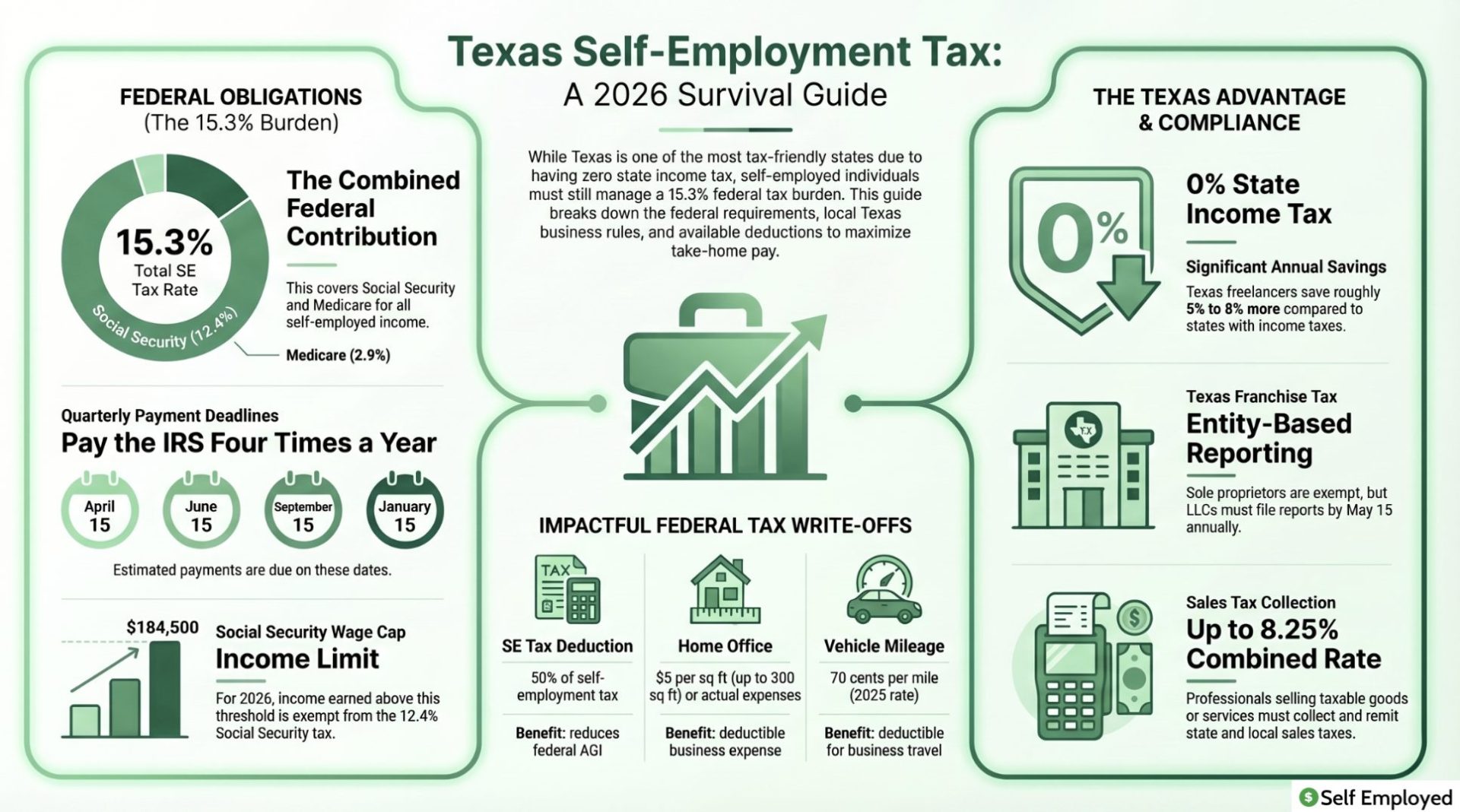
Self-employment tax is the federal tax that funds Social Security and Medicare for people who work for themselves. As a self-employed individual in Texas, you pay the full 15.3% yourself, with 12.4% going to Social Security and 2.9% to Medicare. When you work for an employer, these contributions are split evenly, but as an independent worker, you cover both sides.
The Social Security portion applies to net self-employment earnings up to the annual wage base, which is $176,100 for 2025 and $184,500 for 2026. Earnings above those amounts are exempt from the Social Security tax. The Medicare portion applies to all net self-employment income with no cap. If your net earnings exceed $200,000 as a single filer or $250,000 filing jointly, an additional 0.9% Medicare surtax applies to the income above those thresholds.
You can deduct the employer-equivalent portion of your self-employment tax, 7.65%, from your adjusted gross income on your federal return. This above-the-line deduction is available whether you itemize or take the standard deduction. You must pay self-employment tax if your net self-employment earnings are $400 or more in a tax year.
Texas does not impose any state income tax or state self-employment tax. Your self-employment earnings are taxed only at the federal level, which is a significant financial advantage compared to states where combined state income tax rates can add 5% to 13% to your overall burden.
Texas Tax Landscape for the Self-Employed
No State Income Tax
Texas is one of nine states that does not levy a personal income tax. This means your self-employment income, whether $30,000 or $500,000, is not subject to any state income tax. You do not file a state income tax return, and you do not make state estimated income tax payments. This simplifies your tax life considerably and provides a genuine financial advantage. A freelancer earning $100,000 in net self-employment income in Texas saves roughly $5,000 to $8,000 annually compared to a freelancer with identical income in a state with a 5% to 8% income tax rate.
Texas Franchise Tax
While Texas has no income tax, it does impose a franchise tax on certain business entities. The franchise tax is a privilege tax on businesses organized or operating in the state. The key detail for most self-employed individuals is that sole proprietorships and general partnerships owned entirely by natural persons are generally exempt from the franchise tax. If you operate as a simple freelancer or sole proprietor, you typically do not owe this tax.
However, if you have formed an LLC, S Corporation, or other legal entity for your business, the franchise tax may apply. The standard rate is 0.75% of taxable margin for most entities and 0.375% for those primarily engaged in retail or wholesale activities. There is also an EZ computation rate of 0.331% for qualifying businesses. The no-tax-due threshold for 2026 reports is $2.65 million in annualized total revenue, meaning businesses below that revenue level owe no franchise tax but may still need to file a Public Information Report.
| Entity Type | Franchise Tax Status |
|---|---|
| Sole Proprietorship | Generally exempt |
| General Partnership (natural persons) | Generally exempt |
| LLC | Subject to franchise tax (if applicable) |
| S Corporation | Subject to franchise tax (if applicable) |
| C Corporation | Subject to franchise tax |
Sales Tax Considerations
Texas has a 6.25% state sales tax rate, and local jurisdictions can add up to 2%, bringing the combined rate to as high as 8.25% in many areas. If your self-employment involves selling taxable goods or certain taxable services, you are required to collect sales tax from your customers and remit it to the Texas Comptroller. Most professional and consulting services are not subject to sales tax in Texas, but certain services including data processing, real property repair, and security services are taxable. Verifying whether your specific services are subject to Texas sales tax is an important compliance step.
How to File Self-Employment Taxes in Texas
Filing self-employment taxes in Texas is simpler than in most states because there is no state income tax return to prepare. Your primary filing obligations are federal.
You report your business income and expenses on Schedule C (Form 1040), which calculates your net profit. That net profit flows to Schedule SE for the self-employment tax computation. The deductible half of your SE tax reduces your adjusted gross income on Form 1040.
Clients who paid you $600 or more should provide a Form 1099-NEC. You are responsible for reporting all income regardless of whether you received a 1099.
If you have formed an LLC or corporation in Texas, you may need to file a franchise tax report and Public Information Report with the Texas Comptroller by May 15 annually, even if you owe no franchise tax. Failure to file can result in penalties and eventually lead to the administrative forfeiture of your entity’s right to do business in Texas.
Quarterly Estimated Tax Payments
Since Texas has no state income tax, your quarterly estimated payments are exclusively federal. The IRS requires estimated payments if you expect to owe $1,000 or more in federal tax.
The quarterly due dates are:
| Payment Period | Due Date |
|---|---|
| January 1 – March 31 | April 15 |
| April 1 – May 31 | June 15 |
| June 1 – August 31 | September 15 |
| September 1 – December 31 | January 15 of the following year |
To calculate your quarterly payment, estimate your total annual net self-employment income, apply the 15.3% SE tax rate, add your expected federal income tax, and divide by four. The safe harbor method of paying at least 100% of your prior year’s federal tax liability (or 110% if your AGI exceeded $150,000) protects you from underpayment penalties.
The absence of state estimated payments is a genuine simplification that saves Texas freelancers administrative time every quarter compared to their counterparts in income-tax states.
Tax Deductions for Texas’s Self-Employed
Even without state income tax, federal deductions are essential for reducing your overall tax burden. The 50% self-employment tax deduction automatically reduces your federal AGI. The home office deduction provides either a simplified deduction of $5 per square foot up to 300 square feet for a maximum of $1,500, or the actual expense method.
Health insurance premiums for medical, dental, vision, and long-term care are deductible from your federal AGI. Retirement contributions to a SEP-IRA (up to 25% of net self-employment earnings) or Solo 401(k) reduce your taxable income dollar for dollar. Business expenses including software, advertising, supplies, travel, and professional fees are deductible on Schedule C. Vehicle mileage is deductible at 70 cents per mile for 2025.
| Deduction Category | Details |
|---|---|
| Self-Employment Tax Deduction | 50% of SE tax, reduces federal AGI |
| Home Office | Simplified: $5/sq ft (max $1,500) or actual expenses |
| Health Insurance Premiums | Medical, dental, vision, long-term care |
| Retirement Contributions | SEP-IRA (up to 25% of net SE income), Solo 401(k) |
| Business Expenses | Supplies, software, advertising, professional fees |
| Vehicle/Mileage | 70 cents/mile (2025) or actual vehicle expenses |
Avoiding Common Pitfalls
Assuming No State Filing Requirements
The most common mistake Texas freelancers make is assuming that no state income tax means no state filing requirements whatsoever. If you have formed an LLC or corporation, you still need to file a franchise tax report and Public Information Report with the Texas Comptroller. Missing this deadline, typically May 15, can result in penalties and eventually the forfeiture of your business entity. Sole proprietors who have not formed a legal entity are genuinely free from state filing requirements.
Ignoring Sales Tax Obligations
If your business involves selling taxable goods or certain services, you must register with the Comptroller, collect sales tax, and file regular sales tax returns. Failing to collect and remit sales tax when required can result in personal liability for the unpaid tax plus penalties and interest.
Underestimating Federal Tax Burden
Because Texas has no state income tax, some freelancers become complacent about their federal obligations. The 15.3% self-employment tax plus federal income tax at your marginal rate still produces a significant total liability. A Texas freelancer earning $100,000 in net self-employment income should expect to owe approximately $25,000 to $30,000 in combined federal self-employment tax and income tax, depending on their filing status and deductions. Setting aside 25% to 30% of each payment you receive is a sound practice.
Final Thoughts on Self-Employment Tax in Texas
Texas’s absence of state income tax makes it one of the most favorable states in the country for self-employed professionals. Your tax obligations are streamlined to the federal level, with the potential addition of franchise tax reporting if you have formed a business entity and sales tax collection if you sell taxable goods or services. By maximizing your federal deductions, making timely quarterly estimated payments, and ensuring your business entity filings are current, you can fully capitalize on Texas’s tax-friendly environment. If your self-employment income is growing or you are considering forming an LLC or S Corporation, consulting with a Texas-based tax professional can help you choose the most advantageous structure.
Frequently Asked Questions
Does Texas have a state income tax on self-employment income?
No. Texas does not have a personal income tax, so your self-employment earnings are not subject to state income tax. You only owe federal self-employment tax at 15.3% and federal income tax. This makes Texas one of the most tax-advantaged states for freelancers and independent contractors.
Do I need to pay the Texas franchise tax as a freelancer?
If you operate as a sole proprietor, you are generally exempt from the Texas franchise tax. If you have formed an LLC, S Corporation, or other legal entity, the franchise tax may apply, though businesses with annualized total revenue below $2.65 million (for 2026 reports) owe no tax. You may still need to file a Public Information Report.
When are quarterly estimated tax payments due in Texas?
Since Texas has no state income tax, quarterly estimated payments are federal only. They are due on April 15, June 15, September 15, and January 15 of the following year. Use Form 1040-ES to make these payments to the IRS.
What deductions can I claim as a self-employed person in Texas?
You can deduct 50% of your self-employment tax, health insurance premiums, home office expenses, retirement contributions to a SEP-IRA or Solo 401(k), vehicle mileage at 70 cents per mile for 2025, and ordinary business expenses. These deductions reduce your federal taxable income.
How much should I set aside for taxes as a Texas freelancer?
Without state income tax, Texas freelancers generally need to set aside 25% to 30% of their net self-employment income for federal taxes. This covers both the 15.3% self-employment tax and your federal income tax at your applicable marginal rate.
What forms do I need to file self-employment taxes in Texas?
At the federal level, you need Schedule C (business income and expenses), Schedule SE (self-employment tax), and Form 1040. There is no Texas state income tax return. If you have formed a business entity, you may need to file a franchise tax report with the Texas Comptroller by May 15 annually.


