


As a self-employed professional in Idaho, I’ve learned that understanding the idaho tax rate structure is essential for managing my tax obligations effectively. Whether you’re a freelancer, consultant, or small business owner in the Gem State, knowing how the state income tax and self-employment tax work together can save you thousands of dollars annually. This guide walks you through everything you need to know about Idaho’s tax landscape, from the current flat tax rate to quarterly payment requirements and available deductions.
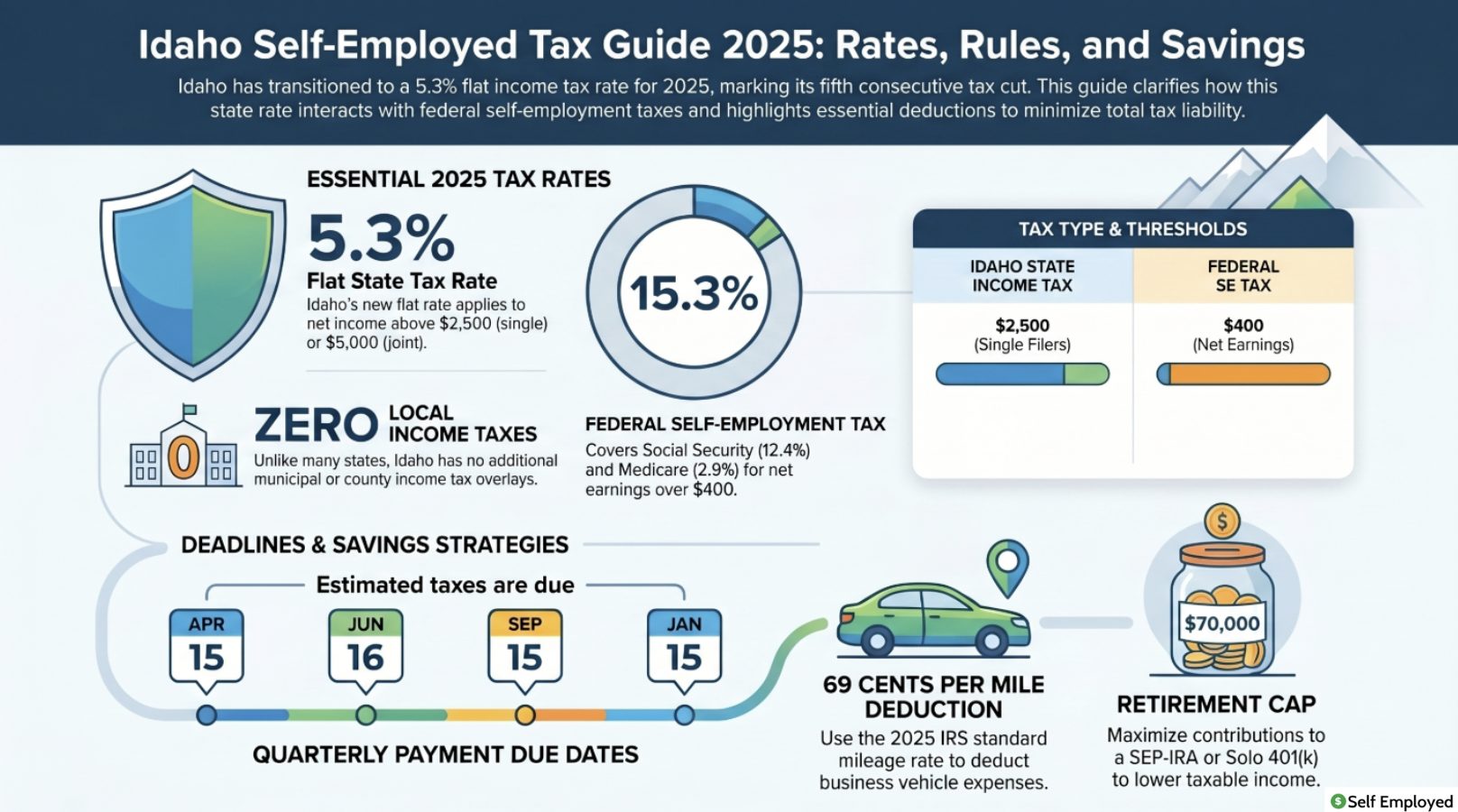
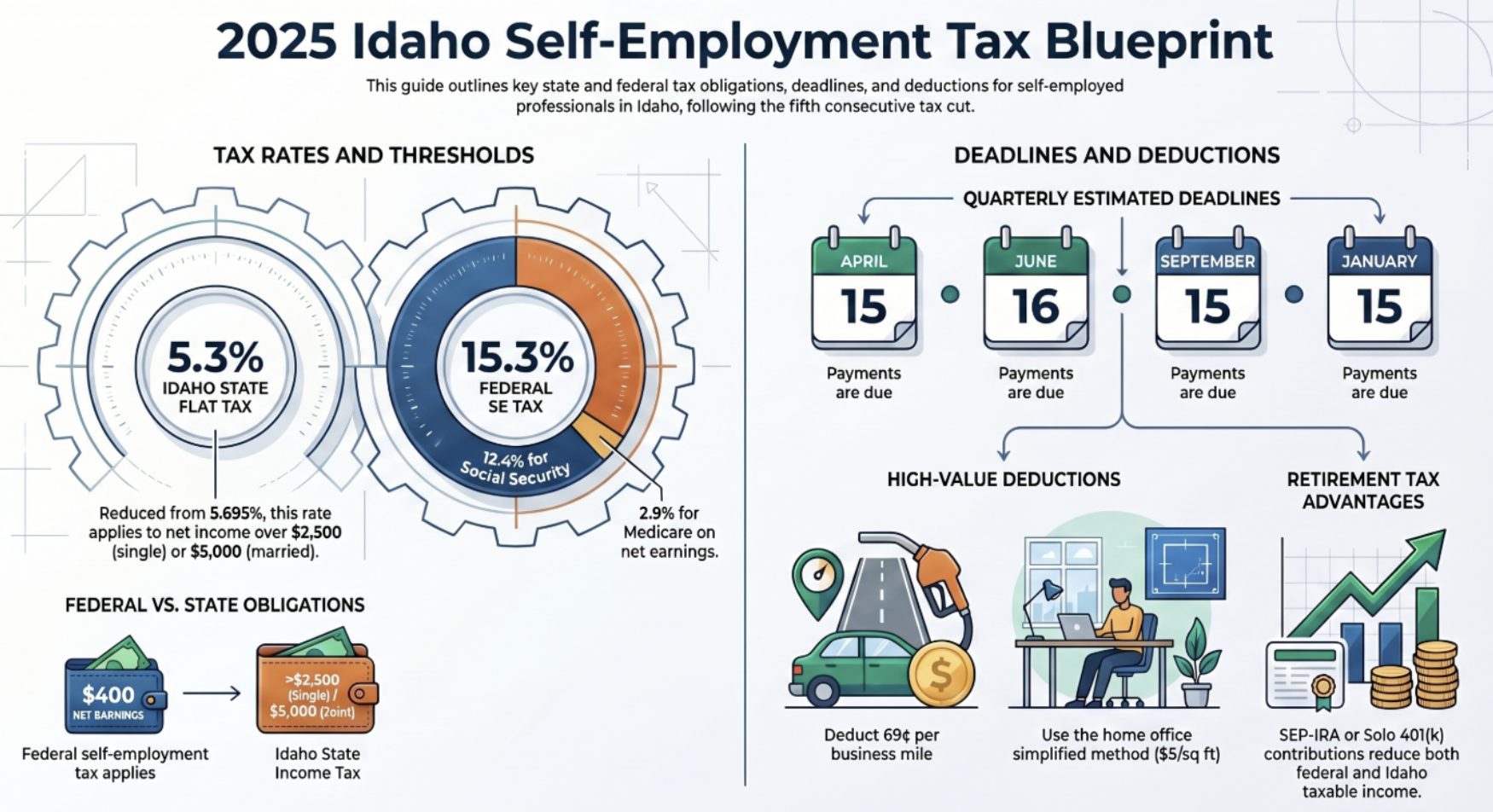
Idaho has made significant progress in reducing the tax burden on residents. The state’s flat income tax rate for 2025 stands at 5.3%, down from 5.695% in 2024. This represents the fifth consecutive tax cut since 2020, reflecting Idaho’s commitment to lowering the tax burden. For most self-employed individuals, this state tax applies to net income above $2,500 (for single filers) or $5,000 (for married filing jointly). Additionally, Idaho has no local income taxes, which is a significant advantage compared to states with municipal tax overlays.
Understanding the Idaho tax rate for 2025
The idaho tax rate of 5.3% is straightforward compared to many other states. As a self-employed person, you’ll apply this rate to your net business income after deductions. Unlike states with progressive tax brackets, Idaho’s flat tax means everyone pays the same percentage regardless of income level. This simplicity makes tax planning more predictable, though you still need to account for federal self-employment taxes.
The income threshold is crucial: single filers don’t owe Idaho state income tax on the first $2,500 of net income, while married filing jointly filers have a $5,000 threshold. If your net business income falls below these amounts, you may not owe state income tax at all. However, you could still owe federal self-employment tax on net earnings of $400 or more.
To calculate your Idaho state tax liability, start with your total business income and subtract qualified business deductions. This adjusted gross income (or your net business income from Schedule C if you’re a sole proprietor) is what the 5.3% tax rate applies to. The state has simplified this process significantly compared to states with graduated tax brackets, making it easier for self-employed individuals to estimate their tax bills.
Federal self-employment tax obligations
While the Idaho state tax rate is 5.3%, federal self-employment tax is a separate and often larger obligation. The self-employment tax rate is 15.3%, consisting of 12.4% for Social Security (on income up to $168,600 in 2024) and 2.9% for Medicare (on all net earnings). As a self-employed person, you pay both the employer and employee portions of these taxes, unlike W-2 employees who split these costs with their employers.
I calculate my self-employment tax quarterly to avoid surprises at filing time. The process starts with your Schedule C net profit. You then multiply this by 92.35% (the business share of self-employment income), then by 15.3% to get your total self-employment tax. You can deduct half of your self-employment tax as an adjustment to income on Form 1040, which provides some relief from this significant tax burden.
Many self-employed individuals in Idaho underestimate their federal tax obligations because they focus solely on the 5.3% state tax rate. Federal self-employment tax actually exceeds the state tax for most people, making accurate quarterly payments essential. Contributing to a SEP-IRA or Solo 401(k) can help reduce your taxable income and lower both state and federal taxes.
Quarterly estimated tax payments
If you expect to owe $1,000 or more in federal taxes (including self-employment tax) during 2025, the IRS requires quarterly estimated tax payments. These are typically due April 15, June 16, September 15, and January 15. Idaho also requires state estimated tax payments if you expect to owe $200 or more in state income tax for the year.
I use Form 1040-ES to calculate my federal estimated taxes each quarter. This form helps you account for expected business income, deductions, tax credits, and prior year tax liability. Missing or underpaying quarterly estimated taxes can result in penalties and interest, so I prioritize these payments.
To estimate accurately, review your previous year’s return and adjust for expected changes in business income. If your income fluctuates significantly, you might use the annualized income installment method, which allows you to adjust payments based on actual year-to-date earnings rather than projecting the same income for all four quarters. This approach is particularly useful if you experience seasonal business fluctuations.
Deductions and tax credits for self-employed Idahoans
One of the best ways to reduce your Idaho tax rate impact is maximizing deductible business expenses. As a self-employed person, you can deduct ordinary and necessary business expenses that reduce your taxable income. Common deductions include office supplies, equipment, professional development, marketing expenses, insurance premiums, and vehicle-related costs.
The home office deduction is particularly valuable for remote entrepreneurs. You can either use the simplified method (multiply qualifying square footage by $5 per square foot, up to 300 square feet) or track actual home office expenses including utilities, rent/mortgage interest, insurance, and depreciation. I use the simplified method for simplicity, though some professionals benefit more from the detailed approach. For more information, see our complete home office deduction guide.
Your vehicle expenses are also deductible if used for business purposes. You can deduct either actual expenses (gas, insurance, maintenance, depreciation) or use the IRS standard mileage rate (67.5 cents per mile for 2024 and 69 cents per mile for 2025). Keep detailed records of business miles to substantiate this deduction if audited.
Self-employed health insurance premiums are fully deductible as an adjustment to income, meaning they reduce your taxable income before calculating self-employment tax. This is a significant benefit that many self-employed individuals overlook. If you’re paying for family coverage, the entire premium is deductible, not just a portion.
Retirement savings opportunities
Establishing a retirement plan not only helps you save for the future but also reduces your current tax burden. A SEP-IRA allows you to contribute up to 25% of your net self-employment income (after the self-employment tax deduction), up to $70,000 in 2024 and $69,000 in 2025. A Solo 401(k) offers similar benefits with additional loan options, allowing contributions up to $69,000 in 2024 and $70,000 in 2025.
The tax deduction from contributing to these plans directly reduces your federal and Idaho taxable income. If you’re self-employed in Idaho, these retirement contributions are often the most effective tax reduction strategy available. The contributions are deductible when calculating your adjusted gross income, which means they reduce both your federal income tax and your Idaho state income tax liability.
Comparing Idaho’s tax rate to neighboring states
Idaho’s 5.3% flat tax rate is competitive compared to neighboring states. Montana has progressive rates up to 6.9%, Washington has no state income tax (but a capital gains tax), and Utah has progressive rates up to 4.85%. However, the comparison changes when you factor in sales tax, property tax, and other state-specific taxes. Idaho’s lack of local income taxes is a significant advantage that keeps the overall state tax burden manageable for self-employed individuals.
For comprehensive comparisons with other state tax structures, review our guides on California’s self-employment tax obligations and essential forms for self-employed professionals to understand how Idaho’s approach differs from other jurisdictions.
Frequently asked questions about Idaho taxes
What is the current Idaho tax rate for 2025?
The Idaho tax rate for 2025 is 5.3%, down from 5.695% in 2024. This represents a flat tax rate applied to net income above $2,500 for single filers or $5,000 for married filing jointly. The state has implemented five consecutive tax cuts since 2020, progressively reducing the burden on residents and self-employed workers.
Do I pay both Idaho state tax and federal self-employment tax?
Yes, self-employed individuals pay both. Idaho’s 5.3% state income tax applies to net business income above the threshold, while federal self-employment tax (15.3%) applies to net self-employment income of $400 or more. These are separate tax obligations calculated independently. You can deduct half of your self-employment tax as an adjustment to gross income on your federal return.
Are there local income taxes in Idaho?
No, Idaho has no local income taxes. Unlike some states where counties or municipalities impose additional income taxes, Idaho’s only state income tax is the 5.3% flat rate. This simplifies tax planning and is one of Idaho’s advantages for self-employed individuals.
When are estimated tax payments due for self-employed individuals?
Federal estimated tax payments are typically due quarterly on April 15, June 16, September 15, and January 15. Idaho also requires quarterly payments if you expect to owe $200 or more in state tax. Use Form 1040-ES to calculate federal estimates and consult Idaho’s Department of Revenue for state estimated payment requirements.
Can I deduct my home office as a self-employed person?
Yes, the home office deduction is available to self-employed individuals. You can use the simplified method ($5 per square foot, up to 300 square feet) or calculate actual expenses. Either method reduces your taxable income and therefore lowers both your federal and Idaho state tax obligations. Keep detailed records to support your deduction if audited.
What retirement plan options are available for self-employed Idahoans?
Self-employed individuals can establish SEP-IRAs or Solo 401(k)s. A SEP-IRA allows contributions up to 25% of net self-employment income, capped at $70,000 in 2024. A Solo 401(k) offers similar limits plus loan options. Both plans provide tax deductions that reduce your federal and Idaho state taxable income.
How do I calculate my Idaho state income tax as a self-employed person?
Start with your total business income from Schedule C and subtract all ordinary and necessary business deductions. The resulting net profit is your Idaho taxable income. If this amount exceeds $2,500 (single) or $5,000 (married filing jointly), multiply the excess by 5.3% to determine your state income tax liability. Keep organized records of all income and deductions throughout the year.
What vehicle expenses can I deduct as a self-employed professional?
You can deduct either actual vehicle expenses (gas, insurance, maintenance, depreciation) or use the IRS standard mileage rate, which is 69 cents per mile for 2025. Keep detailed records of business miles and personal miles to substantiate the deduction. The mileage method is simpler for many self-employed individuals who use their vehicle occasionally for business.
Resources and external links
For authoritative information about self-employment tax, visit the IRS Self-Employment Tax page. This resource provides detailed guidance on calculating self-employment tax, making estimated payments, and understanding your obligations.
Idaho-specific tax information is available from the Idaho Department of Revenue website, which maintains current information about state income tax rates, quarterly payment deadlines, and required forms.
Additional state tax guides
Understanding how different states tax self-employed workers helps you make informed business decisions. Here are guides to self-employment tax obligations in other states:
- California self-employment tax guide
- Washington state self-employment tax and capital gains tax
- Montana self-employment tax guide
- Oregon self-employment tax obligations
- Utah self-employment tax guide
The Idaho tax rate structure, while relatively simple at 5.3%, requires careful planning to minimize your overall tax burden. Combined with federal self-employment tax obligations, your total tax liability can be substantial. However, by maximizing deductions, making quarterly estimated payments, and contributing to retirement plans, you can effectively manage your tax obligations while building wealth for the future. Stay informed about annual rate changes and consult with a tax professional for guidance specific to your situation.


