

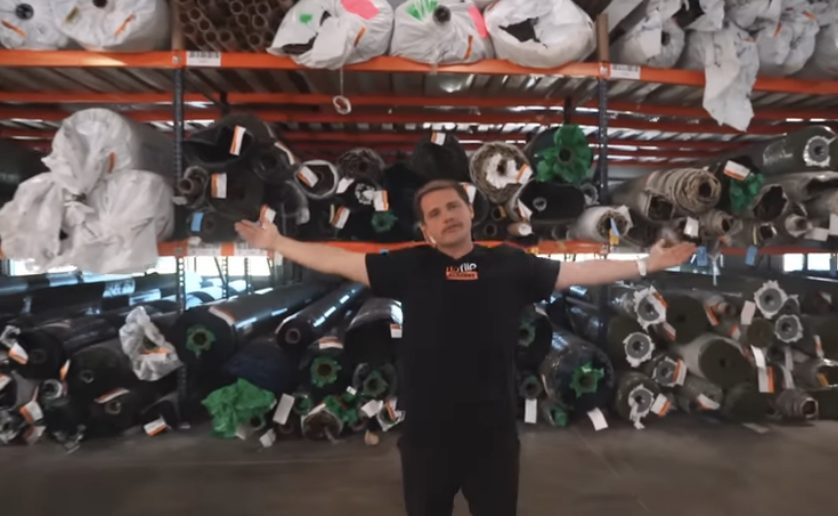
After watching dozens of self-employed founders launch service businesses, I am convinced that knowing how to start a turf business is one of the most overlooked entrepreneurial moves of the next five years. Artificial turf installation has the rare combination of strong unit economics, low marketing cost, recurring referrals, and demand that grows with water restrictions across the country. The founders quietly building seven-figure turf operations are not lucky. They are using a playbook.
This guide breaks down how to start a turf business as a self-employed founder, with the real numbers, sales process, and operating systems that turn a $10,000 launch into a multi-location operation.
Why artificial turf is a strong self-employed opportunity
Artificial turf installation hits four criteria that most self-employed business ideas miss. Margins are good, the work is visible enough to drive word of mouth, customers buy on a clear ROI calculation, and the regulatory backdrop on water use keeps demand expanding.
I have seen founders launch with $10,000 and clear $400,000 in revenue in their first 12 months in markets like Austin and Phoenix. Two years later, the same founders cross $2 million annually with a second location. The variable that explains the difference between turf businesses that flatline and turf businesses that compound is process discipline, not capital.
From corporate burnout to a real turf operation
One of the founders I have worked with launched his turf business with $10,000 the same month he got married. Not the schedule I would recommend, but the numbers tell a clean story. Year one revenue: $400,000 in Austin. By year three, the business cleared $2 million annually across Austin and San Antonio. Marketing spend stayed at roughly $5,000 a month.
The system that produced those numbers is replicable. It depends less on digital advertising than most self-employed founders assume, and more on consistent commercial relationship building. The exact playbook:
- Build face-to-face relationships with potential commercial partners.
- Drop off coffee and donuts to establish personal connections.
- Create 7 to 10 new commercial relationships per day during the first 90 days.
- Follow up consistently. Plan for seven follow-ups per prospect before they close.
This approach looks old-fashioned next to digital ad strategies. It works because the relationships become a sales force you do not have to pay every month. When you are figuring out how to start a turf business with limited capital, that compounding cost advantage is the difference between making payroll and falling behind.
How to start a turf business: the launch sequence
If you are seriously considering this, here is the sequence I would walk a self-employed client through.
Step one: Validate your local market
Drive your service area for one weekend. Note the visible turf already installed, the housing density, and any local water restriction signage. The EPA WaterSense program publishes regional water-use data that helps quantify the regulatory tailwind in your area. Markets with active water-use rules close turf deals faster than markets without them.
Step two: Set up the business properly
Form an LLC, get your EIN, open a business bank account, and acquire general liability insurance with a policy that explicitly covers landscape installation. Skipping any of these steps creates problems the moment you hit your first commercial bid. Our essential forms for self-employed professionals overview walks through the IRS and state paperwork that comes with this kind of launch.
Step three: Build a single perfect job specification
Pick one residential turf product, one base material, and one installation crew. Document the entire installation process in 20 to 30 specific steps. The first job spec is your future training document, your warranty backup, and your quote calibration tool.
Step four: Quote and close the first 10 jobs
The first 10 jobs are an experiment, not a business. Quote them honestly, deliver them perfectly, and ask every customer for a referral and a Google review. Most founders learning how to start a turf business get 30 percent of their next 100 jobs from the first 10 customers’ referral network.
The turf business unit economics
The economics of artificial turf are friendlier than most self-employed services. A typical residential installation requires roughly 20 yards of limestone base material, around $1,000 of base cost, plus the turf product itself. Crews can complete most residential jobs in two days when the process is dialed in.
For customers, the ROI argument is strong. Turf typically pays for itself within five years compared to traditional lawn care, especially when you factor in water bills, maintenance, fertilizer, and labor. Add water conservation in regions with active drought rules and the case becomes nearly self-selling. That ROI math is the reason commercial properties, HOAs, and rental property managers convert quickly once they see a quality reference job.
Sales process that actually closes
The fastest way to grow a turf operation is to close a higher percentage of consultations. Most self-employed turf founders are not bad at quoting. They are slow to respond and slower to follow up. A tight sales process fixes both.
The five-step process I recommend:
- Respond to every inbound lead within 30 minutes during business hours.
- Schedule the on-site consultation within 48 hours of first contact.
- Use a measuring tool and quoting software on site.
- Present the proposal before leaving the property.
- Close with a 50 percent deposit on the spot when possible.
Most jobs close within 24 hours when this process runs cleanly. Many close in the same visit. The discipline of presenting numbers on site is the largest single lever in this business.
Building systems that scale
Going from $400,000 to $2 million is not about working harder. It is about building systems that do the work the same way every day. Maintain a strict 8-to-5 schedule. Document every recurring decision. Treat consistency as a competitive advantage, not a constraint.
The systems that matter most:
- Lead intake and response routing.
- On-site quoting templates with locked margins.
- Crew dispatch and job sequencing.
- Materials reordering thresholds.
- Customer communication touchpoints from quote to warranty.
If you do not yet have the financial visibility behind these systems, our self-employed bookkeeping step-by-step guide covers the simplest setup that lets you read margin by job, by crew, and by month.
From owner-operator to small operation
The biggest mistake self-employed founders make when learning how to start a turf business is staying owner-operator too long. The owner-operator phase is the prototype. After 50 jobs and a year of clean process documentation, the next move is hiring or contracting a second installer and a part-time scheduler.
The transition usually looks like this. The founder works in the field for 12 to 18 months. The business reaches roughly $400,000 to $700,000 in annual revenue. The founder reaches a breaking point where the business is running them, not the other way around. That is the cue to expand. Adding a second location, opening franchise rights, or hiring a second crew all become viable once that breaking point arrives.
The franchise option for self-employed founders
Some self-employed founders skip the build phase and buy into an established turf franchise. The most common franchise model in this category requires roughly $106,000 in initial investment, including training, marketing assistance, and national supplier pricing.
The trade-off is straightforward. You get proven systems, a brand, and pricing leverage. You give up some margin and operational flexibility. For self-employed founders who want the upside of the turf business but do not want to write the systems from scratch, this is a reasonable path.
For broader self-employed direction-setting around this kind of decision, our self-employment ideas guide walks through how to weigh franchise versus independent paths.
Hiring and retaining installation crews
Crew quality decides customer reviews, referrals, and warranty cost. Self-employed turf founders who treat crews well grow steadily. Founders who treat crews like commodities run into reputation problems within 18 months.
Practical retention moves:
- Pay weekly, on time, every week.
- Provide branded work attire and weather-appropriate gear.
- Maintain a five-day work week, not seven.
- Run small appreciation rituals like food, water, and end-of-week check-ins.
- Work with two or three crews so you are never dependent on one team.
The OSHA heat exposure resources are worth reviewing in detail because turf installation work happens in summer and crews can be at real risk of heat illness without the right protocols. This is also one of the cheapest ways to differentiate from competing operators who do not invest in crew safety.
Marketing on a real budget
Turf businesses do not need huge ad budgets. The seven-figure operators I have studied spend $3,000 to $7,000 a month on marketing once they are past the launch phase, with most of that allocated to Google Local Service Ads, targeted Facebook campaigns, and yard signs.
The cheapest marketing channel is still completed jobs. A high-quality install with a yard sign in front of it produces three to five inbound leads from neighbors over the next 90 days. Tracking that referral path is the single most important reporting your business will set up. If you want to layer revenue from related lines, our high-ticket affiliate programs guide covers how to add affiliate income from related home improvement products without diluting the core service.
The bottom line on how to start a turf business
Artificial turf installation rewards self-employed founders who treat the business as a system, not a side hustle. Start with $10,000 or less, validate your local market, build a single perfect job spec, close the first 10 jobs personally, and let the unit economics and referrals carry you into the second year. Add a second crew, then a second location, and the business compounds. After studying multiple self-employed founders work through this exact path, the through line is simple: the discipline shows up in the systems, not the slogans, and the operators who write the systems first are the ones who hit the seven-figure mark.
Frequently asked questions
How much does it cost to start a turf business?
Independent self-employed founders can start with as little as $10,000 by focusing on relationships and word-of-mouth marketing. A franchise route typically requires roughly $106,000, which includes training, marketing support, and national supplier pricing.
How do I find my first turf customers?
Build face-to-face commercial relationships, drop off coffee or food at potential partner offices, and ask every early customer for two referrals. Most operators learning how to start a turf business get 25 to 30 percent of their next 100 jobs from the first 10 customers’ networks.
Is artificial turf actually environmentally friendly?
The main environmental benefit is water conservation. Traditional lawns use significant water for maintenance, while turf needs none. Turf also eliminates the need for fertilizers, pesticides, and gas-powered lawn equipment. The water savings alone can be substantial in regions with drought rules.
How do you handle pet waste on artificial turf?
Modern artificial turf is designed to be pet-friendly. The turf drains at 30 inches or more per hour, allowing liquid waste to pass through. Solid waste is removed as it would be on regular grass. Antimicrobial infill helps control bacteria and odors when needed.
What is the typical ROI for customers who install turf?
Most customers see a complete return within five years through eliminated lawn care costs, water bills, fertilizer, weed control, and equipment maintenance. In regions with high water costs or active restrictions, the payback can come faster.
How do you find and retain reliable installation crews?
Pay weekly and on time, provide quality work attire and weather-appropriate gear, maintain a five-day work week, run small appreciation rituals, and work with two or three crews so you are never dependent on one team. Strong crew retention drives review quality and referral volume.
Can I run a turf business as a side hustle?
Yes, in the early validation phase. Once you cross 30 to 50 paying jobs, the operational demands typically push self-employed founders to commit full-time. The math on response time and on-site quoting becomes hard to sustain alongside another full-time role.


