


In my experience working with self-employed professionals and growing businesses, I’ve found that understanding upstream vs downstream marketing is crucial for developing a cohesive strategy that drives real results. These two approaches represent fundamentally different ways of reaching and engaging your audience, and knowing when and how to apply each one can make the difference between mediocre growth and exceptional business outcomes.
After working with numerous clients across different industries, I’ve noticed that most business owners focus heavily on one approach while neglecting the other. This creates a gap in their marketing funnel that leaves money on the table. In this guide, I’ll break down the key differences between upstream vs downstream marketing, explain when to use each strategy, and show you how to combine both for maximum impact.
What is upstream marketing?
Upstream marketing focuses on building awareness, establishing authority, and creating initial interest in your brand before someone even knows they need your product or service. It’s about reaching people at the earliest stages of their buyer’s journey, often before they’re actively searching for solutions.
In my experience, upstream marketing includes activities like:
- Creating educational content that addresses broader industry topics
- Building thought leadership through articles and speaking engagements
- Running brand awareness campaigns
- Developing partnerships and relationships with complementary businesses
- Publishing long-form content that targets informational keywords
- Creating resources that establish you as an expert in your field
The primary goal of upstream vs downstream marketing strategies is different. Upstream marketing aims to create awareness and position your brand as a trusted authority. You’re not necessarily trying to make an immediate sale; you’re building the foundation for future conversions.
What is downstream marketing?
Downstream marketing, by contrast, targets people who are already aware of your brand and actively looking for solutions to their specific problems. This approach focuses on conversion and turning interested prospects into paying customers.
After working with dozens of self-employed professionals, I’ve seen that downstream marketing typically includes:
- Targeted paid advertising campaigns
- Retargeting people who’ve visited your website
- Email marketing to engaged subscribers
- Product-focused landing pages
- Promotional campaigns and special offers
- Sales follow-up sequences
- Content targeting high-intent keywords with clear commercial intent
The downstream approach is all about converting interest into action. Your messaging is more direct, your offers are more specific, and your metrics focus on sales, conversions, and return on investment.
Key differences between upstream vs downstream marketing
Understanding the distinctions between upstream vs downstream marketing helps you allocate your resources more effectively. Let me break down the major differences:
Buyer journey stage
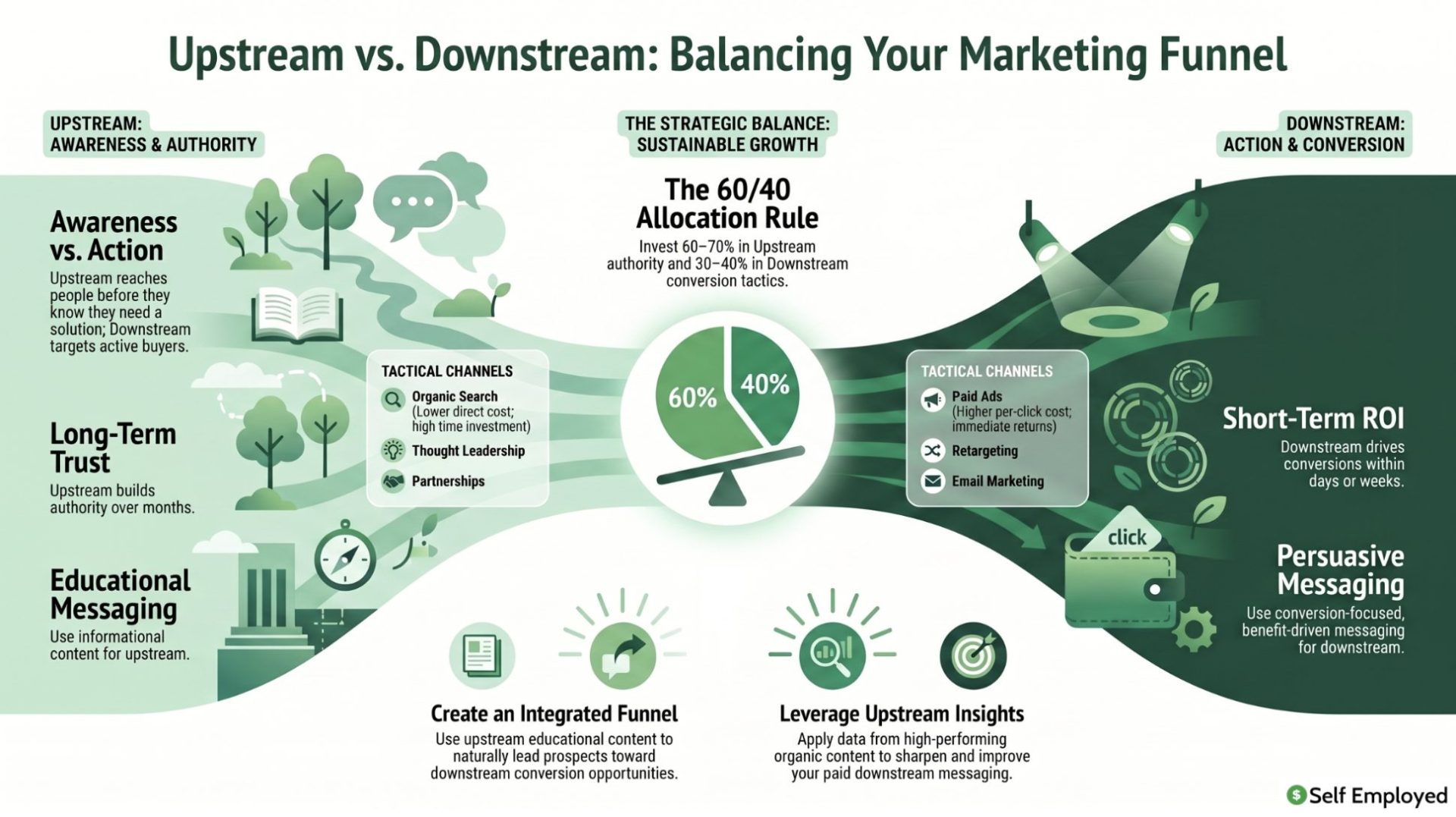
Upstream marketing targets awareness and consideration stages. You’re reaching people who don’t yet know they have a problem. Downstream marketing targets decision and action stages. You’re reaching people who have already identified their need and are evaluating solutions.
Intent level
Upstream marketing reaches audiences with low to medium intent. They might be researching broadly or just learning about your industry. Downstream marketing reaches high-intent audiences. These are people actively searching for solutions or comparing options.
Timeframe to conversion
In my experience, upstream marketing builds authority and trust over months or even years. The conversion payoff comes later, often through organic search or brand recall. Downstream marketing drives shorter-term conversions, often within days or weeks.
Content type and messaging
Upstream marketing relies on educational, informational content that establishes expertise. Downstream marketing uses persuasive, conversion-focused content that highlights benefits and addresses objections.
Channels and tactics
Upstream marketing works best through organic search, content marketing, partnerships, and brand awareness campaigns. Downstream marketing performs well with paid search, retargeting, email marketing, and direct sales outreach.
Cost structure
Upstream marketing often has lower direct costs but requires consistent investment and patience to see returns. Downstream marketing typically has higher per-click or per-conversion costs but delivers more predictable, immediate results.
Why both approaches matter for your business
After working with self-employed professionals and small business owners, I’ve learned that focusing solely on downstream marketing creates several problems. First, you deplete your high-intent audience pool as you convert them. Second, you miss opportunities to build brand awareness that drives long-term organic growth. Third, you become overly dependent on paid advertising, which increases your customer acquisition costs.
On the other hand, ignoring downstream marketing means you’re not effectively monetizing your audience. You might be building tremendous brand awareness through content, but if you’re not converting prospects into customers, that awareness doesn’t generate revenue.
The most successful businesses I’ve encountered use upstream vs downstream marketing as complementary strategies. They invest in building authority and awareness while simultaneously converting ready-to-buy prospects. This balanced approach creates a sustainable growth engine.
Practical upstream marketing strategies for self-employed professionals
If you’re self-employed or running a small business, implementing upstream marketing strategies can help you build credibility and attract organic opportunities. Here are proven tactics I’ve used with clients:
Create pillar content
Develop comprehensive resources that establish your expertise. This could be in-depth guides, research reports, or educational series. For example, if you’re a bookkeeper, consider creating a resource like our self-employed bookkeeping step-by-step guide that positions you as an expert.
Build thought leadership
Write articles that demonstrate deep knowledge of your industry. Contribute to industry publications. Speak at events or webinars. After working with numerous professionals, I’ve found that consistent thought leadership dramatically increases inbound opportunities and attracts higher-quality prospects.
Develop strategic partnerships
Partner with complementary businesses to expand your reach. If you offer services that help people start businesses, partnering with someone who promotes self-employment ideas creates natural opportunities for collaboration and co-marketing.
Invest in organic search
Create content targeting informational keywords that establish your authority. This requires patience, but over time, organic search can become a reliable, low-cost source of qualified traffic.
Practical downstream marketing strategies for conversions
While upstream marketing builds foundations, downstream marketing drives revenue. Here are tactics I’ve found effective for converting prospects:
Target high-intent keywords
Create landing pages and content targeting keywords that show purchase intent. If you’re in affiliate marketing, optimized content about high-ticket affiliate programs converts interested prospects into customers who are ready to invest.
Implement retargeting campaigns
Use paid retargeting to reach people who’ve visited your website but haven’t converted. This keeps your offers top-of-mind and significantly improves conversion rates.
Build an email marketing system
Capture emails from interested prospects and nurture them with targeted messaging. In my experience, email sequences focused on specific pain points convert at significantly higher rates than general marketing messages.
Optimize conversion pages
Create dedicated landing pages for specific offers. These pages should be highly focused, addressing specific objections and clearly stating your value proposition.
Use social proof
Include testimonials, case studies, and results from satisfied clients. After working with various businesses, I’ve found that social proof dramatically increases conversion rates, often by 20-30 percent or more.
How to combine upstream vs downstream marketing for maximum impact
The real power comes from integrating both approaches into a cohesive strategy. Here’s how I recommend structuring this:
Map your buyer journey
First, understand where your audience enters your funnel. Some people discover you through organic search (upstream). Others find you through paid ads (downstream). Map these touchpoints and optimize for both.
Create integrated messaging
Ensure your upstream content naturally leads to downstream conversion opportunities. Your educational content should subtly position your products or services as solutions to problems you’re addressing.
Use upstream insights to improve downstream messaging
Pay attention to which upstream content drives the most traffic and engagement. Use those insights to create more effective downstream messaging and targeting.
Allocate budget strategically
I typically recommend allocating 60-70 percent of marketing budget to upstream activities that build long-term equity, and 30-40 percent to downstream activities that drive immediate conversions. Adjust this ratio based on your industry and growth stage.
Measure both metrics
Track upstream metrics like organic traffic, brand searches, and authority signals alongside downstream metrics like conversions and cost per acquisition. Both matter for sustainable growth.
Common mistakes in upstream vs downstream marketing
After working with hundreds of self-employed professionals, I’ve identified common pitfalls to avoid:
- Over-investing in downstream marketing without building upstream authority, leading to unsustainable customer acquisition costs
- Creating upstream content without any conversion mechanism, generating awareness but no revenue
- Inconsistent messaging between upstream and downstream efforts, confusing your audience
- Ignoring data from either upstream or downstream campaigns, missing optimization opportunities
- Expecting immediate ROI from upstream marketing, which is a long-term investment
- Not tracking which upstream activities eventually lead to downstream conversions
Measuring success in upstream vs downstream marketing
Different metrics matter for each approach. For upstream marketing, I focus on:
- Organic traffic growth
- Brand search volume
- Time on page and engagement metrics
- Backlinks and domain authority
- Social shares and mentions
- Industry recognition and speaking opportunities
For downstream marketing, the key metrics include:
- Click-through rate
- Conversion rate
- Cost per acquisition
- Return on ad spend
- Customer lifetime value
- Email open and click rates
Conclusion
Understanding upstream vs downstream marketing isn’t just academic; it’s essential for building a sustainable, profitable business. In my experience, the most successful self-employed professionals and business owners recognize that these aren’t competing strategies – they’re complementary approaches that work together to drive growth.
Start by assessing where you currently stand. Are you investing heavily in downstream conversion tactics while neglecting upstream authority building? Or are you creating excellent content but failing to convert interested prospects? Most likely, you need to strengthen one or both areas.
The path forward is clear: invest consistently in upstream marketing to build authority and awareness, while simultaneously optimizing downstream marketing to convert interested prospects. This balanced approach generates sustainable growth, reduces customer acquisition costs over time, and builds a business that attracts opportunities rather than constantly chasing them.
FAQ
What’s the main difference between upstream and downstream marketing?
Upstream marketing builds brand awareness and authority with audiences in early buyer journey stages, while downstream marketing targets high-intent prospects ready to make purchasing decisions. Upstream is long-term authority building; downstream is short-term conversion focused.
Should I focus on upstream or downstream marketing?
You should invest in both. Focusing only on downstream marketing creates unsustainable customer acquisition costs. Focusing only on upstream marketing generates awareness without revenue. The most successful businesses allocate roughly 60-70 percent to upstream and 30-40 percent to downstream activities.
How long does upstream marketing take to show results?
Upstream marketing typically takes 3-6 months to show measurable results in organic traffic and brand awareness, with significant impact appearing after 6-12 months. It’s a long-term investment that builds sustainable competitive advantages.
What are examples of upstream marketing tactics?
Examples include educational content creation, thought leadership articles, industry partnerships, brand awareness campaigns, speaking engagements, and long-form resources that establish your expertise.
How do I measure upstream marketing success?
Track metrics like organic traffic growth, brand search volume, engagement time, backlinks, domain authority, social mentions, and industry recognition. Unlike downstream marketing, upstream success focuses on authority and awareness rather than immediate conversions.
Can downstream marketing work without upstream marketing?
Yes, but it’s inefficient. Without upstream authority building, downstream marketing relies entirely on paid advertising, leading to high customer acquisition costs. Combining both creates a more sustainable, profitable business model.
What budget should I allocate to upstream vs downstream marketing?
A balanced approach typically allocates 60-70 percent of budget to upstream activities and 30-40 percent to downstream. However, adjust this ratio based on your business stage, industry, and current customer acquisition costs.
How do upstream and downstream marketing work together?
Upstream marketing builds an audience and establishes authority, creating natural downstream conversion opportunities. Downstream marketing monetizes that upstream audience through targeted conversion tactics. Together, they create a complete marketing system that attracts and converts customers.


