


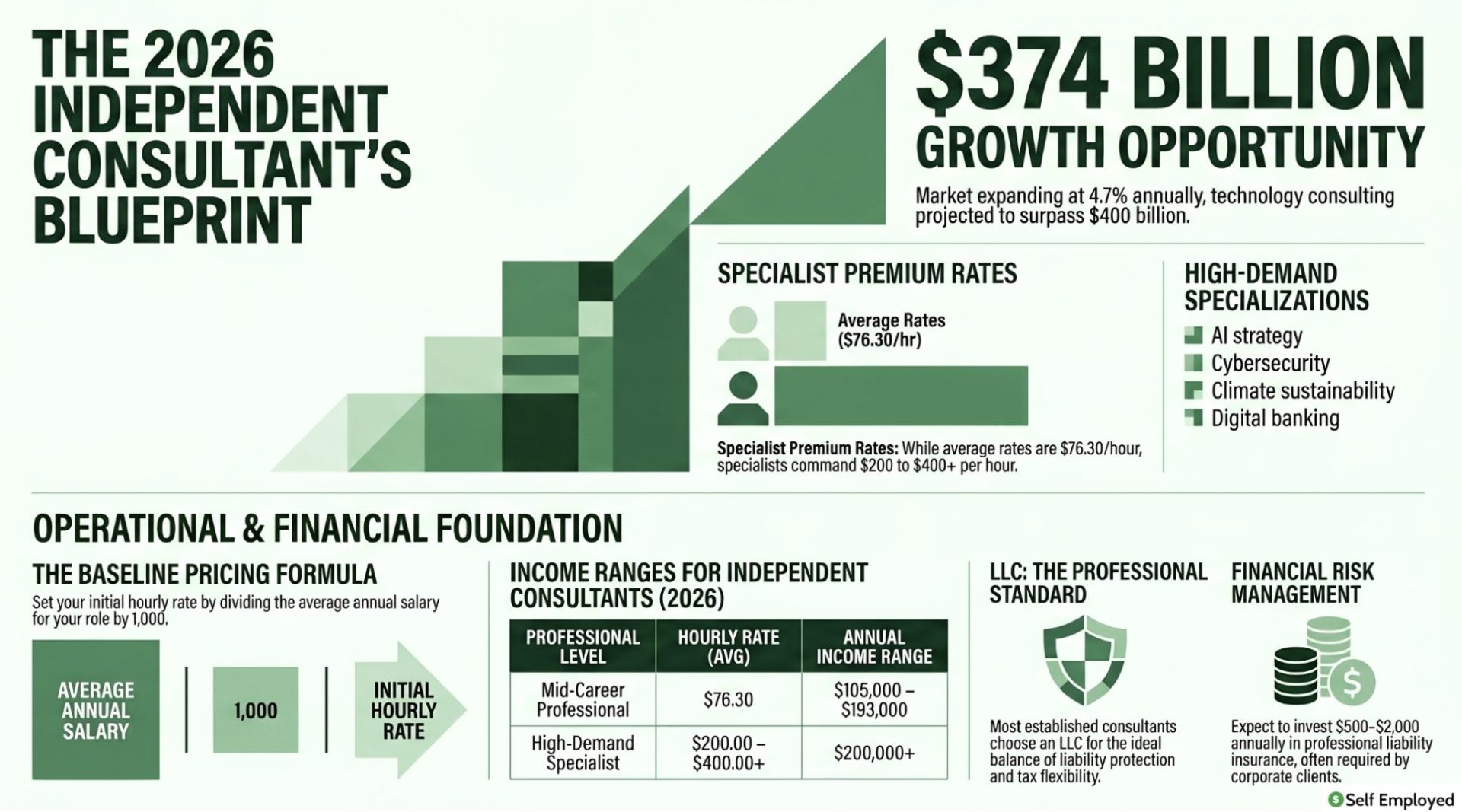
I’m Elliot, founder of selfemployed.com, and I’ve spent the last decade helping hundreds of consultants launch and scale their independent practices. If you’re considering how to become a consultant, you’re entering a market worth $374 billion in 2026 and growing at 4.7% annually. Success requires strategy, proper planning, and understanding what separates thriving consultants from those who struggle.
What does a self-employed consultant do
A self-employed consultant uses specialized expertise to solve problems for businesses or individuals. Unlike a freelancer who executes tasks, you provide strategic advice and guidance. You might reshape a company’s digital strategy, advise on regulatory compliance, or optimize manufacturing processes. The consultant’s role differs from a contractor. Contractors perform specific deliverables on a fixed schedule. Consultants work at a higher advisory level.
Consulting spans every industry. Management, IT, healthcare, finance, human resources, sustainability, and supply chain are among the most active sectors. When you learn how to become a consultant, you’re joining a profession that values expertise and results above all else.
Understanding today’s market
Let’s talk numbers. According to 2026 data, independent consultants earn an average of $76.30 per hour, with annual incomes typically ranging from $105,000 to $193,000 for mid-career professionals. Specialists in AI strategy, digital transformation, or executive consulting command $200 to $400 or more per hour.
What’s driving demand? Artificial intelligence and digital transformation remain top priorities. The marketplace is rewarding specialization over generalism. If you specialize in AI strategy, cybersecurity, climate sustainability, or digital banking, clients are actively seeking your expertise. Technology consulting alone is projected to surpass $400 billion in 2026.
Here’s what’s critical: the landscape is becoming more competitive. Clients are demanding performance-based pricing, shorter engagements, and clear ROI metrics. To learn how to become a consultant successfully, you need to differentiate through proven expertise and measurable results.
Choosing your specialty
Get crystal clear on what you’re offering. Your specialty is where your skills meet market demand and client willingness to pay. Start by auditing your background. What problems have you solved? What expertise have you built? What feedback have you consistently received from colleagues and clients?
Next, research your market. Who faces the problems you solve? What industries are investing in solutions in your domain? What will they pay? Narrow your target market to be specific enough to guide marketing but broad enough to generate demand. This focus is essential when learning how to become a consultant in a crowded field.
Consider exploring these high-demand niches: digital transformation, sustainable business practices, data analytics, regulatory compliance, and organizational change management. Each offers strong earning potential and growing client demand. Within these niches, positioning yourself as a specialist rather than a generalist allows you to command premium pricing and attract clients actively seeking expertise in your domain.
Setting up your business structure
You can operate as a sole proprietor, LLC, or corporation. A sole proprietorship requires minimal paperwork but offers no liability protection. An LLC provides liability protection with pass-through taxation and typically costs $50 to $300 to establish. Most established consultants choose an LLC for the balance of protection and flexibility.
Register your business with your state, obtain an EIN from the IRS, and immediately open a business bank account. This separation protects you legally and eliminates accounting headaches. If you’re serious about how to become a consultant, treat it like a real business from day one.
Want to understand the full setup process? Check our guide on forming an LLC for detailed steps and state-specific requirements. Proper legal structure sets the foundation for sustainable growth and protects your personal assets from business liability.
Pricing your services
Hourly rates for independent consultants typically range from $75 to $250 or more per hour. But consultants who use project-based or retainer pricing consistently earn more than those relying solely on hourly billing. Project pricing rewards efficiency. Retainers provide stability and predictable income.
When starting, resist undercutting the market. Charge competitively from day one and compete on quality. Use this formula: take the annual salary for similar work, divide by 1,000, and that’s your hourly rate. For example, if the market rate is $150,000 annually, charge $150 per hour initially. As you build credibility and track record, raise your rates strategically.
Many successful consultants find that moving beyond hourly pricing accelerates growth. Consider package pricing for specific deliverables, retainers for ongoing advisory work, and value-based pricing once you understand client ROI. The transition from hourly to project-based pricing typically increases annual revenue by 30 to 50 percent.
Building your client acquisition engine
There are four primary channels: referrals, your professional network, content marketing, and direct outreach. Successful consultants use all four. Start by telling your existing network you’ve launched and what you specialize in. Ask for introductions, not clients.
Build a professional website that explains who you serve and what problems you solve. Create content demonstrating expertise through blog posts, LinkedIn articles, or newsletters. Content marketing attracts prospects seeking solutions and establishes authority. This is one of the most effective ways to learn how to become a consultant while building your reputation simultaneously.
Direct outreach to companies and decision-makers in your target market remains underutilized. Personalized emails, LinkedIn messages, and calls to relevant prospects yield consistent results. For guidance on self-employment strategies, explore our comprehensive self-employment guide. This resource covers everything from initial planning through scaling your practice.
Consider these acquisition tactics: publish case studies, speak at industry events, contribute to relevant publications, join industry associations, and leverage your existing client relationships for referrals. The most reliable path involves combining multiple channels to create a diversified pipeline of leads.
Managing taxes and finances
You’re responsible for income taxes and self-employment taxes at 15.3% of net income. If you expect to owe more than $1,000, make quarterly estimated payments to avoid IRS penalties. Set aside 25 to 30% of revenue for taxes.
Legitimate deductions include home office, business meals, travel, equipment, and software. The most impactful strategy is maximizing retirement contributions. A SEP-IRA allows contributions up to $70,000 in 2025, directly reducing taxable income. The Section 199A deduction allows a 20% deduction of net business income and is now permanent.
Use accounting software like QuickBooks or FreshBooks from day one. Track income and expenses consistently. One final note: the 1099-K reporting threshold for 2025 is more than $20,000 in payments and more than 200 transactions. Understanding self-employment tax obligations is critical when you learn how to become a consultant.
For detailed tax planning, consult with a CPA experienced in working with consultants. The right professional can save you thousands in taxes through strategic deductions and retirement planning.
Insurance and risk management
Professional liability insurance is essential if you provide advice. Clients, especially larger companies, often require it before engaging you. You can deduct 100% of your health insurance premiums from self-employment income. General liability insurance protects against other business risks.
The cost of professional liability insurance varies but typically ranges from $500 to $2,000 annually depending on your specialty and risk profile. This investment is non-negotiable when working with corporate clients. Insurance demonstrates professionalism and provides peace of mind as you grow your practice.
Growing your practice
Once established, scale by taking larger engagements, expanding services, or bringing on subcontractors. Invest in credibility through certifications, speaking engagements, and thought leadership. Join professional organizations relevant to your niche. Track client feedback meticulously. Consultants who listen and iterate earn longer engagements and referrals.
Consider these growth strategies: develop proprietary methodologies, create productized services, build strategic partnerships, expand geographically, and develop recurring revenue streams through retainers. Many consultants find that systems and processes allow them to scale without proportionally increasing their workload.
Maintaining sustainability
Set clear boundaries with clients around availability. Aim for 70 to 75% billable utilization, leaving time for business development, learning, and personal restoration. Take breaks seriously. Your expertise is your product. When you’re burned out, both suffer.
Successful consultants who understand how to become a consultant sustainably invest in continuous learning. Dedicate 5 to 10% of your time to staying current with industry trends, developing new skills, and expanding your knowledge base. This commitment to learning keeps you competitive and allows you to serve clients at higher levels.
Frequently asked questions
What is the average income for a self-employed consultant
Independent consultants earn an average of $76.30 per hour in 2026. Annual incomes typically range from $105,000 to $193,000 for mid-career professionals. Specialists in AI strategy, executive consulting, or digital transformation can earn considerably more, with rates from $200 to $400 or more per hour or project-based fees exceeding six figures.
How much should I charge as a new consultant
Research your market to find competitive rates in your specialization and region. Take the annual salary for similar work, divide by 1,000, and that is your baseline hourly rate. For example, if the market rate is $150,000 annually, charge $150 per hour initially. Increase rates as you build credibility and track record.
Do I need an LLC to start consulting
You can start as a sole proprietor. Forming an LLC is recommended once you establish regular income. An LLC provides liability protection with pass-through taxation. Formation costs are typically $50 to $300 depending on your state. Consult a business attorney for advice specific to your situation.
What are the biggest tax deductions for consultants
Major deductions include home office, dedicated space, business meals with documentation, travel expenses, equipment, software, and professional development. The most impactful strategy is maximizing retirement contributions through a SEP-IRA up to $70,000 in 2025 or Solo 401(k), directly reducing taxable income. Work with a CPA to maximize deductions specific to your situation.
How do I find my first clients
Start with your existing professional network. Build a professional website explaining who you serve. Create content demonstrating expertise through blogs or LinkedIn articles. Use direct outreach to decision-makers in your target market. Word-of-mouth referrals and your professional network remain your strongest channels as you grow.
Is professional liability insurance necessary
If you provide advice or strategic recommendations, professional liability insurance is essential. Many clients, especially larger companies, require it before engaging consultants. Insurance costs are tax deductible and typically range from $500 to $2,000 annually depending on your specialty and risk profile.
External resources
For regulatory guidance and business resources, visit the U.S. Small Business Administration (SBA), which offers free consulting resources, funding information, and training programs. For labor market data and industry trends, check the Bureau of Labor Statistics (BLS) for detailed occupational employment projections and salary information by region and specialty.
Understanding how to become a consultant requires more than expertise in your field. It requires business acumen, financial discipline, and strategic planning. Use these resources to support your journey and make informed decisions as you build your consulting practice.


