


What Phoebe Gates’ startup tells us about entrepreneurial independence
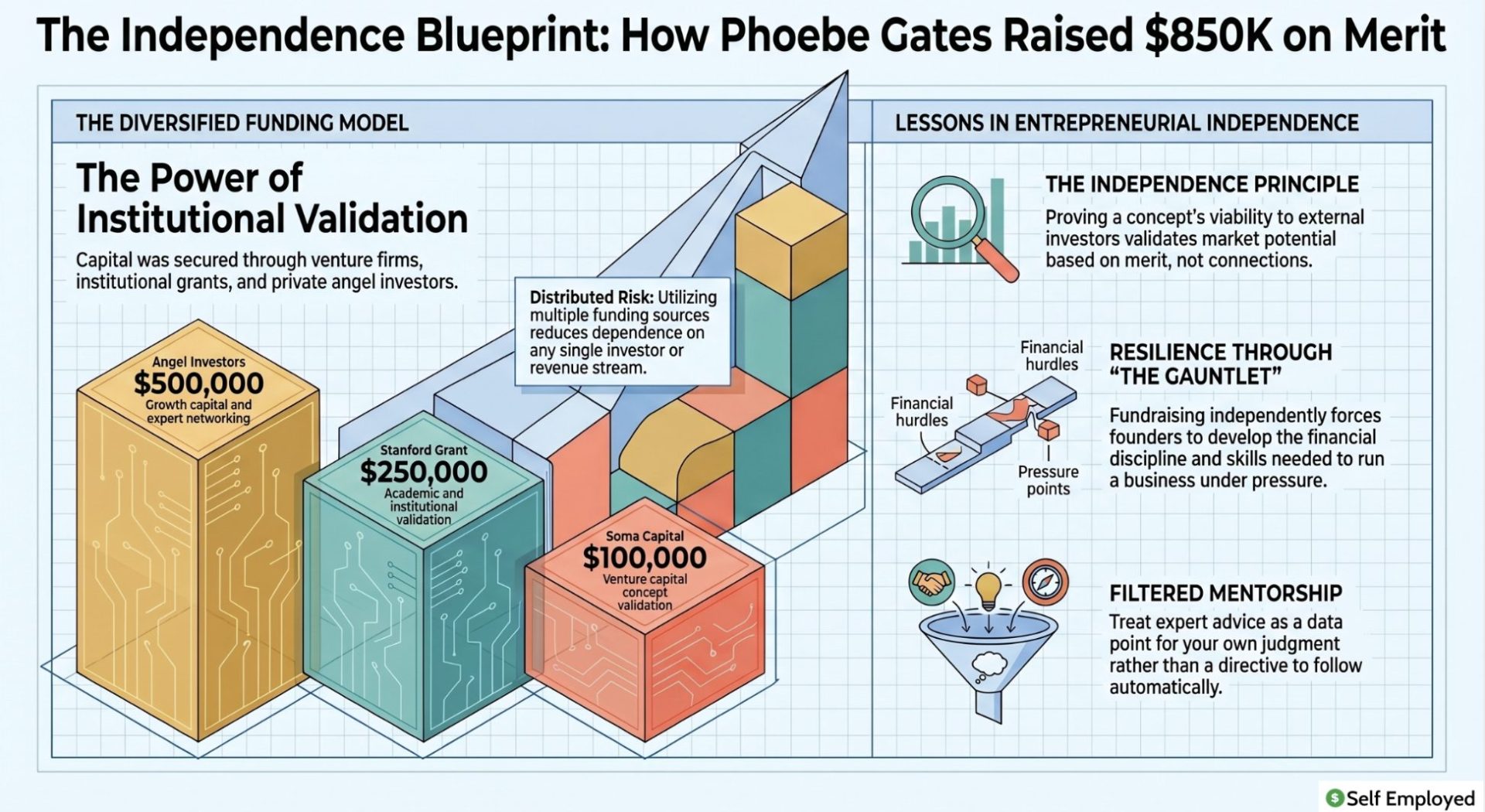
When Phoebe Gates co-founded Phia, an online price comparison platform, she made a deliberate choice that resonates deeply with the self-employed community. Rather than relying on her famous father’s wealth or connections, she raised capital through unconventional channels: $100,000 from Soma Capital, a $250,000 Stanford grant, and $500,000 from angel investors. Bill Gates himself offered strategic advice but pointedly did not fund the venture. This approach offers crucial entrepreneurship lessons for anyone building their own business.
I’ve observed that the most resilient entrepreneurs are those who prove their concept’s viability independently. Phoebe’s funding strategy demonstrates this principle perfectly. By securing capital from venture firms and institutional sources, she validated that investors believed in Phia’s market potential on its own merits, not because of her surname. For self-employed professionals considering scaling into a full business, this distinction matters enormously.
The independence principle in building credibility
One of the hardest lessons I’ve learned in business is that your achievements only count if you can demonstrate they’re yours. Phoebe understood this instinctively. She could have asked her father for a $100 million investment. Instead, she built credibility through the fundraising gauntlet that every other founder faces. This approach protected her long-term reputation and forced her to develop the skills necessary to run a business under pressure.
For self-employed professionals, this translates to a critical insight: the relationships and skills you develop while starting lean stay with you forever. When you bootstrap your business or raise capital strategically rather than relying on external safety nets, you develop resilience that translates into better decision-making, stronger financial discipline, and deeper market understanding.
Learning from Bill Gates’ hands-off approach
Perhaps the most instructive aspect of Phoebe’s story is what Bill Gates didn’t do. Having access to one of the world’s most successful entrepreneurs and his vast network, she could have leveraged unlimited advice and connections. Instead, the family’s philosophy emphasized independence and learning through experience.
I think this reflects something important about sustainable business growth. When you’re starting out as a self-employed professional, you need to own your learning process. This doesn’t mean rejecting mentorship or advice, but it does mean filtering advice through your own judgment and market understanding. Phoebe’s approach to her father’s counsel likely involved careful consideration rather than automatic implementation.
This independence mindset becomes even more critical as you consider scaling. If you’re exploring self-employment ideas, understanding your own decision-making process matters more than having access to the best advice in the world.
The funding landscape for early-stage startups
Phia’s funding breakdown reveals important truths about how modern startups get funded. A $100,000 seed from a venture firm validates the business concept. The Stanford grant recognized institutional merit. Angel investors provided additional capital and presumably brought expertise and networks to the table.
This distributed funding approach mirrors what many self-employed professionals should consider when raising capital for growth. Rather than seeking one massive investment, developing multiple revenue streams or funding sources reduces dependence on any single source. It also forces you to tell a compelling story to each type of investor, which clarifies your value proposition.
For those building consulting businesses, service agencies, or product companies, this lesson applies directly. Diverse funding sources including customer revenue, personal investment, and selective outside capital create more resilient businesses than those dependent on a single investor or loan.
Price comparison platforms and market positioning
Phia operates in the price comparison space, a market where consumer trust and data accuracy drive success. This positioning required Phoebe and her co-founders to understand consumer behavior, competitor differentiation, and regulatory requirements. It’s a space where family connections matter far less than product quality and market execution.
I’ve learned that competitive markets force you to develop genuine expertise. Phoebe couldn’t simply leverage her family name to win market share. She needed to build a better platform, offer better data, or serve customers more effectively than existing competitors. This harsh reality is actually beneficial for long-term business success.
What this means for your own entrepreneurial journey
Whether you’re considering starting a business or scaling an existing self-employed practice, Phoebe Gates’ approach offers practical guidance. First, develop your business concept independently before seeking capital. Second, build relationships with multiple funding sources rather than relying on one investor or lender. Third, view advice from experienced mentors as input to your decision-making process, not directives to follow automatically.
Understanding tax implications of different business structures also supports this independence-first mentality. When you’re clear on how different funding and business structures affect your tax situation, you make better choices about how to structure your venture.
The self-employed professionals who build the most resilient, profitable businesses are those who develop deep expertise in their market, maintain financial discipline, and build diverse relationships with customers, vendors, and potential investors. Phoebe Gates’ startup story validates these principles at a high profile level.
Building sustainable competitive advantages
What ultimately matters for any startup, regardless of the founder’s background, is whether the business solves a real customer problem better than alternatives. Phia’s value proposition depends entirely on data quality, user interface, and trust. These factors can’t be purchased or inherited; they must be built through sustained effort and iteration.
I’ve found that this focus on genuine competitive advantages separates businesses that survive from those that don’t. Phoebe’s willingness to build her venture on merit rather than leverage her family’s resources suggests she understands this principle deeply.
For self-employed professionals, managing the administrative and legal side of self-employment is important, but your actual competitive advantage comes from superior service, deeper expertise, or innovative solutions. That’s where your real energy should go.
The role of institutional support and validation
The $250,000 Stanford grant deserves special attention. This type of institutional support validates business concepts at an academic and research level. It suggests that Phia’s underlying technology or market approach has intellectual merit beyond commercial appeal.
For self-employed professionals with strong intellectual property or service innovations, exploring grants, academic partnerships, or research collaborations can provide both capital and credibility. This path requires more work than traditional fundraising, but it aligns your business with larger institutional missions and creates natural marketing advantages.
Long-term implications for Phoebe’s business
Having raised capital through diverse sources and maintained independence from family wealth, Phoebe has positioned herself for long-term success regardless of how Phia’s market opportunity evolves. If the business thrives, she can take pride in building it independently. If the market shifts, she’s developed the entrepreneurial skills to identify and pursue new opportunities.
This optionality matters enormously. I’ve observed that entrepreneurs who maintain independence and develop diverse skills adapt better to market changes than those with a single dependence.
Can a famous family name help your startup succeed?
Family connections can provide networks and credibility, but they can’t replace product quality and market fit. Phoebe’s approach demonstrates that proving merit through independent fundraising and execution creates more durable competitive advantages than relying on family leverage.
What’s the best way to fund an early-stage startup?
Diversifying funding sources reduces risk and forces you to refine your pitch for different audiences. Combining venture capital, grants, and angel investment creates a more resilient capital structure than depending on a single source.
Should you follow advice from successful mentors?
Mentorship is valuable, but you should filter it through your own market understanding and business judgment. Phoebe’s approach suggests that integrating mentor advice with your independent thinking creates better outcomes than either blindly following or ignoring experienced guidance.
What matters more in competitive markets, product quality or founder background?
Product quality and market execution ultimately determine success in competitive spaces. Founder background can provide initial advantages, but customers choose based on whether a solution solves their problem better than alternatives.
When should self-employed professionals consider raising outside capital?
Raise outside capital when you’ve validated product-market fit, have a clear path to growth that requires capital investment, and can maintain control of your business strategy. Many self-employed professionals build profitable businesses with customer revenue and personal investment.
What builds entrepreneurial resilience and adaptability?
Maintaining independence, developing diverse skills, building multiple customer and funding relationships, and learning through direct market experience all contribute to resilience. These factors help entrepreneurs adapt when markets or circumstances change unexpectedly.


