


Intel stock analysis has become one of the most watched exercises on Wall Street, and for good reason. After helping dozens of self-employed traders build their own research routines, I’ve seen the way a few charts, volume prints, and news catalysts can completely reframe a position in INTC. This piece walks through how I break down Intel stock analysis the way a working trader does, with a focus on what the tape is telling you right now.
The latest market listing for Intel Corp’s INTC-Q ticker highlights the hunger for fresh trading signals as investors reprice chipmakers in a volatile year. Traders want real-time context on volume, ranges, and momentum, with every tick offering hints on where the cycle goes next. Intel sits at the center of several industry shifts, and that makes disciplined Intel stock analysis more useful than ever.
Why Intel stock analysis matters right now
Intel is trying to rebuild its manufacturing edge while competing with chip designers that outsource production. The company is investing in new plants under the CHIPS Act framework and aims to win foundry work, a long game that can reshape margins and risk. Before putting capital at risk, I always review the basics with tools from the SEC’s EDGAR filings database, where Intel’s 10-Q and 10-K reports live.
At the same time, the market for personal computers has had uneven demand since the pandemic spike. Data center spending is strong, but much of the growth has funneled to suppliers of high-performance chips used for AI training and inference. Intel is working to capture more of that spend. These cross-currents make every price swing feel loaded with meaning, and they are exactly why I structure my Intel stock analysis around catalysts rather than generic technicals.
What a useful market listing actually offers
“Detailed price information for Intel Corp (INTC-Q) including charting and trades.”
That promise is about more than a quote screen. Traders who want intraday depth need more than a closing price. Charts reveal ranges and momentum. Trade logs show size and speed. Together, they sketch how buyers and sellers are meeting in the market at any moment.
Such tools help answer key questions. Is volume rising with price, hinting at stronger conviction? Are large prints crossing at the bid, which can point to pressure? I look for these signals when headlines are thin but volatility climbs. In my experience, the best Intel stock analysis sessions start with a clean chart, a watchlist of sector peers, and a quick scan of the news wire.
Reading the tape: signals I track for INTC
I watch for a few core patterns when a chip stock draws heavy interest:
- Volume surges during news hours versus quiet midday trade.
- Breakouts or breakdowns that hold past the first hour.
- Repeated tests of support or resistance on rising volume.
- Large block trades that shift the day’s tone.
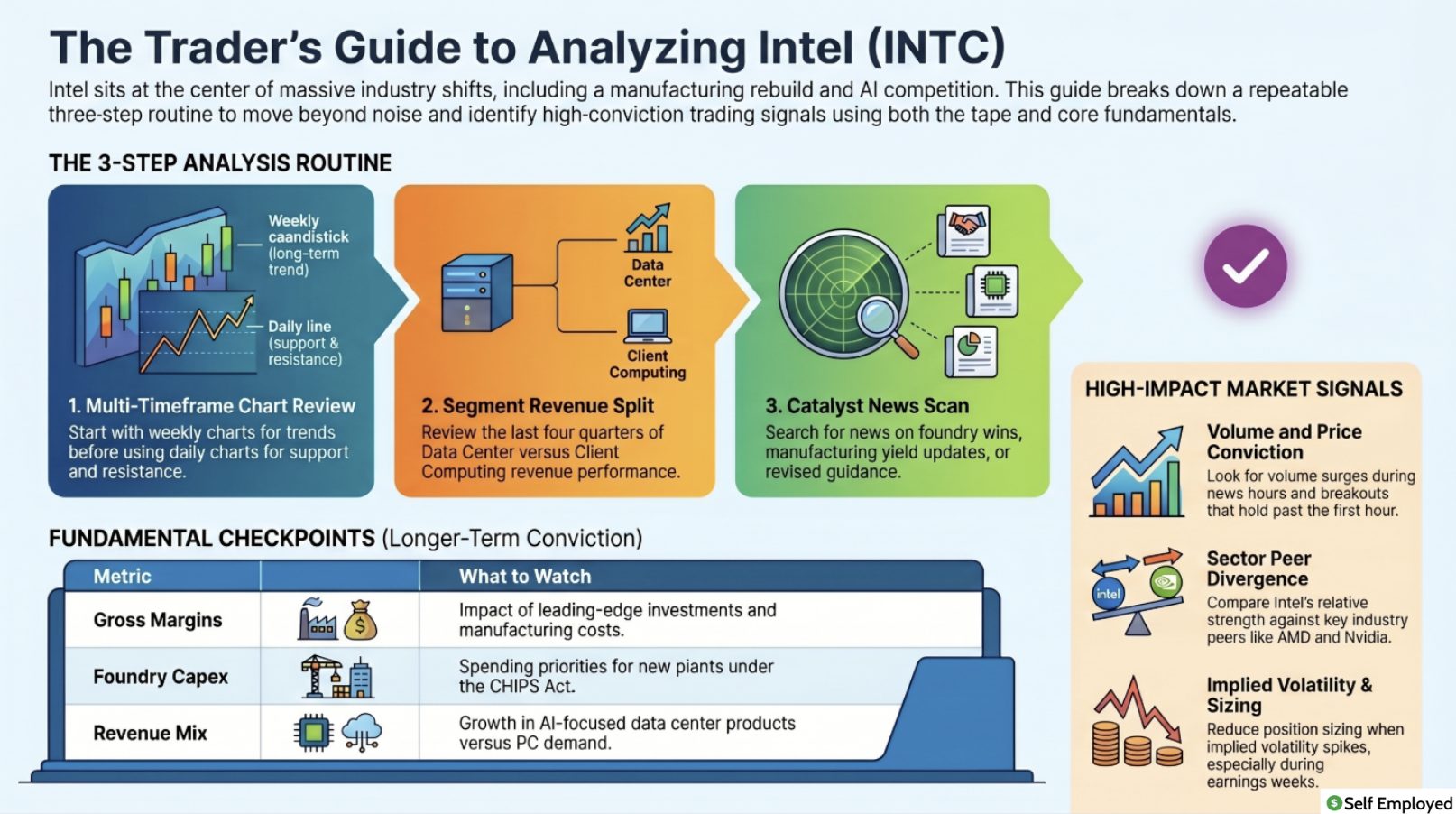
- Divergences between Intel and sector peers like AMD or Nvidia.
Charting packages can flag moving averages, gaps, or relative strength against sector peers. Trade logs reveal whether programs or discretionary buyers are in control. None of this replaces earnings or guidance, but it helps frame risk between reports. For anyone doing this full time from home, tracking these metrics is essentially a business activity, which is why I cover how traders handle the books in my self-employed bookkeeping step by step guide.
The broader industry context behind Intel stock analysis
Semiconductor stocks often move together, yet leadership changes fast. AI spending has lifted parts of the sector, while PC-focused names have seen more swings. Investors lean hard on short-term signals when macro news clouds the picture.
Public incentives for domestic chip production, including the CHIPS and Science Act administered in part through the U.S. Department of Commerce, have added long-horizon hope. But those programs do not settle next quarter’s margin questions. For Intel, execution on manufacturing roadmaps, server product traction, and capital spending priorities remain the key checkpoints investors track against the tape.
How I structure my own Intel stock analysis
After years of building trading routines for solo operators, I’ve settled on a simple four step framework:
- Start with the weekly chart to see the broader trend before zooming in.
- Check the daily chart for key support, resistance, and moving averages.
- Review the last four quarters of data center and client revenue splits.
- Scan the news wire for catalysts like foundry wins, yield updates, or guidance.
I also pull position sizing back whenever the implied volatility spikes into earnings week. Intel’s reactions to guidance have been sharp in both directions over the past few years, and sizing matters more than direction when the market is set up for a gap move.
Fundamentals still drive Intel stock analysis
Price action without fundamentals is noise. When I evaluate INTC, I look at gross margins, foundry capex, product mix, and management’s commentary on cycle timing. Margin pressure from leading-edge investments is real, and analysts often debate how long the drag will last. A rally on weak fundamentals rarely lasts. A sell-off on solid fundamentals can create an opening if you have cash on the sidelines.
For self-employed investors managing their own accounts, I also recommend reviewing your tax posture on active trading. Short term capital gains are taxed as ordinary income, which can be a surprise in a strong year. The IRS guidance on capital gains and losses lays out the basics clearly, and my essential forms for self-employed professionals guide walks through the paperwork side.
What to watch next with Intel
Near term, the market will judge whether trading strength pairs with improving fundamentals. The most useful Intel stock analysis will help identify that link. I expect close attention to:
- Volume on up days versus down days.
- Sector rotation between AI winners and laggards.
- Reactions to product updates, yield milestones, or foundry wins.
- Commentary from large customers about Intel’s roadmap.
If price advances come with rising, broad-based volume, the message is stronger. If rallies fade on light trade, the market may still be waiting for firmer proof. If you plan to trade INTC around earnings, I strongly recommend sizing for the move you can afford to be wrong on, not the move you hope to catch.
Turning Intel stock analysis into a repeatable habit
The fresh listing that spotlights charting and trades meets a clear need at a tense moment for chip stocks. These tools do not predict the future. But they make the present legible. For Intel, that clarity matters. It helps investors judge whether a swing is noise or the start of a new phase worth following.
I have found that the traders who make money on INTC over multiple years are the ones who treat Intel stock analysis as a routine, not an event. They review the same few data points weekly, log their trades, and adjust their position sizing based on conviction rather than emotion. If you want a broader framework for managing a trading business from home, my self-employment ideas guide has several related paths worth exploring.
Frequently asked questions about Intel stock analysis
What is the best way to start an Intel stock analysis?
Start with the weekly chart to see the trend, then drop to the daily chart for support and resistance. Review recent earnings commentary, key revenue segments, and any news on foundry contracts or product milestones before sizing any position.
How often does Intel report earnings?
Intel reports quarterly earnings like most U.S. public companies. Each release typically includes revenue by segment, gross margin, and forward guidance. Earnings dates are listed in Intel’s investor relations section and filings on EDGAR.
What indicators matter most for Intel stock analysis?
Volume, moving averages, relative strength against sector peers, and support and resistance levels matter the most. Fundamentals such as data center revenue growth, gross margin trends, and capital expenditure are equally important for longer term views.
Is Intel considered an AI stock?
Intel has AI exposure through its data center products and its Gaudi AI accelerator line, but it is not seen as a pure play AI chipmaker in the way Nvidia is. That positioning is part of why Intel stock analysis often compares INTC to peers on AI revenue mix.
How does Intel’s foundry business affect its stock?
Foundry wins can lift sentiment and future revenue expectations, but heavy capex needed to build leading edge fabs can pressure near term margins. Traders typically weigh both when running their Intel stock analysis.
Should I trade INTC around earnings?
Trading around earnings adds event risk and often higher implied volatility. If you do it, size your position for the potential gap move, not the move you hope to capture, and make sure your trading plan matches your overall risk tolerance.
Where can I find official Intel financial information?
Intel’s financial filings are available on the SEC’s EDGAR database and on the company’s investor relations site. Both sources are free and provide quarterly and annual reports, proxies, and press releases.


