


The Toronto Blue Jays have made a key decision on their starting rotation following a $30 million pitching investment, reshaping how they plan to deploy veteran arms as the American League East race tightens. The Blue Jays starting rotation move signals a broader organizational shift – balancing financial commitments with on-field flexibility over a grueling 162-game schedule.
Roster management decisions in professional baseball carry lessons that apply far beyond the diamond, particularly for self-employed professionals and small business owners who must constantly balance investment, resource allocation, and long-term planning with short-term results.
What changed in the Blue Jays starting rotation
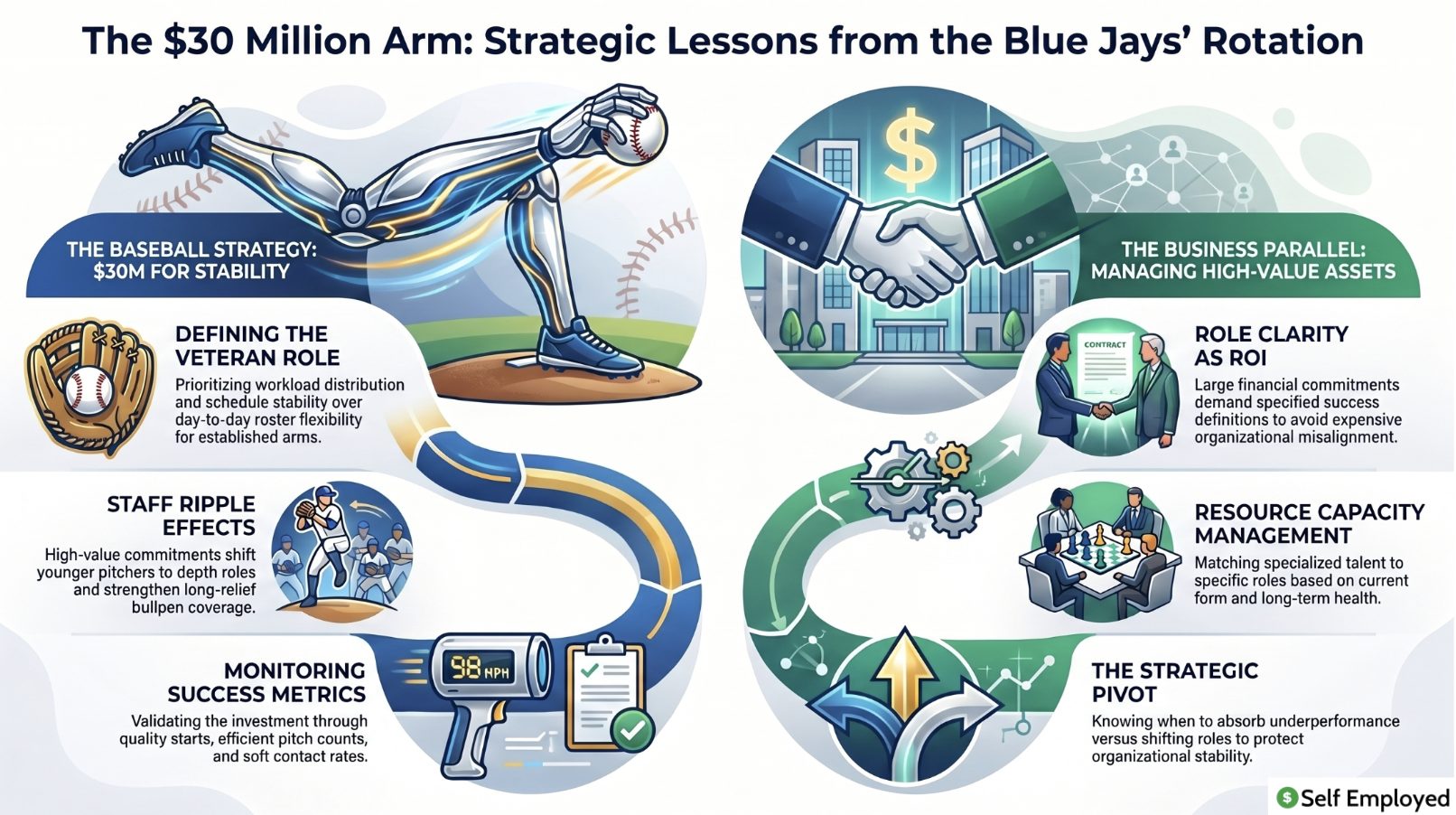
The Blue Jays moved to redefine a veteran starter’s role after committing $30 million to the rotation, according to reporting that surfaced this week. While specific details of the arrangement remain limited, the direction reflects a front office prioritizing stability and workload distribution over roster flexibility. A defined role for an established arm reduces day-to-day uncertainty in the pitching schedule and lets the coaching staff plan matchups further in advance.
“The Toronto Blue Jays have reportedly made a key decision on a veteran starter after a $30 million move in their rotation.”
For a team competing in a division that has consistently been one of baseball’s most contested, rotation depth is not a luxury – it is a necessity. The Blue Jays starting rotation has been a competitive strength in recent years, built on high strikeout rates and improved command from multiple starters. The front office’s latest move doubles down on that identity.
Why $30 million decisions require defined roles
When organizations make large financial commitments, clarity of role follows out of necessity. Ambiguity around how a highly-paid asset will be deployed creates organizational friction and undermines the return on investment. Whether it is a veteran pitcher, a senior consultant, or a specialized piece of equipment, large commitments demand defined roles and clear performance expectations.
The Blue Jays’ approach mirrors what effective small business owners do when they make significant hires or investments: they specify exactly what success looks like, how the investment integrates with existing operations, and what the plan is if circumstances change. Leaving those details undefined is a recipe for expensive misalignment.
Rotation decisions and their ripple effects
A single rotation decision creates downstream implications across an entire pitching staff:
- If the veteran holds a full-time rotation spot, younger pitchers may shift to depth roles or spot-start assignments.
- If the veteran shifts to long relief, the bullpen gains high-quality multi-inning coverage during doubleheaders and heavy stretches.
- If the move creates trade flexibility, the front office gains leverage to address other roster needs at the deadline.
Toronto’s bullpen usage patterns suggest the club values multi-inning relievers and fresh leverage arms in late-game situations. A veteran starter with a clearly defined, appropriate role strengthens those plans regardless of which direction the arrangement takes.
The business of managing a pitching staff
Running a major league pitching staff shares more with managing a professional services business than most people realize. Each starter is a specialized resource with a finite workload capacity. Overuse creates injury risk; underuse wastes expensive investment. Matching each arm to the right role – based on current form, opposition matchups, and long-term health – requires constant information and quick decision-making.
Self-employed professionals face analogous decisions when managing their own capacity and that of any contractors or collaborators they bring in. Understanding when to commit resources, when to hold back, and how to structure roles for maximum output is as relevant to a solo consulting practice as it is to a front office building a championship roster.
For more on managing income, resources, and strategic decisions as a self-employed professional, see our self-employment strategy guide and guide to high-value income streams.
What to watch as the season develops
How the veteran performs in the early weeks will determine whether Toronto’s decision holds or requires adjustment. Quality starts, efficient pitch counts, and soft contact rates will validate the front office’s confidence. If results disappoint, the team faces a difficult choice: absorb the underperformance for the sake of the financial commitment, or pivot to a different role at the cost of organizational stability.
The Blue Jays’ official roster updates will reflect any changes as the situation develops. For broader context on pitcher workload management, Baseball Prospectus offers detailed analysis of how pitching staff construction decisions affect team performance across a full season.
Frequently asked questions
What did the Blue Jays decide about their starting rotation?
The Toronto Blue Jays made a key decision on a veteran starter’s role following a $30 million pitching investment, reshaping their Blue Jays starting rotation for the season. The move defines how a veteran arm will be deployed, providing clarity for the coaching staff’s planning while stabilizing the overall pitching structure.
How does the $30 million pitching investment affect the Blue Jays roster?
A $30 million commitment to the rotation creates defined role expectations for the pitcher involved and ripple effects across the entire staff. It may shift younger pitchers to depth roles, strengthen long relief coverage, or create trade flexibility depending on how the arrangement is structured and how the veteran performs.
Why is starting rotation management important in baseball?
Starting rotation management directly affects a team’s ability to limit runs over 162 games. Defined roles reduce uncertainty for pitchers and coaches, allow proper rest scheduling, and protect long-term arm health. In a competitive division like the American League East, where games are often decided by narrow margins, rotation stability can be the difference between a playoff berth and an early exit.
What is the Blue Jays’ competitive outlook?
The Toronto Blue Jays compete in the American League East, one of baseball’s most competitive divisions. Their approach – building around a strong rotation, high strikeout rates, and a well-managed bullpen – positions them as a consistent playoff contender. The latest rotation decision reinforces their commitment to that identity heading into the current season.


