

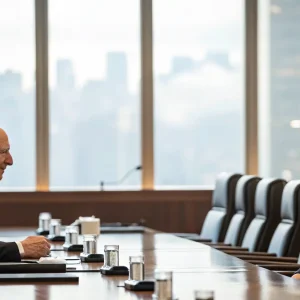
As tariff tensions flare and U.S. and Chinese leaders meet, Goldman Sachs CEO David Solomon issued a stark assessment of decades of U.S. policy toward China, calling it a mistake. His remarks land as President Trump and Xi Jinping hold high-stakes talks on trade, technology, and national security. The comments frame a debate over how the world’s two largest economies should compete and trade after years of tariffs and strained ties.
Solomon’s criticism targets the strategic choices made since the 1970s, when Washington deepened economic ties with Beijing. The goal then was to integrate China into the global economy and anchor relations through commerce. Today, tariffs, export controls, and investment reviews dominate the agenda, with companies racing to adjust supply chains and manage risk.
A Sharp Reversal in Tone
Solomon’s statement adds corporate weight to a growing shift. For much of the 2000s, U.S. finance and multinational firms supported deeper engagement with China. They sought market access and lower costs. Now, many executives speak about resilience, redundancy, and exposure to policy shocks.
“The past 50 years of China trade policy were a mistake,” said David Solomon, arguing that the United States misread incentives and overestimated benefits.
His view reflects concern that expected gains in market access and intellectual property protections fell short. It also mirrors worries about national security and the pace of China’s industrial support.
How We Got Here
Tariffs surged in 2018 and 2019 under Section 301 actions, hitting hundreds of billions of dollars in goods. China responded with duties on U.S. exports. A “Phase One” deal paused escalation but did not remove most tariffs.
Policies since then have tightened. The United States has expanded export controls on advanced chips and placed new limits on outbound investment in sensitive technologies. In 2024, Washington raised duties on Chinese electric vehicles and certain clean-energy products, citing overcapacity and security concerns. Beijing has criticized the measures and filed complaints at the World Trade Organization.
- U.S.-China goods trade peaked near $690 billion in 2022, then eased in 2023.
- Average U.S. tariffs on Chinese goods remain elevated compared with pre-2018 levels.
- Foreign direct investment into China has weakened as companies reassess risk.
Industry Impact and Business Choices
Manufacturers have shifted production to Southeast Asia and Mexico to avoid tariffs and diversify supply chains. Retailers and electronics makers face higher costs and longer lead times. Auto and clean-tech firms weigh China’s scale against policy risk.
Some businesses welcome a tougher stance. They argue that subsidies and forced technology transfers skew markets. Others warn that higher barriers raise prices for consumers and slow innovation.
“Companies can manage risk, but policy whiplash is costly,” said one trade advisor, noting the burden on small and mid-size suppliers.
Economists caution that rapid decoupling could strain growth. They point to lost efficiency and the risk of retaliatory measures. Farm and energy exporters could face renewed pressure if talks falter.
What the Talks Could Decide
The meeting between Trump and Xi comes with limited room for quick fixes. Tariffs are politically durable and complicated to unwind. Export controls and investment screens are tied to security reviews, which move slowly.
Still, officials could agree on small steps. These might include clearer licensing rules, faster customs processes, or pilot projects on data and audits. Even modest gains could lower uncertainty for companies planning multi-year investments.
Beijing seeks fewer barriers on advanced manufacturing and access to U.S. technologies. Washington seeks fairer competition, stronger protections for intellectual property, and reduced reliance on sensitive Chinese inputs. The gap remains wide.
Competing Views on the Path Ahead
Supporters of Solomon’s stance say decades of engagement have not delivered the expected reforms. They push for targeted tariffs, stronger trade enforcement, and incentives to build domestic capacity.
Critics argue that calling the entire period a mistake ignores gains for consumers and farmers, and underestimates the stabilizing effects of trade. They favor clearer rules, narrower controls, and more predictable enforcement.
“The question is not trade or no trade,” said a former U.S. trade official. “It is where to set guardrails that protect security without choking commerce.”
Outlook and Key Signals to Watch
Investors will watch for any freeze or rollback of planned tariffs, and whether new technology controls expand. Corporate guidance on supply chain moves will signal how durable the current split is.
For now, Solomon’s blunt critique shows how mainstream skepticism has become in boardrooms. Business leaders may press for certainty, even if they no longer expect open access to China’s market.
The talks could cool tensions or harden positions. The outcome will shape prices, investment, and where the next generation of factories gets built.


