

When I first learned about Ty’s wood restoration business, I immediately understood why it became a case study in how to scale a small business. What started with just $300 in epoxy resin grew into a multi-location operation generating $1.3 million annually. But here’s what makes this story valuable: it’s not about luck or timing. It’s about understanding core principles of growth that apply to any business trying to scale from startup to sustainable operation.
If you’re asking “how to scale a small business,” you’re already asking the right question. Scaling isn’t just about working harder or spending more on marketing. It’s about building systems, identifying your unique value, and expanding strategically. Let me walk you through the strategies that transformed Ty’s startup into an empire, plus the universal principles every business owner should know.
Find the underserved problem your business can solve at scale
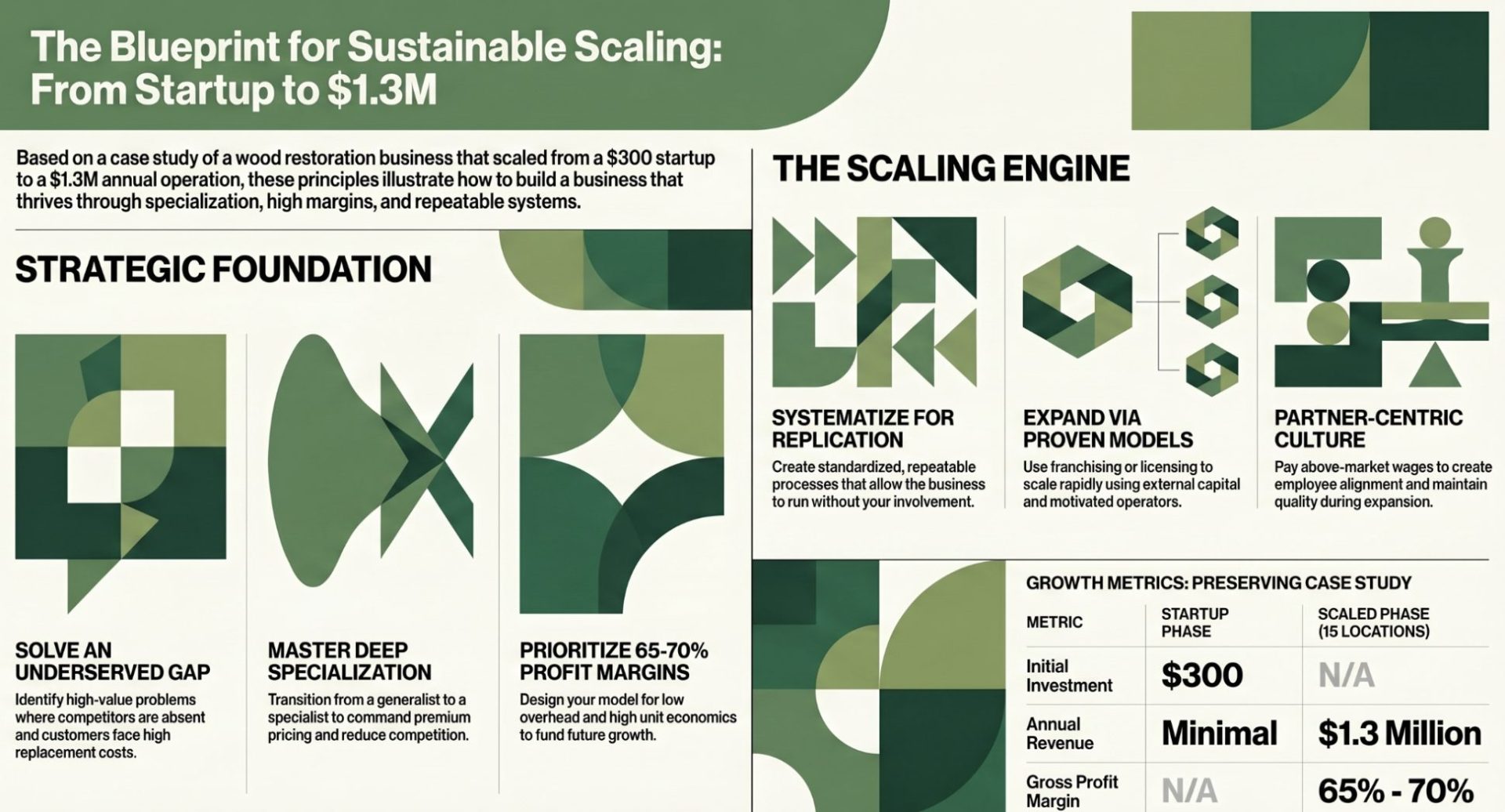
The foundation of any scalable business is solving a real problem that customers desperately want solved. For Preserving, that problem was the cost of wood replacement. Homeowners facing $250,000 replacement bills didn’t know restoration was an option. Once they learned it, the decision became obvious: pay $3,000 for restoration or $250,000 for replacement.
This is the first principle of how to scale a small business: find a gap in the market that others have overlooked. Ty’s insight was that most people didn’t even know his service existed, which meant he had minimal competition despite high demand. When you discover an underserved market, you create room to grow without constant price wars.
To find your underserved problem, ask yourself these questions:
- What problem do your current customers complain about repeatedly?
- What solution are they currently using that feels inadequate?
- Why aren’t competitors already solving this problem?
- How much would solving this problem be worth to your customer?
When the value proposition is clear (save 90% of costs), scaling becomes possible because customer acquisition becomes easier and retention improves naturally.
Build a business model with healthy profit margins and low overhead
Preserving operates with 65-70% profit margins. This isn’t accidental. Ty designed the business model intentionally around low overhead. There’s no requirement for expensive facilities, minimal equipment needed, and technicians work from compact vehicles containing everything required for the job.
When you understand how to scale a small business, you realize that scaling is only possible when your unit economics work. If you’re barely profitable on each sale, you can’t invest in growth. If you require expensive infrastructure for each new location, expansion becomes capital-intensive and slow.
Preserving’s model works because:
- Each technician operates independently from a vehicle (Kia Soul or hybrid Maverick)
- The specialized epoxy product creates a moat (not available at home centers)
- Minimal training required compared to general contracting work
- No inventory carrying costs or warehouse requirements
- High customer value means customers seek them out (not expensive customer acquisition)
As you think about how to scale a small business, examine your cost structure ruthlessly. Where are unnecessary expenses? What assets could be eliminated? What overhead could become variable costs that scale with revenue?
For guidance on managing your finances as you scale, check out our comprehensive guide to self-employed bookkeeping step by step. Understanding your numbers is essential before attempting any growth strategy.
Create a specialization that commands premium pricing
One of Ty’s most important insights about how to scale a small business came from his own evolution: “Stay in your lane. Master something, go deep with it.” He transitioned from being a general contractor who would take any job to becoming a specialist in wood restoration using epoxy technology.
This specialization serves multiple scaling purposes:
- Premium pricing – specialists charge more than generalists
- Efficient marketing – you can target specific customer problems, not compete on price
- Team training – specialists are easier to train and replicate across locations
- Competitive moat – specialists create defensibility that commodities can’t
- Customer perception – expertise commands higher margins and loyalty
When you specialize deeply, you fundamentally change the game on how to scale a small business. Instead of competing with dozens of general contractors, Preserving faces minimal direct competition because few have invested in mastering this specific technique.
If you’re considering starting or scaling a service-based business, explore our guide on self-employment ideas for inspiration on finding your own specialization.
Design systems and processes that replicate consistently
Ty’s business grew from a solo operation to 15 locations with around 50 team members. This expansion only became possible because he systematized the work. The restoration process is repeatable: identify damage, drill injection points, apply epoxy, fill and harden, sand, shape, and paint. Two days from start to finish.
When learning how to scale a small business, most entrepreneurs focus on revenue. The real secret is creating systems that produce consistent results without your personal involvement in every transaction. Preserving achieves this through:
- Standardized processes that technicians follow consistently
- Proprietary product (Everresin) that ensures quality control
- Training programs that prepare new technicians quickly
- Technology for job scheduling and customer communication
- Quality assurance checks before customers receive final work
Without systems, scaling is impossible. You’ll simply create more chaos at higher revenue levels. With systems, you transform your business from a service that depends on you personally into a machine that can operate across multiple locations.
Expand through proven models like franchising
Preserving’s growth to 15 locations happened through a franchise model. This is one of the most effective answers to how to scale a small business when you’ve proven the model works. Franchising allows rapid expansion because:
- Capital comes from franchisees, not the parent company
- Motivated operators run each location (they own the business)
- Quality control improves through standardized training and oversight
- Your role shifts from operations to systems, support, and quality
First-year franchisees can expect to generate around $300,000 in revenue with mid-60% gross profit margins. That compelling economics is what makes the franchise model attractive and what allows Preserving to scale.
Franchising isn’t the only model for scaling. Other approaches include partnerships, licensing, wholesale distribution, or geographic expansion with company-owned locations. Choose the model that matches your business structure and your capacity to support growth.
Focus marketing investment on proven channels that scale
When you understand how to scale a small business, you realize marketing efficiency matters enormously. Preserving’s marketing budget is modest at $3,000-$3,500 monthly, primarily spent on Meta ads and direct mail. This isn’t because they don’t care about marketing; it’s because they’ve found what works and doubled down on it.
Many businesses waste money testing every possible channel. The better approach is to:
- Identify which channels produce profitable customer acquisition
- Understand your customer acquisition cost and lifetime value ratio
- Double down on what works rather than spreading resources thin
- Track metrics religiously to know which campaigns drive actual revenue
- Resist vanity metrics (impressions, clicks) in favor of real metrics (customers, revenue, profit)
For Preserving, the “customer finds us” dynamic also plays a role. When customers save $247,000 on a $250,000 project, they tell everyone. Referrals and word-of-mouth become powerful scaling forces when your customer value proposition is compelling enough.
Build a culture where employees feel like partners
One detail I noticed throughout Ty’s story was his perspective on team members: they’re treated as neighbors, not labor. Preserving pays technicians $25+ per hour, which is above-average for the market. The company maintains healthy profit margins while compensating people well.
When thinking about how to scale a small business, the quality of your team becomes your limiting factor once you grow beyond solo operation. Ty’s approach creates alignment:
- Technicians earn excellent wages for their market
- They take pride in quality work because they’re treated well
- Turnover decreases, which reduces training costs
- Team members become informal brand ambassadors
- Culture consistency helps the business scale without losing identity
The “neighbor” mentality also reveals Ty’s accountability. When he encountered an unhappy customer at the grocery store, he didn’t avoid her. He faced it directly: “That’s not who I am. That’s not the business I’m going to have.” This commitment to quality and customer relationships at scale prevents the reputation decay that kills many growing businesses.
Measure impact by the value you deliver, not just revenue
Last year alone, Preserving saved customers over $20 million. Over the company’s lifetime, that number has exceeded $50 million. These aren’t vanity metrics; they tell the real story of impact. When you’re scaling a business, impact metrics often matter more than revenue metrics for long-term sustainability.
Why? Because impact drives:
- Customer satisfaction and retention (people know you saved them enormous sums)
- Referral quality (satisfied customers recruit other high-value customers)
- Employee pride (people want to work for businesses that change lives)
- Media attention (a $300 startup that saved customers $50 million is a story worth telling)
- Long-term defensibility (you’re not just optimizing for profit; you’re optimizing for solving real problems)
When you master how to scale a small business, you move beyond short-term growth hacking into sustainable, profitable expansion that compounds over years.
Create defensibility through specialization and brand
The most interesting moat in Preserving’s business isn’t a patent or a trademark. It’s specialization. The company has invested years in mastering wood restoration with epoxy technology. They’ve built brand recognition around this specific service. They’ve trained teams in this technique. They own the customer conversation in this category.
For any business learning how to scale a small business, building defensibility is crucial. Without it, competitors will follow success and copy your model. With defensibility, you create a protected space to grow.
Defensibility comes from:
- Exclusive access to key resources (Preserving’s specialized epoxy)
- Proprietary knowledge that takes time to develop (restoration expertise)
- Network effects (as more customers use you, more people hear about you)
- Brand trust (when you execute consistently, customers recommend you)
- Scale advantages (you can offer better prices or service at higher volumes)
Understand your path to sustainable profitability
Ty’s journey teaches an important lesson about how to scale a small business sustainably. He didn’t chase growth for growth’s sake. He built a business that makes sense economically for customers (saves them money), economically for the company (healthy margins), economically for team members (good wages), and economically for the environment (prevents waste).
This alignment is what sustainable scaling looks like. Every stakeholder wins. There are no conflicts of interest. The business isn’t extracting value; it’s distributing it.
As you develop your scaling strategy, ensure sustainable profitability by:
- Protecting your core margins as you grow (don’t slash prices to scale faster)
- Investing in team quality and retention (turnover destroys margins)
- Building brand and reputation (they enable pricing power)
- Reinvesting profits into systems that improve efficiency
- Staying focused on your core specialization (avoid the temptation to diversify)
Learn from the numbers
If you’re self-employed or planning to be, you need to understand your financial picture as you scale. This isn’t optional. You need to know your customer acquisition cost, your gross margins, your overhead as a percentage of revenue, your cash conversion cycle, and dozens of other metrics. Strong bookkeeping practices will make scaling much easier.
Review our resource on essential forms for self-employed professionals to ensure you’re set up properly for growth.
Key takeaways on how to scale a small business
Ty’s story from $300 startup to $1.3 million operation compressed into a few years provides a masterclass in how to scale a small business. But the principles apply whether you’re scaling to $500K, $5M, or $50M:
- Solve an underserved problem worth solving
- Build healthy unit economics before scaling
- Specialize deeply to create defensibility
- Systematize ruthlessly so growth doesn’t destroy quality
- Choose expansion models (franchising, licensing, etc.) that match your strengths
- Focus marketing on proven channels
- Build a team culture that supports growth
- Measure impact in addition to revenue
- Create defensibility through specialization and brand
- Maintain sustainable profitability throughout scaling
The good news: you don’t need to be in wood restoration to apply these principles. You don’t need a special product or a unique industry. You need clarity on the problem you’re solving, a business model that makes economic sense, and the discipline to focus on what works rather than chasing every opportunity.
For external insights on small business scaling, the Small Business Administration provides excellent resources at sba.gov. Additionally, SCORE.org offers free mentoring and resources from experienced business leaders.
Frequently asked questions
What is the most common mistake businesses make when trying to scale?
The most common mistake is scaling before the core business model is profitable. Many entrepreneurs increase volume hoping it will improve margins, but that usually makes problems worse. Preserving proved the model worked at a small scale before expanding to franchises. Ensure your unit economics are healthy before attempting growth.
How do you know when your business is ready to scale?
Your business is ready to scale when: you have consistent customer demand exceeding your capacity, your operations are systematized (not dependent on you personally), your profit margins are healthy, and you have the management capacity to oversee growth. Ty reached these milestones before expanding to multiple locations.
Should I grow through franchising, licensing, or company-owned expansion?
This depends on your capital, management bandwidth, and control preferences. Franchising requires less capital but less control. Company-owned expansion gives you more control but requires more capital and management. Licensing is fast but offers less control over customer experience. Choose based on your strengths and constraints.
How important is specialization to scaling successfully?
Specialization is crucial. It allows you to command premium pricing, reduces competition, makes team training easier, and creates defensibility. Ty’s transition from general contractor to wood restoration specialist enabled scaling in ways that pure contracting never could have.
What metrics should I track to monitor scaling progress?
Track customer acquisition cost, customer lifetime value, gross profit margin, operating margin, customer satisfaction/retention, team turnover, and cash flow. These metrics reveal whether you’re scaling sustainably or building a house of cards that will collapse under its own weight.
How do you maintain quality and culture as your business grows?
Invest in systems and training from the start. Document your processes. Hire slowly and carefully. Build a strong culture and hire for cultural fit, not just skills. Regular quality audits prevent drift. Preserving maintains quality through standardized processes and ongoing support for franchisees.
What role should profit margins play in scaling decisions?
Healthy margins are essential for sustainable scaling. Don’t cut prices to grow faster. Instead, build defensibility that allows premium pricing. Preserving’s 65-70% margins fund growth, allow team investment, and provide cushion for market changes. Low-margin businesses struggle to scale sustainably.
How long does it typically take to scale a small business successfully?
There’s no universal timeline. Ty went from $300 to $1.3M in a few years, but that’s accelerated growth built on a unique model. Most businesses scale over 5-10 years as they prove the model, build systems, develop management capacity, and expand carefully. Focus on sustainable growth rather than speed.


