


The entrepreneurial spirit is the driving force behind innovation, risk-taking, and business success. It’s the internal fire that pushes individuals to identify opportunities, take calculated risks, and persist through challenges. In this guide, I’ll share what I’ve learned about the entrepreneurial spirit, how it shapes business outcomes, and practical ways to nurture this mindset in yourself and your organization.
What is the entrepreneurial spirit?
The entrepreneurial spirit refers to a mindset and set of characteristics that define individuals who pursue business opportunities with determination and creativity. It goes beyond simply starting a business. The entrepreneurial spirit encompasses the courage to challenge conventions, the resilience to overcome setbacks, and the vision to see potential where others see obstacles.
From my experience working with self-employed professionals and business founders, I’ve observed that entrepreneurial spirit isn’t something you’re born with entirely. It’s a combination of natural traits and learned behaviors that can be developed, strengthened, and refined over time. This is encouraging news for anyone who feels they lack the “gene” for entrepreneurship.
The essence of entrepreneurial spirit is fundamentally about creating value. Whether you’re launching a startup or scaling an existing operation, this spirit drives you to solve problems, meet unmet needs, and build something meaningful. It’s the reason people leave stable jobs to pursue their passions and why some individuals consistently find new opportunities others overlook.
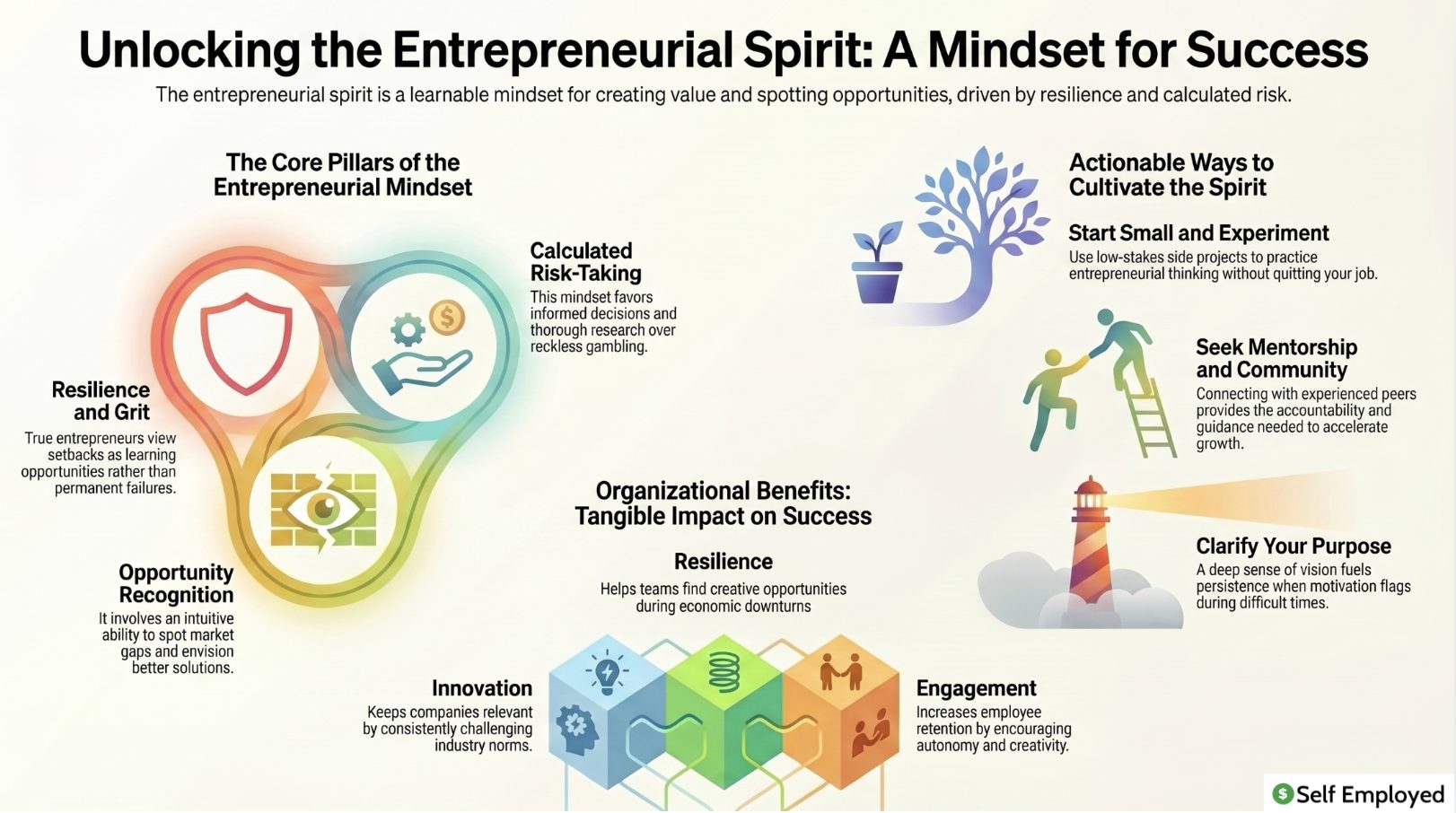
Key characteristics of the entrepreneurial spirit
Through years of observation and direct involvement in the entrepreneurial community, I’ve identified several defining characteristics that individuals with a strong entrepreneurial spirit consistently demonstrate.
Resilience and grit stand at the forefront. Entrepreneurs encounter rejection, failure, and uncertainty regularly. Those with a true entrepreneurial spirit don’t view setbacks as permanent; they see them as learning opportunities. I’ve witnessed countless business owners bounce back from failed ventures stronger and wiser than before.
Vision and opportunity recognition is another hallmark trait. Individuals with entrepreneurial spirit possess an almost intuitive ability to spot gaps in the market and envision solutions. They don’t just accept how things are done currently; they ask themselves, “How could this be better?”
Calculated risk-taking distinguishes the entrepreneurial spirit from reckless behavior. True entrepreneurs don’t gamble; they research, plan, and then take informed risks. I’ve observed that those with the strongest entrepreneurial spirit spend considerable time validating ideas before committing significant resources.
Adaptability rounds out the core characteristics. The business landscape changes constantly, and those with a developed entrepreneurial spirit thrive in uncertainty. They pivot when necessary, embrace change, and use flexibility as a competitive advantage.
Additional characteristics include:
- Passion and intrinsic motivation
- Problem-solving orientation
- Self-reliance and independence
- Continuous learning mindset
- Strong work ethic and discipline
- Networking and relationship-building ability
How to cultivate entrepreneurial spirit in yourself
One of the most empowering realizations I’ve had is that the entrepreneurial spirit can be deliberately cultivated. You don’t need to possess all characteristics from day one; rather, you develop them through intentional practice and experience.
Start with self-awareness. Assess your current strengths and challenges. Which elements of entrepreneurial spirit come naturally to you? Where do you need growth? This honest evaluation provides your starting point.
Embrace a learning orientation. Read books on business and entrepreneurship. Follow industry leaders. Take courses on skills you’ll need. I’ve found that people who actively develop their knowledge base demonstrate stronger entrepreneurial spirit because they understand their industry deeply.
Seek mentorship and community. Find entrepreneurs further along the path and learn from their experiences. Participate in networking groups, mastermind circles, or online communities. These connections provide accountability, inspiration, and practical guidance that accelerates your development of entrepreneurial spirit.
Start small and experiment. You don’t need to quit your job tomorrow to develop entrepreneurial spirit. Begin with side projects, freelance work, or small business experiments. Real experience teaches lessons no book can match. I always recommend that aspiring entrepreneurs start with low-stakes opportunities to practice their entrepreneurial thinking.
Build resilience intentionally. Seek out challenges, take small risks, and learn from failures. Each setback strengthens your entrepreneurial spirit when you extract lessons from it. I’ve noticed that individuals who actively reflect on failures develop remarkable resilience.
Clarify your vision and purpose. What problems do you want to solve? What legacy do you want to build? A clear sense of purpose fuels your entrepreneurial spirit during difficult times. When motivation flags, your deeper purpose reignites your drive.
For more structured guidance on launching your entrepreneurial journey, explore our self-employment ideas guide and learn about the realities of starting your own business.
The role of entrepreneurial spirit in business success
The difference between businesses that thrive and those that merely survive often comes down to the presence of entrepreneurial spirit. This mindset directly influences business outcomes across multiple dimensions.
Innovation and differentiation. Businesses led by people with strong entrepreneurial spirit innovate consistently. They ask “what if” questions, challenge industry norms, and create new value propositions. This innovation-focused mindset keeps companies relevant and competitive.
Resilience during downturns. Economic cycles are inevitable. Organizations where entrepreneurial spirit permeates the culture respond more creatively to challenges. Rather than reacting passively, they find new opportunities within constraints.
Employee engagement and retention. Research from leading business institutions shows that entrepreneurial spirit energizes organizations. When employees work in environments that encourage creativity and calculated risk-taking, engagement increases significantly.
Growth and scalability. Rapid growth requires entrepreneurial thinking. Leaders with entrepreneurial spirit identify new markets, develop new products, and expand in ways that accelerate revenue growth and market share.
Attracting talent and resources. Top performers want to work for leaders who demonstrate genuine entrepreneurial spirit. Investors also gravitate toward entrepreneurs whose passion and vision are evident. This positive cycle strengthens as entrepreneurial spirit becomes more pronounced.
According to research from the Small Business Administration, small businesses led by entrepreneurs with clear vision and resilience show significantly higher survival rates and growth trajectories.
Challenges and obstacles to entrepreneurial spirit
While the benefits of entrepreneurial spirit are clear, developing and maintaining it presents real challenges. Understanding these obstacles helps you navigate them effectively.
Fear of failure is perhaps the most significant barrier. The prospect of losing money, time, or reputation deters many from taking entrepreneurial action. However, I’ve observed that reframing failure as feedback rather than judgment significantly reduces this fear and strengthens entrepreneurial spirit.
Self-doubt undermines entrepreneurial spirit. Imposter syndrome affects even experienced entrepreneurs. Quieting this inner critic requires both external validation (from mentors and community) and internal work (self-compassion and affirmation).
Financial constraints limit action. Many aspiring entrepreneurs believe they need substantial capital to start. While capital helps, those with true entrepreneurial spirit find creative solutions, bootstrap operations, or secure funding through non-traditional means.
Lack of knowledge or experience can paralyze potential entrepreneurs. The antidote is exactly what differentiates those with developed entrepreneurial spirit from those without: they start anyway and learn as they go.
Environmental factors also influence entrepreneurial spirit. Family expectations, cultural narratives, and peer influences shape whether someone feels permission to pursue entrepreneurial paths. Creating or joining communities that celebrate entrepreneurial thinking helps overcome these external pressures.
Burnout and sustaining momentum challenges long-term entrepreneurs. The initial excitement of entrepreneurial spirit must be coupled with systems, delegation, and sustainability practices to prevent exhaustion.
For perspective on how successful entrepreneurs navigate failure, check out our collection of failure quotes that inspire success.
Fostering entrepreneurial spirit in organizations
Leaders seeking to strengthen organizational performance increasingly recognize the importance of fostering entrepreneurial spirit throughout their teams. This internal entrepreneurship, sometimes called “intrapreneurship,” drives innovation from within.
Create psychological safety. Employees need to know that reasonable risks and even failures won’t result in punishment. Organizations with strong entrepreneurial spirit cultures explicitly reward the courage to try new approaches, even when some attempts don’t succeed.
Provide resources and autonomy. Give teams the tools, time, and decision-making authority to pursue ideas. Entrepreneurial spirit flourishes when people have agency and don’t need approval for every small decision.
Model entrepreneurial behavior. As a leader, your demonstrated entrepreneurial spirit sets the tone. When you take calculated risks, embrace change, and learn from mistakes, you give permission for others to do the same.
Celebrate and share wins. Recognize employees who demonstrate entrepreneurial spirit, whether their projects succeeded or failed instructively. Sharing these stories embeds entrepreneurial values in organizational culture.
Invest in development. Offer training, mentorship, and coaching that builds entrepreneurial capabilities. External speakers, workshops, and learning opportunities strengthen organizational entrepreneurial spirit.
Define clear boundaries. While encouraging entrepreneurial spirit, organizations need clarity on core values and acceptable risk levels. Employees thrive when they understand the framework within which they can operate entrepreneurially.
Research from Harvard Business Review demonstrates that organizations deliberately fostering entrepreneurial spirit show higher innovation rates, faster adaptation to market changes, and stronger employee retention.
The future of entrepreneurial spirit
As the business landscape continues evolving, entrepreneurial spirit becomes increasingly central to individual and organizational success. Several trends shape how entrepreneurial spirit will manifest going forward.
Digital transformation lowers barriers to entry for entrepreneurs. With cloud technology, digital marketing, and e-commerce platforms, individuals can launch viable businesses with minimal capital. This democratization of entrepreneurship means more people can express their entrepreneurial spirit.
Remote work and distributed teams enable entrepreneurial flexibility. The traditional constraints of location-based employment have loosened, allowing people to pursue entrepreneurial ventures while maintaining income stability. This shift empowers more people to develop their entrepreneurial spirit.
Focus on purpose and impact shapes modern entrepreneurship. Today’s entrepreneurs increasingly pursue ventures aligned with personal values and social impact. This evolution of entrepreneurial spirit reflects changing priorities, especially among younger generations.
Sustainability and ethical practices become fundamental to entrepreneurial spirit. Entrepreneurs must consider environmental and social impacts alongside profitability. This holistic approach to entrepreneurial spirit creates business models that thrive long-term.
Continuous upskilling is essential. As technology evolves, maintaining strong entrepreneurial spirit requires ongoing learning. The entrepreneurs who thrive demonstrate curiosity and commitment to staying current with industry developments.
Collaborative ecosystems replace purely competitive models. Modern entrepreneurial spirit often involves partnerships, networks, and collaborative problem-solving rather than solo ventures. This shift reflects a maturing understanding of how businesses create value.
Practical action steps to strengthen your entrepreneurial spirit
Understanding entrepreneurial spirit intellectually differs from embodying it. Here are concrete steps you can take this week to strengthen yours:
- Identify one problem you want to solve. Write down three potential solutions. This activates your opportunity recognition capabilities.
- Reach out to one entrepreneur you admire and request a brief conversation. Mentorship accelerates entrepreneurial spirit development.
- Take one small risk aligned with your business or career goals. This might be pitching an idea, trying a new marketing channel, or offering a new service. Small wins build momentum and confidence.
- Reflect on a past failure and extract three lessons. This practice transforms setbacks into fuel for entrepreneurial spirit.
- Commit to one learning activity. Read a business book, take an online course, or listen to entrepreneur interviews. Knowledge strengthens your entrepreneurial foundation.
- Find or create an accountability group. Community support sustains entrepreneurial spirit over the long term.
Frequently asked questions about entrepreneurial spirit
Absolutely. While some personality traits support entrepreneurial thinking, entrepreneurial spirit is primarily a learned mindset. Through intentional practice, mentorship, and real-world experience, anyone can develop strong entrepreneurial capabilities.
No. Entrepreneurial spirit benefits anyone in any role. Employees, managers, nonprofit leaders, and public sector workers all benefit from entrepreneurial thinking. This mindset drives innovation, career advancement, and problem-solving regardless of employment structure.
Development is ongoing. You can begin demonstrating entrepreneurial behaviors within weeks through small actions and mindset shifts. However, building a robust entrepreneurial spirit that sustains you through challenges typically requires consistent effort over months and years of practice.
While no single metric captures entrepreneurial spirit completely, various assessments evaluate entrepreneurial traits, mindsets, and behaviors. More importantly, you can assess your own development by tracking whether you’re taking more risks, learning faster, solving problems more creatively, and bouncing back from failures more quickly.
Being an entrepreneur is an occupation; entrepreneurial spirit is a mindset. You can be an employee with strong entrepreneurial spirit, and unfortunately, some business owners lack this spirit. The spirit refers to how you approach work regardless of employment status.
Entrepreneurial spirit drives calculated risk-taking, not reckless gambling. Those with true entrepreneurial spirit research opportunities, assess risks carefully, and make informed decisions. They understand that some risks are necessary for growth but aren’t ignorant about potential consequences.
The entrepreneurial spirit remains one of humanity’s most powerful forces for innovation and change. By understanding its components and actively developing this mindset within yourself and your organization, you unlock remarkable potential for growth, impact, and fulfillment. The path requires courage, persistence, and a willingness to learn continuously. Yet millions of entrepreneurs worldwide demonstrate daily that this spirit can be nurtured, strengthened, and expressed through meaningful business endeavors and personal growth.


