


Minnesota is a state I approach with both respect and strategy when advising self-employed professionals, because it has some of the highest income tax rates in the country but also rewards careful planning. With a top rate of 9.85% and four progressive brackets, Minnesota taxes self-employment income aggressively at higher levels. I have worked with freelancers in Minneapolis, St. Paul, Duluth, and Rochester, and those who take full advantage of deductions and retirement contributions consistently manage their effective rates down to much more comfortable levels.
Self Employment Tax Calculator
What Is Self-Employment Tax in Minnesota?
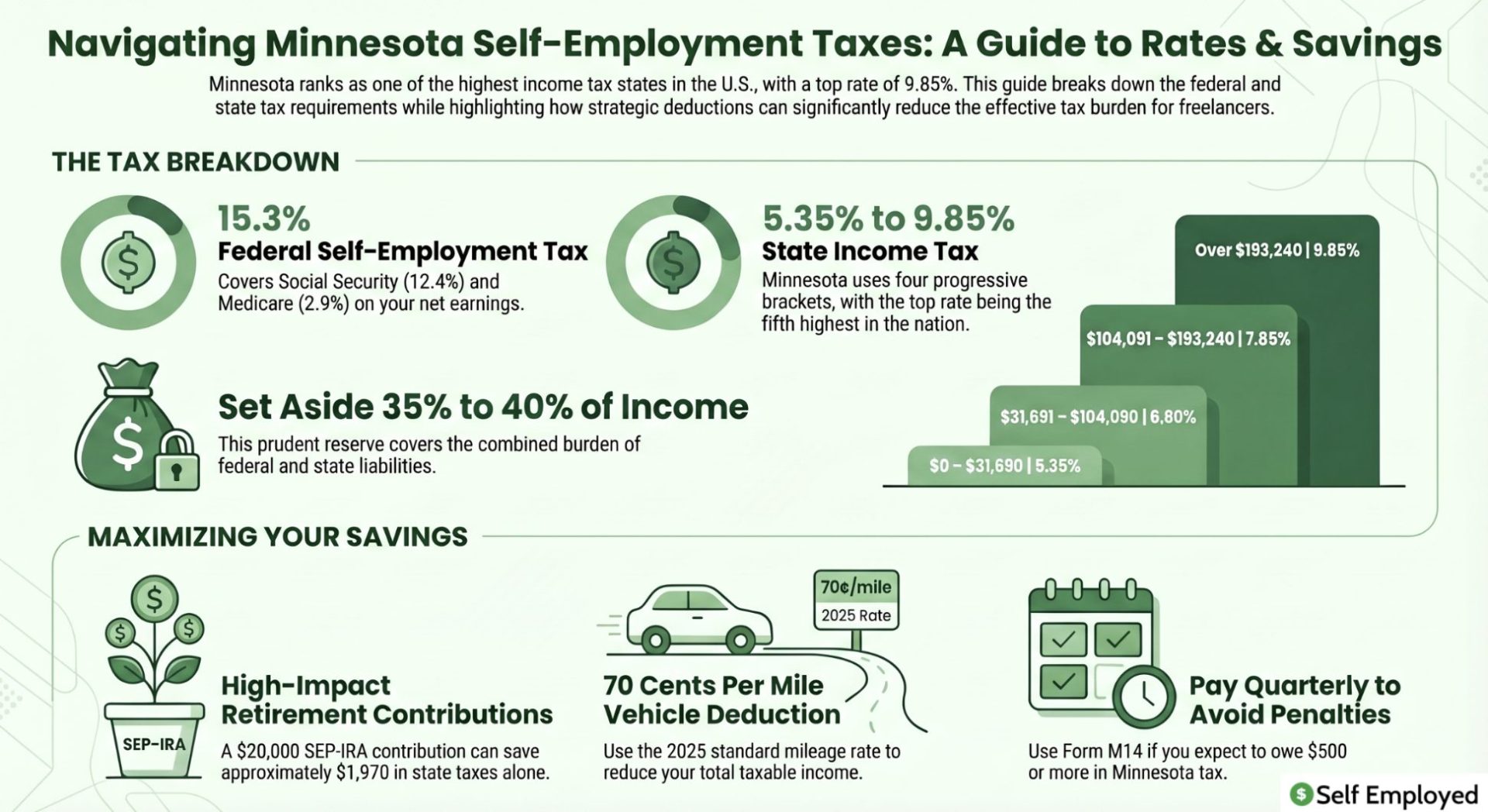
Self-employment tax is the federal tax funding Social Security and Medicare. You pay 15.3%: 12.4% for Social Security (on earnings up to $176,100 in 2025, $184,500 in 2026) and 2.9% for Medicare with no cap. An additional 0.9% surtax applies above $200,000 for single filers. You can deduct 7.65% from your federal AGI. Minnesota does not impose a separate state SE tax.
Minnesota State Income Tax for the Self-Employed
Progressive Tax Brackets
Minnesota has four brackets with rates from 5.35% to 9.85% for 2025:
| Taxable Income (Single) | Minnesota Rate |
|---|---|
| $0 – $31,690 | 5.35% |
| $31,691 – $104,090 | 6.80% |
| $104,091 – $193,240 | 7.85% |
| Over $193,240 | 9.85% |
Minnesota’s 9.85% top rate is the fifth highest in the nation. The standard deduction follows federal amounts. Minnesota does not have local municipal income taxes.
Filing Requirements
File using Form M1. Filing deadline is April 15. Estimated payments required if you expect to owe $500 or more. Use Form M14.
How to File Self-Employment Taxes in Minnesota
Federal filing uses Schedule C, Schedule SE, and Form 1040. For Minnesota, file Form M1. Estimated payments use Form M14.
Quarterly Estimated Tax Payments in Minnesota
| Payment Period | Due Date |
|---|---|
| January 1 – March 31 | April 15 |
| April 1 – May 31 | June 15 |
| June 1 – August 31 | September 15 |
| September 1 – December 31 | January 15 of the following year |
Tax Deductions and Credits for Minnesota’s Self-Employed
Deductions provide outsized benefits in Minnesota because of the high state rates. The 50% SE tax deduction, home office deduction, health insurance premiums, retirement contributions (SEP-IRA up to 25%, Solo 401k), business expenses, and vehicle mileage at 70 cents per mile all reduce both federal and Minnesota liability.
At Minnesota’s 9.85% top rate, a $20,000 retirement contribution saves $1,970 in state taxes alone.
| Deduction Category | Details |
|---|---|
| Self-Employment Tax Deduction | 50% of SE tax, reduces AGI at both levels |
| Home Office | Simplified: $5/sq ft (max $1,500) or actual expenses |
| Health Insurance Premiums | Medical, dental, vision, long-term care |
| Retirement Contributions | SEP-IRA (up to 25% of net SE income), Solo 401(k) |
| Business Expenses | Supplies, software, advertising, professional fees |
| Vehicle/Mileage | 70 cents/mile (2025) or actual vehicle expenses |
Avoiding Common Pitfalls
Underestimating the Combined Burden
Minnesota freelancers face combined rates that can exceed 45% at higher incomes. Setting aside 35% to 40% of each payment is prudent.
Not Maximizing Retirement Contributions
Given Minnesota’s high rates, retirement contributions provide the highest state-level tax savings of almost any state.
Poor Recordkeeping
Organized records are essential for both IRS and Minnesota compliance.
Final Thoughts on Self-Employment Tax in Minnesota
Minnesota’s top rate of 9.85% makes it one of the higher-tax states, but the absence of local income taxes and generous federal deductions that flow through to state make the burden manageable with proper planning. Maximize retirement contributions and take every available deduction.
Frequently Asked Questions
What is Minnesota’s top income tax rate?
9.85% on taxable income exceeding $193,240 for single filers. Four brackets range from 5.35% to 9.85%.
Does Minnesota have local income taxes?
No. Minnesota does not impose local or municipal income taxes.
When are quarterly payments due?
April 15, June 15, September 15, January 15. Threshold: $500 or more. Use Form M14.
What forms do I need?
Federal: Schedule C, Schedule SE, Form 1040. Minnesota: Form M1. Estimated: Form 1040-ES and Form M14.
How much should I set aside?
35% to 40% of net self-employment income for combined federal and state taxes.
What deductions are most valuable?
Retirement contributions provide outsized benefits. A $20,000 SEP-IRA saves approximately $1,970 in state taxes at the 9.85% top rate.


