

Indiana has been quietly building a reputation as one of the most tax-friendly states in the Midwest for self-employed professionals, and having worked with freelancers and independent contractors in Indianapolis, Fort Wayne, and across the state, I have watched the steady reduction of the state income tax rate with great appreciation. The Hoosier State’s flat rate just hit 3.00% for 2025 and will drop even further in coming years. That said, Indiana’s county income tax adds a layer that many newcomers to self-employment do not anticipate. Understanding the full picture, from federal self-employment tax through state and county obligations, is essential for anyone running their own business here.
Self Employment Tax Calculator
What Is Self-Employment Tax in Indiana?
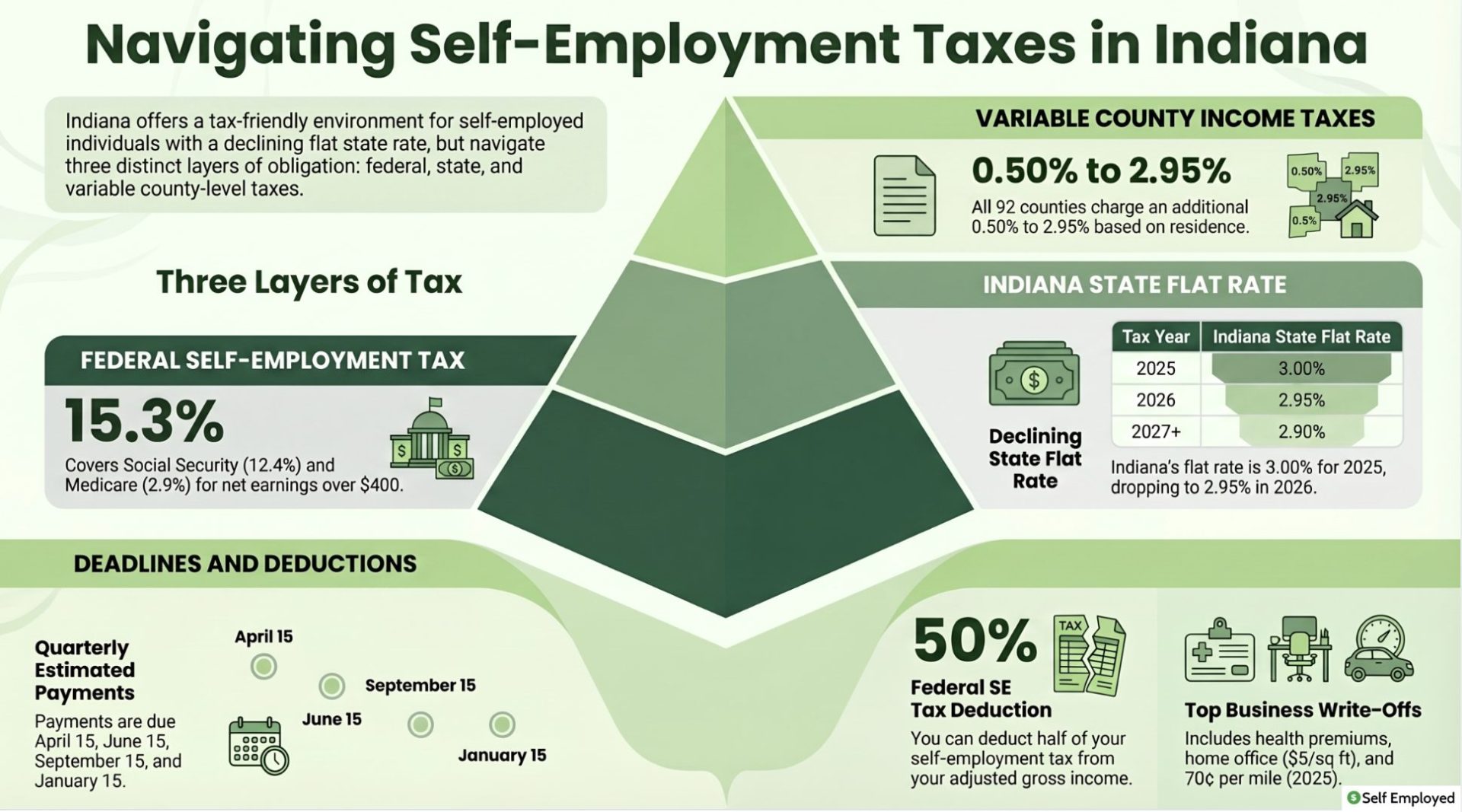
Self-employment tax is the federal tax that independent workers pay to fund Social Security and Medicare. When you work for an employer, the 15.3% combined tax is split evenly between you and your employer at 7.65% each. When you are self-employed, you cover the full 15.3% yourself.
The 15.3% consists of two components. The Social Security portion is 12.4% and applies to net self-employment earnings up to the annual wage base, which is $176,100 for 2025 and increases to $184,500 for 2026. Earnings above those thresholds are exempt from the Social Security portion. The Medicare portion is 2.9% and applies to all net self-employment income with no cap. If your net earnings exceed $200,000 as a single filer or $250,000 filing jointly, an additional 0.9% Medicare surtax applies to income above that threshold.
You can deduct the employer-equivalent portion of your self-employment tax, 7.65%, from your adjusted gross income on your federal return regardless of whether you itemize. You are required to pay self-employment tax and file Schedule SE once your net self-employment earnings reach $400.
Indiana State Income Tax for the Self-Employed
Indiana’s Declining Flat Rate
Indiana uses a flat state income tax that has been steadily declining over the past several years. For tax year 2025, the flat rate is 3.00%. This will drop to 2.95% in 2026 and is scheduled to reach 2.90% in 2027 and beyond, thanks to legislation enacted in 2023 that accelerated the reduction timeline.
| Tax Year | Indiana Flat Rate |
|---|---|
| 2024 | 3.05% |
| 2025 | 3.00% |
| 2026 | 2.95% |
| 2027+ | 2.90% |
Indiana does not impose a separate state-level self-employment tax. Your self-employment income flows through to your Indiana Form IT-40 and is taxed at the same flat rate as all other income.
County Income Taxes: Indiana’s Extra Layer
One aspect of Indiana taxes that catches many self-employed workers off guard is the county income tax. All 92 of Indiana’s counties levy their own local income tax on top of the state rate, with rates ranging from 0.50% to 2.95% depending on the county. This means your effective combined state and county income tax rate can range from about 3.50% to nearly 6.00%.
For example, Marion County (Indianapolis) has a county rate of 2.02%, bringing the combined state and county rate to 5.02% for 2025. Lake County’s rate is 1.50%, while Monroe County charges 1.345%. The county rate is based on where you live as of January 1 of the tax year, not where you perform your work.
County income taxes are reported on the same Indiana Form IT-40 and are calculated as part of your state filing. There is no separate county return to file, which simplifies the process. However, you do need to account for the county rate when calculating your estimated payments. A complete list of current county tax rates is available on the Indiana Department of Revenue website.
How to File Self-Employment Taxes in Indiana
Filing self-employment taxes in Indiana involves coordinating your federal and state returns. On the federal side, you report business income and expenses on Schedule C (Form 1040), which produces your net profit or loss. That net profit carries over to Schedule SE, where your self-employment tax is calculated. The resulting tax is added to Form 1040, and the deductible half is subtracted from your adjusted gross income.
For Indiana, you file Form IT-40, the resident individual income tax return. Your federal adjusted gross income is the starting point, and Indiana allows certain additions and deductions to arrive at state adjusted gross income. The flat state rate and your county rate are both applied on this form. Indiana’s filing deadline aligns with the federal deadline of April 15.
If you received $600 or more from any single client, that client should provide a Form 1099-NEC. Maintain organized records of all income. Indiana supports electronic filing through its INtax system and INfreefile program.
Quarterly Estimated Tax Payments in Indiana
Self-employed individuals must make estimated tax payments throughout the year. At the federal level, payments are required if you expect to owe $1,000 or more. Indiana requires estimated payments if you expect to owe $1,000 or more in combined state and county income tax after withholding and credits.
| Payment Period | Due Date |
|---|---|
| January 1 – March 31 | April 15 |
| April 1 – May 31 | June 15 |
| June 1 – August 31 | September 15 |
| September 1 – December 31 | January 15 of the following year |
When calculating your quarterly payments, remember to include both the state rate and your county rate. For example, if you live in Marion County, you would apply a combined rate of approximately 5.02% to your projected Indiana taxable income. The safe harbor method of paying at least 100% of your prior year’s total tax liability (or 110% if your AGI exceeded $150,000) across four installments protects against underpayment penalties. Use Form 1040-ES for federal payments and Indiana Form ES-40 for combined state and county payments.
Tax Deductions and Credits for Indiana’s Self-Employed
Maximizing your deductions reduces both your federal and Indiana tax liability since the state starts with your federal adjusted gross income. The deduction for 50% of your self-employment tax is automatic and reduces your AGI, benefiting both your federal and Indiana returns.
The home office deduction provides $5 per square foot under the simplified method up to 300 square feet for a $1,500 maximum. The regular method calculates actual expenses based on business-use percentage. Self-employed individuals who pay their own health insurance premiums can deduct medical, dental, vision, and long-term care coverage from AGI.
Retirement contributions through a SEP-IRA (up to 25% of net self-employment earnings) or Solo 401(k) reduce taxable income dollar for dollar. Business expenses including software, advertising, professional development, supplies, and professional fees are fully deductible. Vehicle mileage for business use can be deducted at 70 cents per mile for 2025.
| Deduction Category | Details |
|---|---|
| Self-Employment Tax Deduction | 50% of SE tax, reduces AGI automatically |
| Home Office | Simplified: $5/sq ft (max $1,500) or actual expenses |
| Health Insurance Premiums | Medical, dental, vision, long-term care |
| Retirement Contributions | SEP-IRA (up to 25% of net SE income), Solo 401(k) |
| Business Expenses | Supplies, software, advertising, professional fees |
| Vehicle/Mileage | 70 cents/mile (2025) or actual vehicle expenses |
Avoiding Common Pitfalls
Forgetting County Income Tax in Estimated Payments
The most common mistake Indiana’s self-employed workers make is calculating estimated payments based only on the state rate and forgetting the county income tax. Since county rates can add up to nearly 3% on top of the state rate, this oversight can result in a significant shortfall at filing time and trigger underpayment penalties. Always include your county rate when estimating your quarterly payments.
Using the Wrong Tax Year’s Rate
With Indiana’s state rate changing annually, make sure you use the correct year’s rate. For 2025 estimated payments, use 3.00%; for 2026, use 2.95%. County rates can also change from year to year, so verify your county’s current rate at the beginning of each tax year.
Misclassifying Workers
Worker misclassification is a concern in Indiana’s manufacturing, construction, and logistics industries. If the IRS or Indiana Department of Revenue determines that someone you classified as a contractor is actually an employee, you could face back taxes, penalties, and interest. The determination hinges on the degree of control over the work.
Poor Recordkeeping
Maintain organized records of all income and expenses. Keep receipts, maintain mileage logs, and track income from all sources. Separate business and personal bank accounts to create a clear audit trail.
Final Thoughts on Self-Employment Tax in Indiana
Indiana’s steadily declining flat state income tax rate, dropping from 3.00% in 2025 to 2.90% by 2027, makes the Hoosier State increasingly attractive for self-employed professionals. The county income tax adds complexity, but the combined state and county burden remains competitive with most of the country. Federal deductions for self-employment tax, health insurance, home office, and retirement contributions provide meaningful savings on both your federal and state returns. Stay current on your estimated payments, account for your county rate, and keep thorough records, and you will be well positioned to manage your tax obligations effectively.
Frequently Asked Questions
What is self-employment tax in Indiana?
Self-employment tax in Indiana is the federal tax that independent workers pay to fund Social Security and Medicare. The rate is 15.3% of net self-employment earnings, split between 12.4% for Social Security (on income up to $184,500 in 2026) and 2.9% for Medicare on all earnings. Indiana does not impose a separate state-level self-employment tax, but self-employment income is subject to the state’s flat 3.00% rate for 2025 plus applicable county income tax.
What is Indiana’s income tax rate?
Indiana’s flat state income tax rate is 3.00% for 2025 and will drop to 2.95% in 2026. In addition, all 92 Indiana counties levy their own income tax at rates ranging from 0.50% to 2.95%, which is reported on the same state return. The combined state and county rate ranges from about 3.50% to nearly 6.00% depending on where you live.
When are quarterly estimated tax payments due in Indiana?
Quarterly estimated payments are due on April 15, June 15, September 15, and January 15 of the following year. These dates apply to both federal (Form 1040-ES) and Indiana (Form ES-40) estimated payments. Indiana requires estimated payments if you expect to owe $1,000 or more in combined state and county tax after withholding and credits.
Does Indiana have county income taxes?
Yes. All 92 Indiana counties levy their own income tax on top of the state rate, with rates ranging from 0.50% to 2.95%. The county rate is based on your county of residence as of January 1 of the tax year. County taxes are reported on the same Indiana Form IT-40 and included in your estimated payments.
Self-Employment Tax Guides by State
- Check out self-employment tax rates for Maryland
- See the self-employment tax guide for Nevada
- Learn about self-employment taxes in Oklahoma
- Explore self-employment tax rates in Washington
- View the self-employment tax guide for Connecticut
What deductions can I claim as a self-employed person in Indiana?
Self-employed individuals in Indiana can deduct 50% of self-employment tax, health insurance premiums, home office expenses, retirement contributions to a SEP-IRA or Solo 401(k), business vehicle mileage at 70 cents per mile for 2025, and ordinary business expenses. These federal deductions reduce your adjusted gross income, which also lowers your Indiana state and county tax liability.


