


After helping hundreds of aspiring entrepreneurs launch ventures from their kitchens, spare bedrooms, and coffee shops, I can tell you definitively: you don’t need capital to start a business without money. What you do need is creativity, strategy, and a willingness to leverage what you already have. This guide walks you through proven methods for launching a profitable business with zero startup costs.
Why starting a business without money is actually possible
The biggest myth about entrepreneurship is that you need thousands (or millions) to get started. In reality, some of the most successful businesses today—from Airbnb to Instagram—started with minimal capital. The entrepreneurs focused on solving problems first, then monetizing them later.
When you start a business without money, you’re forced to be resourceful. You prioritize essentials over luxuries. You leverage free tools instead of expensive software. You build an audience before hiring staff. This constraint often leads to leaner, more sustainable businesses than those funded by venture capital.
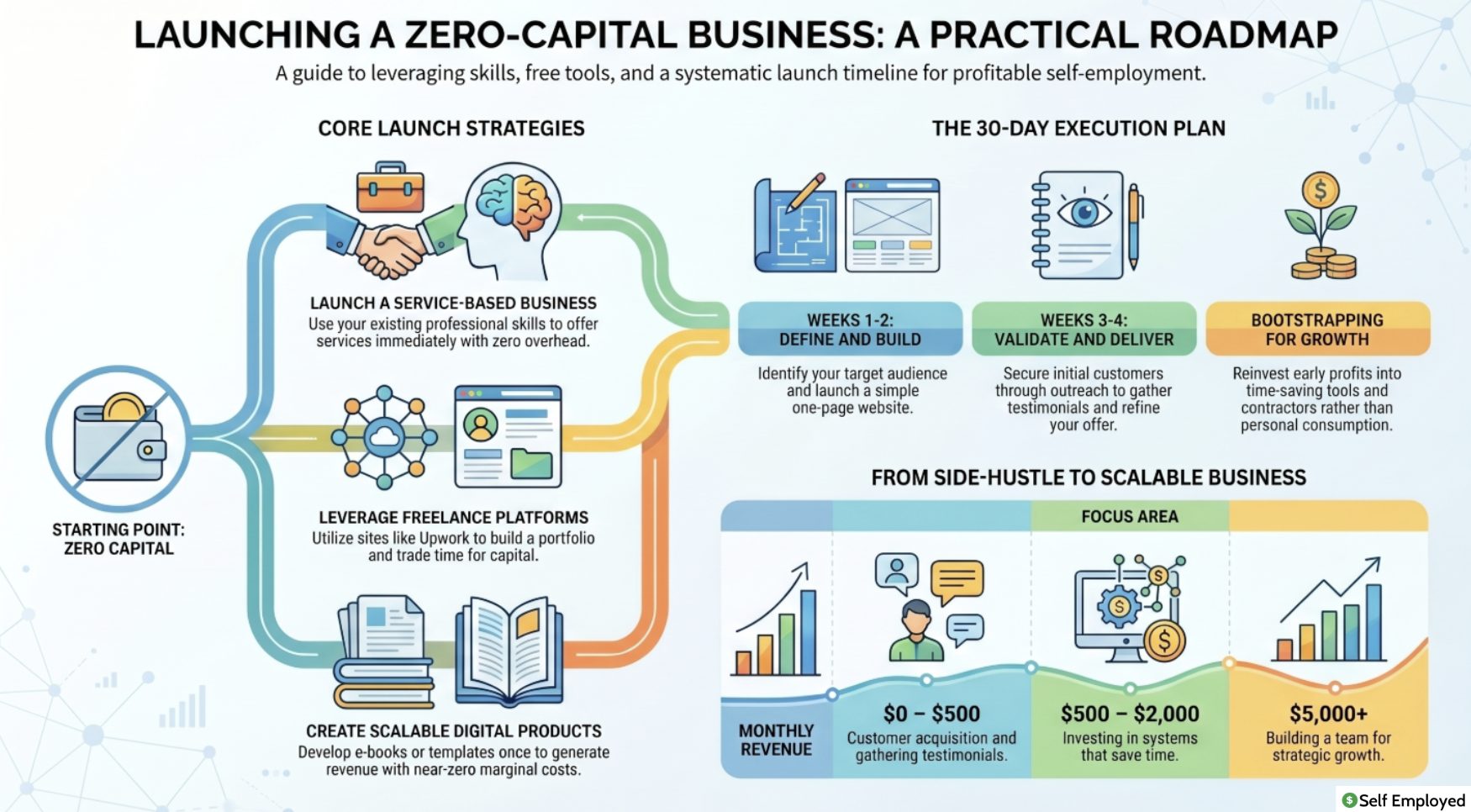
Method 1: Launch a service business
Service businesses are the easiest path if you want to start without capital. You already have the primary asset—your skills and time. Whether you’re a writer, designer, marketer, accountant, or consultant, you can begin offering services immediately.
Getting started:
- Create a simple one-page website using free tools like Wix or WordPress.com
- Write a clear description of what you offer and who you serve
- List 3-5 service packages with transparent pricing
- Use free project management tools like Asana or Monday.com to organize client work
- Start outreach to warm leads—friends, former colleagues, online communities
Service businesses let you validate demand before investing heavily. If no one wants your services, you lose only time. If demand exists, you can systematically improve and raise rates.
Related: Read our guide on self-employment ideas for specific service niches that require minimal overhead.
Method 2: Freelance your expertise
Freelancing bridges the gap between employment and full business ownership. You’re still trading time for money initially, but building toward productized offerings and passive income. Platforms like Upwork, Fiverr, and Freelancer let you start immediately with zero barrier to entry.
Your action plan:
- Set up profiles on 2-3 major freelance platforms
- Create a portfolio showcasing your best work (even if it’s personal projects)
- Write compelling service descriptions using your target keywords
- Start bidding on projects in your expertise area
- Over-deliver on early projects to build reviews and ratings
Freelancing provides steady income while you build a personal brand and recurring client base. Many entrepreneurs transition from freelancing to running an agency—which simply means hiring other freelancers to deliver work while you manage relationships and operations.
Method 3: Create and sell digital products
Digital products—courses, templates, e-books, plugins, themes—have near-zero marginal costs. Create once, sell infinitely. You can start building an audience and promoting digital products today using entirely free tools.
Zero-cost digital product ideas:
- E-books or guides: Write in Google Docs, convert to PDF, sell through Gumroad or SendOwl
- Email courses: Use ConvertKit’s free tier to build an audience and deliver educational content
- Video tutorials: Record with free tools like OBS, upload to YouTube, embed on your site
- Templates or spreadsheets: Create in Google Sheets or Docs, sell through Etsy or your own site
- Canva templates: Design templates and sell them directly through Canva’s Creator Marketplace
The challenge with digital products isn’t creation—it’s marketing. Focus on building an audience first through content marketing, social media, and email. Once you have 1,000+ interested people, you can launch a product with reasonable confidence.
Method 4: Leverage free tools and resources
Before paying for expensive software subscriptions, exhaust all free alternatives. Many world-class tools offer generous free tiers specifically designed for bootstrapped businesses and solopreneurs.
Essential free tools for zero-capital startups:
- Website: WordPress.org, Wix, Carrd, or Webflow
- Email marketing: Mailchimp, ConvertKit, or Brevo (formerly Sendinblue)
- Scheduling and automation: Zapier, Make, or IFTTT
- Design: Canva, Figma, or Pixlr
- Video editing: DaVinci Resolve, Shotcut, or CapCut
- Project management: Asana, Notion, or Trello
- Accounting: Wave Accounting (completely free for small businesses)
- Social media management: Buffer, Later, or Later.com’s free plan
As your business grows and revenue increases, you can upgrade to paid plans. But most bootstrapped businesses can operate profitably using entirely free tools for their first 1-2 years.
Method 5: Master bootstrapping and resourcefulness
Bootstrapping means building your business using revenue from customers rather than external investment. This forces discipline and profitability from day one—which is actually a strength, not a limitation.
Bootstrapping strategies:
- Start small: Offer a limited service or product, perfect execution, then expand
- Barter and trade: Exchange your services for things you need (website design for accounting help)
- Use what you have: A laptop, phone, and internet connection are sufficient to start most online businesses
- Build in public: Share your journey on social media—it attracts customers and partners
- Reinvest profits: Every dollar earned goes back into growth, not personal consumption
- Collaborate: Partner with complementary businesses to reach new audiences
Related: Learn the detailed mechanics of managing finances in our self-employed bookkeeping guide.
Method 6: Build strategic partnerships and affiliate programs
You don’t need to build everything yourself. Strategic partnerships and affiliate relationships can accelerate your business with zero capital investment.
Partnership approaches:
- Affiliate marketing: Promote other people’s products and earn commissions with zero upfront cost
- White label or reselling: Partner with service providers to offer their solutions under your brand
- Joint ventures: Collaborate with complementary businesses to cross-promote and share resources
- Content partnerships: Guest post on established blogs to reach audiences and build authority
Check out our comprehensive guide on high-ticket affiliate programs for specific programs that offer meaningful commissions in your niche.
How to scale your no-money startup
Starting without capital is one challenge; scaling is another. But the same principles apply: focus on revenue, reinvest profits, and be strategic about spending.
Scaling milestones:
- $0-$500/month: Optimize for customer acquisition and testimonials
- $500-$2,000/month: Invest in tools and systems that save you time
- $2,000-$5,000/month: Consider hiring contractors for repetitive tasks
- $5,000+/month: Build a small team and focus on strategic growth
Each tier of growth unlocks different possibilities. A $500/month business can afford one $50 tool subscription. A $5,000/month business can hire its first contractor. This incremental approach prevents overspending and ensures sustainability.
Common mistakes when starting a business without money
Avoid these traps:
- Perfectionism: Waiting for a perfect website, logo, or product before launching. Launch imperfectly and improve with real feedback.
- Wrong focus: Spending time on things that don’t generate revenue. Every decision should move you toward customer acquisition or product improvement.
- No differentiation: Competing on price when you have no capital. Instead, focus on unique positioning, better service, or solving a specific problem.
- Ignoring legal fundamentals: Even bootstrapped businesses need basic legal structures. Check the Small Business Administration for free resources on business formation and regulations.
- Tax confusion: Keep detailed records from day one. See IRS guidance on self-employed tax obligations.
Your first steps: a 30-day action plan
Don’t overthink this. Here’s exactly what to do in your first month:
Week 1: Define your offer and identify your first 10 ideal customers. Who do you know that has the problem you solve?
Week 2: Build a simple online presence. One landing page. One clear call-to-action. One way for people to contact you.
Week 3: Reach out to 10 potential customers. Offer your service at a discount in exchange for testimonials and referrals.
Week 4: Deliver exceptional work. Collect testimonials. Refine your offer based on feedback.
By the end of month one, you should have 1-3 paying customers and clear evidence of market demand. Everything else builds from there.
FAQ: Starting a business without money
Can you really start a business without any money?
Yes. The only absolute requirement is internet access and a device (which you likely already have). You can start a service business, freelance business, or digital product business with zero capital. Your time and skills are the investment.
How long before a no-money startup becomes profitable?
Most bootstrapped businesses see their first sale within 30-60 days if you’re actively marketing. Profitability—where revenue exceeds your time investment at a reasonable hourly rate—typically takes 3-6 months. Full-time viability (where you can quit your job) usually takes 12-18 months of consistent effort.
What’s the easiest type of business to start without money?
Service businesses are easiest because you’re selling existing skills. Freelancing on platforms like Upwork lets you start within days. The hardest are physical product businesses, which require inventory costs. Digital products fall somewhere in between—free to create but expensive to market.
Do I need a business license or LLC to start?
Requirements vary by location, business type, and revenue. Many bootstrapped businesses operate as sole proprietorships initially (no formation needed). Consult your local Small Business Administration office or a business attorney for specific guidance in your area.
How do I validate demand for my business idea before investing?
Talk to potential customers before building anything. Post in relevant online communities asking about their pain points. Offer a minimum viable version of your product at a low price. If people are willing to pay, even a small amount, demand is real. If not, you’ve avoided wasting time and money.
What if I fail? What’s the risk?
If you start without capital, the worst-case scenario is you lose time and learn valuable lessons. You don’t lose money. Contrast this with traditional startups: if you invest $50,000 and fail, you’ve lost $50,000. The zero-capital approach is actually the lowest-risk path to entrepreneurship.
Can I work a full-time job while building a no-money business?
Absolutely. Many successful entrepreneurs start while employed, using evenings and weekends to build their business. This approach reduces financial stress and lets you validate the idea before quitting your job. Once revenue reaches a meaningful level (ideally 30-50% of your employment income), consider transitioning to full-time entrepreneurship.
Which free tools should I prioritize first?
Start with: a simple website (Carrd or WordPress.com), email marketing (Mailchimp), and a way to get paid (Stripe or PayPal). Those three cover most foundational needs. Add project management and design tools as you take on more work.
The bottom line
Starting a business without money is not just possible—it’s increasingly common and often the smarter path. You avoid debt, you maintain flexibility, and you build a sustainable business rather than one dependent on continuous external funding.
The constraint of zero capital forces you to be creative, to focus on what truly matters, and to validate ideas quickly. Every successful entrepreneur started somewhere, and many started with nothing but an idea and determination.
Your competitive advantage isn’t money—it’s speed, resourcefulness, and the willingness to do things that don’t scale initially. Start today. Launch imperfectly. Learn from customers. Scale systematically.
The business you want to build is waiting. You already have everything you need to begin.


