

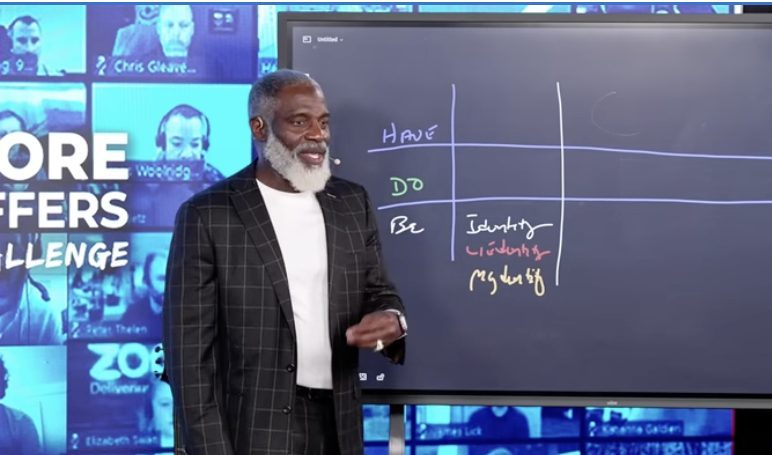
The be do have formula is the simplest explanation I have found for why hard-working people stay stuck. Most of us chase results first, copy the actions of successful people second, and barely think about identity at all. Myron Golden flips that order, and the shift is what makes the be do have formula actually work.
I have spent the last year pressure-testing this framework in my own solo business and with creators I coach. The pattern is the same across every case. When identity moves first, action follows, and results show up with far less friction than before.
What the be do have formula really means
Golden’s teaching reframes a popular idea. Most people try to have first, so they copy what successful people do, and hope that eventually they become someone new. The be do have formula runs the sequence in the opposite direction.
You begin with who you are becoming. Then your actions adjust to match the new identity. Only after that does your outer life catch up with results, money, and influence.
It sounds abstract, but the mechanics are concrete. The be do have formula says the input, not the output, is where change begins. If you want a different output, change the input. In this case, the input is identity.
Why the backward approach keeps failing
We have all heard the advice, “If what you are doing is not working, try harder.” Golden calls this one of the worst pieces of advice possible. Pouring more effort into an approach that has already proven not to work is not persistence, it is just volume.
Most people focus on the having part first. They want the income, the audience, the recognition. When those things do not arrive, they examine what successful people are doing and try to copy those actions.
The problem is that the actions only work once you are the kind of person who takes them naturally. This is why the be do have formula starts with being. You cannot reliably do what a top operator does until you have become the kind of operator who can.
Identity as the foundation
According to Golden, one of our biggest problems is not knowing who we truly are. Most of us operate from what he calls a “lie-dentity,” a collection of everything people told us we were not: not smart enough, not talented enough, not disciplined enough.
In response, many of us create a “my-identity,” a performance identity designed to prove we are better than the labels we rejected. It feels like confidence, but it is really pressure. We spend our lives trying to disprove something rather than building from something real.
The be do have formula pulls identity out of that tug-of-war. Golden argues that your true identity comes from a source outside the crowd of opinions you have absorbed. When you stop trying to prove anything, your daily actions quiet down and get more accurate.
For solo operators, that shift is especially useful. Most of us work without a boss or team to validate us. An identity anchored in self-knowledge, rather than audience reaction, is more stable over the long grind of building a business.
The three gaps inside the be do have formula
Each layer of the framework has a gap between current state and potential. Golden names three of them and maps a specific tool to each.
- The being gap sits between who you think you are and who you actually are. You close it with intentionality.
- The doing gap sits between what you are currently doing and what you could be doing. You close it with ingenuity.
- The having gap sits between what you currently have and what you could have. You close it with intensity.
This ordering matters. The be do have formula treats intentionality as the master key because it unlocks everything downstream. Without a clear sense of who you are becoming, ingenuity and intensity often get aimed at the wrong target.
Intentionality: the master key
Golden believes the biggest distinction between people who succeed and people who struggle is focus. Successful people hyperfocus on intention and ignore distraction. Struggling people do the opposite.
The line is simple. Intention is anything that moves the needle in favor of your purpose, productivity, or profit. Distraction is anything that does not. The be do have formula lives or dies on your willingness to notice the difference in real time.
In my own work, this shows up as a kind of daily filter. Before I start a task, I ask whether it moves my identity forward. If the answer is no, the task gets deferred or deleted, not rescheduled.
The disruption that always follows intention
One of the most valuable insights in the be do have formula is that disruption always follows intention. When you start taking new actions because you are becoming new, the first thing you will feel is friction.
This explains why so many people quit right before a breakthrough. They read the disruption as evidence they chose the wrong path, when it is actually confirmation they are growing. Golden shares that he went 18 months without making a single sale when he started in sales.
He kept refining his approach through ingenuity and eventually became the top salesperson in his office month after month. The difference was that he ran out of the ways that would not work. All he had left were the ways that would.
Most people do not go through enough iterations of anything to discover the thing that works. The be do have formula gives you the identity stability to keep iterating when results are slow.
Momentum and the compounding effect
As you become more intentional about identity and more ingenious in activity, momentum starts to build. Your being gains positive momentum first, which eventually affects your doing, and finally transforms your having.
This does not happen overnight. It asks for patience and persistence. As Golden’s friend likes to say, “Eventually is undefeated.”
The ultimate goal inside the be do have formula is not to be better than others. It is to be better than you have ever been, perpetually. That is how you become the best of the best in whatever arena you choose.
How solo operators can apply the be do have formula this week
If you want the be do have formula to stop being a mindset post and start being a business tool, three moves will get you further than reading another book.
- Name the identity. Write one sentence in the present tense that describes who you are becoming. Not your job title, your posture.
- Audit last week’s calendar. Mark every block as intention or distraction. Most people find 30 to 50 percent of their week is distraction disguised as work.
- Pick the smallest next action that only your new identity would take. Schedule it. Do it. Repeat.
If you want deeper context on how mindset ties to concrete growth, our breakdown on how consistency drives success walks through the compounding side of this system. For the action side, see our guide on focus quotes for business success for daily prompts that keep intention top of mind.
Where the formula fits in a bigger business system
The be do have formula is not a replacement for strategy. It is the layer beneath strategy that decides whether you actually execute. Treat it as the identity operating system, and put your tactics on top.
For a snapshot of what a modern creator stack looks like once the identity work is in place, see our overview of why content creators need to embrace digital products. For sustained growth thinking from an outside source, Forbes Coaches Council has a useful piece on three keys to professional and personal development that pairs well with the framework. The Harvard Business Review research archive offers additional rigor on behavioral change for founders who want the academic view.
Common mistakes when applying the be do have formula
Three failure patterns show up again and again in readers who email me about this framework. Knowing them in advance saves months.
The first mistake is starting with doing. People try to copy the actions of someone three levels above them and burn out inside a month. The be do have formula says become first, then act.
The second mistake is quitting at the disruption point. Early results often feel worse than baseline because you are dismantling old patterns. If you expect the dip, you keep going.
The third mistake is rushing to having. Trying to measure identity work by weekly income is like weighing yourself hourly. The scale is too noisy for that kind of resolution.
Final take on the be do have formula
The be do have formula is not just another success strategy. It is a paradigm shift that aligns with how human beings actually change. When the order is right, everything downstream gets easier.
I am implementing these principles in my own business and focusing first on who I am becoming rather than what I am doing or what I want to have. The results that seemed impossible before are starting to show up, quietly, the way Golden predicts.
Frequently asked questions
How is the be do have formula different from other success frameworks?
Most success frameworks focus primarily on actions and results. The be do have formula treats sustainable success as an identity-first process and argues you cannot consistently do what success requires until you have become the person who takes those actions naturally.
What does Myron Golden mean by “lie-dentity”?
A lie-dentity is the false self-concept built from negative messages you absorbed over time. Golden argues that it caps potential and must be replaced with a true identity before the be do have formula can produce real change.
How long does it typically take to see results?
Timelines vary, but Golden emphasizes that identity shifts come first, activity changes follow, and visible results trail both. Small wins often show up quickly, while major breakthroughs tend to arrive after months of consistent application.
Can the be do have formula be applied to any area of life?
Yes. The framework works in business, relationships, health, skill development, and broader personal growth. The principles of identity transformation, intentional action, and persistent refinement apply wherever meaningful achievement is the goal.
What is the most common mistake people make with this formula?
The most common mistake is trying to start with doing rather than being. People force themselves into actions they cannot yet sustain because they skipped the identity layer, and they often quit at the disruption phase that follows any new intention.
Is the be do have formula religious?
Golden’s teaching has spiritual roots, but the framework itself works for anyone willing to anchor identity in a source outside peer opinion. Solo operators often adapt it using values, mission, or chosen principles as their anchor.
How do I know if I am making progress?
Track inputs before outputs. Measure how many decisions each week came from your new identity versus the old one. Over time, the ratio shifts, and the be do have formula starts producing the external results you originally wanted.


