

In my years analyzing consumer markets and working with small business owners, I’ve discovered that non durable goods represent one of the most accessible yet consistently profitable sectors for self-employed professionals. Non durable goods are products designed to be used up or wear out quickly, typically within a year or less, and they’re everywhere in our daily lives. From food and beverage to toiletries and cleaning supplies, these essential items generate trillions in annual revenue. Understanding this market isn’t just interesting from an economic perspective, it’s a practical way to identify business opportunities that align with fundamental consumer needs.
What are non durable goods?
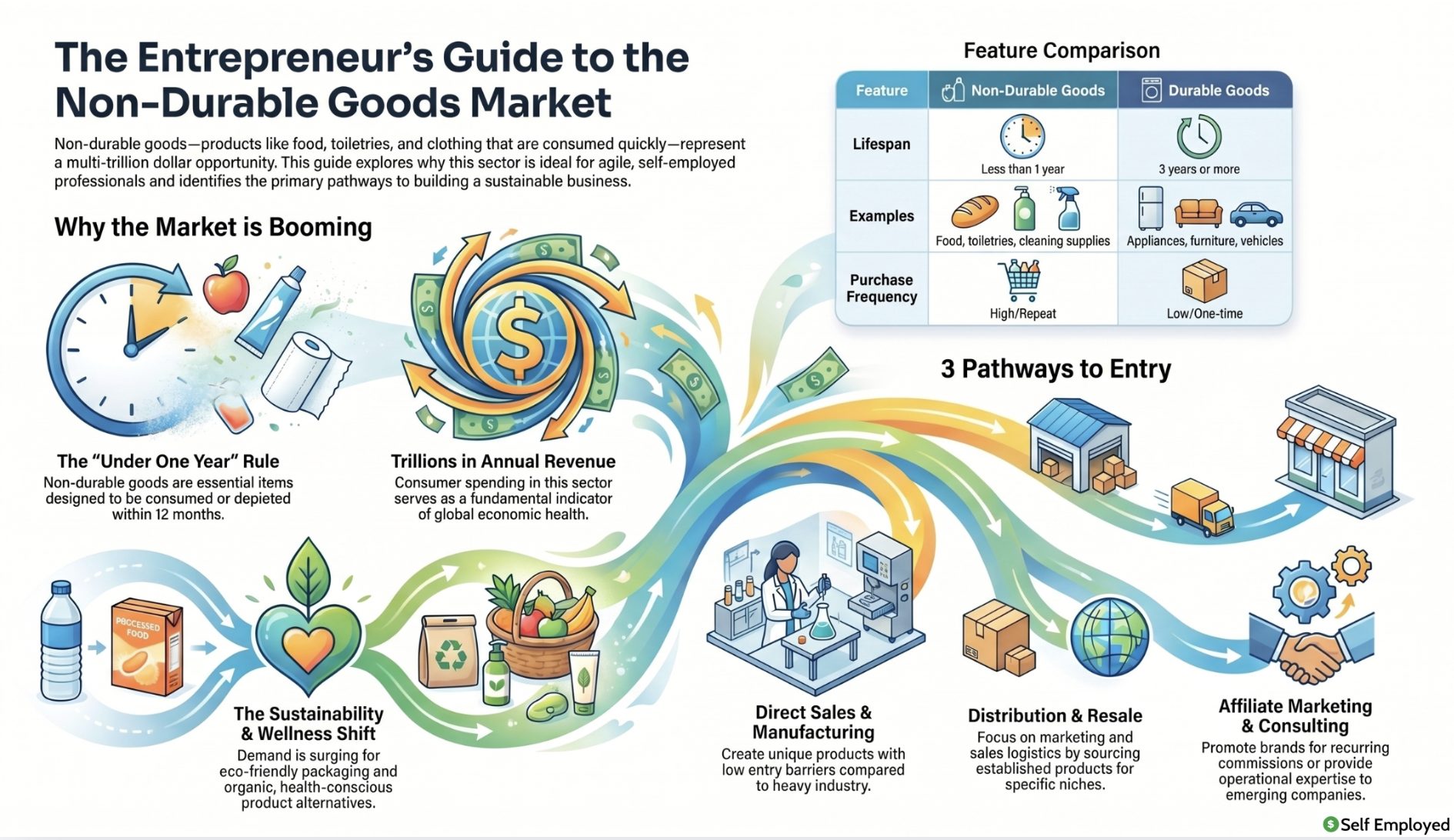
Non durable goods differ fundamentally from durable goods in one key way: longevity. While durable goods like appliances or furniture are meant to last for years, non durable goods are consumed or depleted relatively quickly. This category includes food and beverages, personal care products, clothing, tobacco products, pharmaceuticals, and paper goods. From what I’ve seen working directly with entrepreneurs, this distinction matters because it affects everything from inventory management to profit margins to customer acquisition strategies.
The non durable goods sector is massive. According to the U.S. Census Bureau, consumer spending on non durable goods represents a significant portion of overall retail activity, making it a fundamental indicator of economic health. When consumers reduce spending on non durable goods, it signals economic concern. When spending increases, it suggests confidence and stability in the market.
Market trends shaping non durable goods today
The non durable goods market is undergoing several meaningful transformations that create opportunities for savvy entrepreneurs. The shift toward e-commerce has fundamentally changed how non durable goods reach consumers. In the past, these products were primarily distributed through traditional retail channels. Today, subscription services, direct-to-consumer brands, and online marketplaces have disrupted the entire supply chain.
Sustainability is another powerful trend reshaping the sector. I’ve noticed consumers increasingly prefer eco-friendly options, from biodegradable packaging to sustainably sourced ingredients. This preference creates premium pricing opportunities and differentiates new entrants from established competitors. Brands that emphasize environmental responsibility often command higher margins and build stronger customer loyalty.
Health and wellness consciousness continues to drive market innovation. The demand for organic food products, natural personal care items, and allergen-free options has created entirely new subcategories within the non durable goods space. According to the Bureau of Labor Statistics, spending on these premium products has grown consistently over the past decade, outpacing conventional product categories.
Personalization and customization represent another growth area. From customized supplements to personalized skincare regimens, consumers increasingly want products tailored to their specific needs. This trend supports smaller, agile businesses that can move quickly and respond to niche demands better than large corporations.
Business opportunities in non durable goods
The non durable goods market offers several distinct pathways for self-employed professionals. First, there’s the direct sales or manufacturing route, where you create and sell your own products. This might involve developing a unique food product, formulating skincare items, or sourcing specialty goods and selling them through multiple channels. The barrier to entry is relatively low compared to durable goods manufacturing, and you can start small with a dropshipper or small production batch.
Second, there’s the distribution and resale opportunity. Many self-employed professionals find success by identifying promising non durable goods from manufacturers and building a sales infrastructure around them. This requires less capital than manufacturing and lets you focus on sales and marketing rather than production logistics. You might specialize in a particular customer segment or geographic region to build sustainable competitive advantages.
Third, consider affiliate marketing and promotion within the non durable goods space. If you have an audience interested in health, lifestyle, beauty, or wellness, you can recommend and promote non durable goods from established brands. Many companies offer generous affiliate commissions on non durable products because the high repeat purchase rate means customers will continuously return for more. If you’re interested in this path, my guide on high-ticket affiliate programs explores strategies for building sustainable affiliate income.
Fourth, there are service opportunities adjacent to non durable goods. Consulting with small brands on product development, helping them navigate distribution channels, or managing their supply chains can generate recurring income. Many emerging non durable goods companies lack the operational expertise to scale efficiently, and that’s where your value proposition lives.
Why self-employed professionals excel in this sector
Self-employed professionals have several inherent advantages in the non durable goods space. You can move faster than large corporations, adapt to market changes quickly, and build direct relationships with customers. You also have lower overhead than traditional retail operations, which means you can be profitable at smaller sales volumes.
The nature of non durable goods creates built-in customer loyalty. People need these products regularly, which means you have natural opportunities for repeat sales and long-term customer relationships. This predictability makes it easier to forecast revenue and plan growth compared to businesses selling one-time purchase items.
Many self-employed professionals in this space leverage digital marketing effectively. Because non durable goods appeal to broad demographics, you can build an online presence through content marketing, social media, email campaigns, and paid advertising. The competition may be intense, but so are the rewards for those who execute effectively.
Getting started with a non durable goods business
If you’re considering entry into this space, start by validating your idea. What specific problem does your product or service solve? Who is your target customer? How will you reach them? I’ve found that entrepreneurs who spend time answering these questions thoroughly have significantly higher success rates than those who rush to launch.
Research your competition thoroughly. Visit their websites, examine their packaging, read customer reviews, and understand their pricing strategies. Look for gaps in the market, unmet customer needs, or underserved segments. This competitive analysis often reveals your best opportunities for differentiation.
Consider your supply chain carefully. Whether you’re manufacturing or reselling, understand every step from sourcing to final delivery. Non durable goods often have tight margins, so supply chain efficiency directly impacts profitability. Work with reliable suppliers and build relationships that can support your growth.
If you need guidance on structuring your self-employment operation, my step-by-step guide on self-employment ideas covers foundational business setup. Additionally, managing finances properly from day one is crucial, and my resource on self-employed bookkeeping walks through accounting fundamentals that keep your non durable goods business financially healthy.
Challenges and realistic expectations
I want to be transparent about the challenges. Non durable goods businesses often operate on thin margins, especially if you’re competing with established manufacturers and retailers. You need to find a niche where you can command premium pricing or operate with lower cost structure than competitors.
Inventory management can be complex. You need enough stock to meet demand, but not so much that you’re tying up excessive capital in products that might not sell. Perishable non durable goods add additional complexity around shelf life and spoilage.
Scaling a non durable goods business requires investment. As you grow, you’ll need better production equipment, storage facilities, and distribution infrastructure. Getting funding for growth can be challenging for self-employed entrepreneurs without significant existing assets or track records.
Customer acquisition costs matter significantly. In a competitive market with many alternatives, attracting customers at sustainable costs is crucial to profitability. Your marketing needs to be strategic and measurable.
Making your decision
Non durable goods represent a genuine opportunity for self-employed professionals because they address fundamental human needs. The market is large, the barriers to entry are manageable, and the repeat purchase nature creates natural business sustainability. However, success requires careful planning, market understanding, and operational discipline.
Start by identifying a specific segment or product category that genuinely excites you. Your enthusiasm will sustain you through the inevitable challenges of starting and growing a business. Research thoroughly, validate your assumptions with real customers, and begin small enough to test your model without excessive risk.
The self-employed professionals I’ve known who succeeded in non durable goods didn’t necessarily have more resources than those who failed. They had clearer vision, stronger execution, and genuine understanding of their customers’ needs. That’s a formula you can replicate.
Frequently asked questions
What is the difference between durable and non-durable goods?
Durable goods are designed to last three years or more, like furniture, appliances, and vehicles. Non durable goods are consumed or wear out within a year, including food, toiletries, clothing, and cleaning supplies. This difference fundamentally affects business operations, inventory management, and profit models.
What are examples of non-durable goods?
Examples include food and beverages, personal care products (shampoo, soap, toothpaste), cleaning supplies, paper products, pharmaceuticals, clothing, tobacco products, and cosmetics. Essentially, anything intended for frequent replacement or consumption falls into this category.
Why are non-durable goods important for the economy?
Non durable goods spending reflects consumer confidence and economic health. Because people must purchase these items regularly regardless of economic conditions, they’re more stable than durable goods purchases. The non durable goods market also represents a massive portion of retail activity and employment.
Can a self-employed person start a non-durable goods business?
Absolutely. Self-employed entrepreneurs have several advantages in this sector including lower overhead, faster decision-making, and the ability to serve niche markets. You can start with direct sales, affiliate marketing, distribution partnerships, or product manufacturing depending on your resources and expertise.
What skills do I need to succeed in non-durable goods?
Essential skills include market understanding, customer-centric thinking, supply chain management, marketing and sales, and financial management. You don’t need specialized technical knowledge, but you do need ability to identify unmet customer needs and execute consistently.
How much money do I need to start?
Startup costs vary widely depending on your business model. Affiliate marketing requires minimal investment. Resale businesses might need a few thousand dollars for initial inventory. Manufacturing products typically requires more capital for equipment and materials, but you can start small with artisanal production or dropshipping.
What’s the best way to find suppliers for non-durable goods?
Research manufacturing directories like Alibaba, Thomas Net, or industry-specific supplier networks. Attend industry trade shows and events. Network with other entrepreneurs in the space. Evaluate suppliers based on reliability, quality, pricing, and willingness to work with smaller orders as you establish your business.
How do I know if my non-durable goods business idea is viable?
Validate your idea by directly surveying potential customers about their needs and willingness to pay. Research market size using resources like Census.gov for consumer data and BLS.gov for employment and spending trends. Test your product or service with a small pilot group before full-scale launch.


