

Social Security sent payments to millions of beneficiaries on Wednesday, May 14, 2025. Recipients of retirement, disability, or survivor benefits born between the 1st and the 10th of each month received their monthly payment on that date. The U.S. Social Security Administration (SSA) issues payments to nearly 70 million recipients across retirement, disability, and survivor programs.
Understanding when and how payments arrive matters for budgeting, especially for self-employed workers who rely on Social Security as part of their retirement income. Here is how the payment schedule works, what amounts to expect, and what self-employed people should know about building their benefits.
How the Social Security payment schedule works
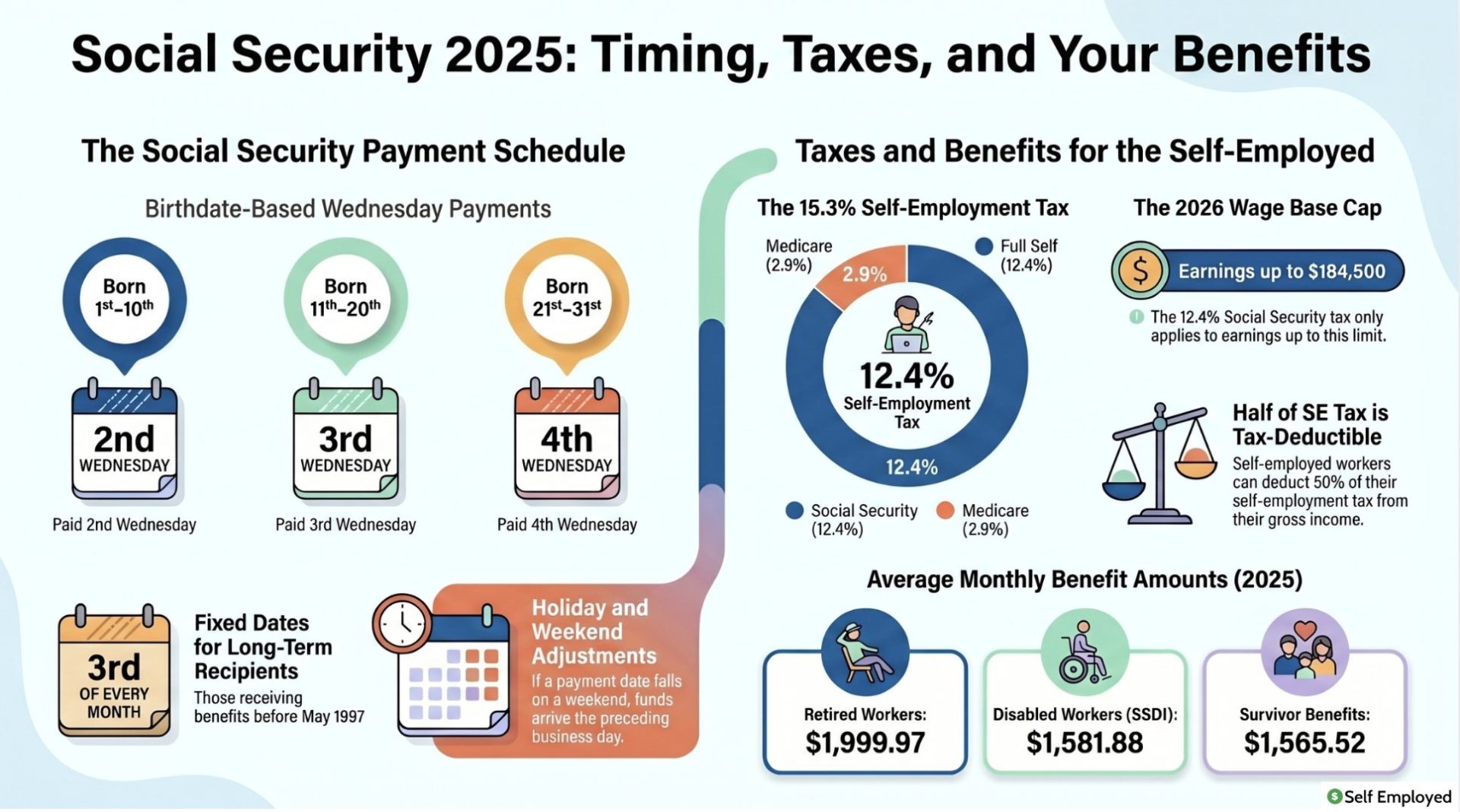
The SSA staggers payments across multiple dates each month to manage distribution efficiently. For most beneficiaries who started receiving benefits after May 1997, the payment date depends on the day of the month they were born.
- 2nd Wednesday of the month: Beneficiaries born on the 1st through the 10th
- 3rd Wednesday of the month: Beneficiaries born on the 11th through the 20th
- 4th Wednesday of the month: Beneficiaries born on the 21st through the 31st
Beneficiaries who began collecting benefits before May 1997 receive payments on the 3rd of each month, regardless of their birthday. When the 3rd falls on a weekend or federal holiday, the payment is issued on the preceding business day.
In May 2025, because May 3 was a Saturday, long-term recipients received their retirement, SSDI, or survivor benefits on Friday, May 2.
SSI payments and dual recipients
Supplemental Security Income (SSI) is a needs-based program separate from regular Social Security. SSI recipients receive payments on the 1st of each month. When the 1st falls on a weekend or holiday, the payment arrives on the preceding business day.
Beneficiaries who receive both SSI and regular Social Security (retirement, SSDI, or survivor benefits) typically get SSI on the 1st and the other benefit on the 3rd each month. Dual recipients in May 2025 received their SSI on May 1 and their other Social Security benefit on May 2 (because May 3 was a Saturday).
Average Social Security payment amounts in 2025
Social Security benefit amounts vary based on lifetime earnings, the age at which you claim benefits, and annual cost-of-living adjustments (COLAs). A 2.5% COLA took effect in January 2025.
Average monthly Social Security payments for 2025 are as follows. Retired workers receive an average of $1,999.97 per month. Disabled workers (SSDI) receive an average of $1,581.88 per month. Survivor benefits average $1,565.52 per month. SSI recipients receive an average of $717.87 per month.
The maximum Social Security benefit for a worker retiring at full retirement age in 2025 is $4,018 per month. Workers who delay claiming until age 70 can receive even more, up to $5,108 per month, because benefits grow by 8% for each year past full retirement age that you delay.
Social Security and self-employed workers
Self-employed workers have a distinct relationship with Social Security that affects both how much they pay in and what they can expect to receive.
While employees split Social Security and Medicare taxes with their employer, self-employed individuals pay the full 15.3% self-employment tax themselves. Of that, 12.4% goes toward Social Security and 2.9% toward Medicare. On the upside, you can deduct half of your self-employment tax from gross income when calculating your federal income tax, which partially offsets the higher burden.
Your Social Security benefits in retirement are calculated based on your earnings record. For self-employed workers, this means accurately reporting all self-employment income each year is essential. Under-reporting income reduces your future Social Security benefits. The Schedule SE tax form is what you file each year to calculate and report self-employment tax to the IRS.
The 2026 Social Security wage base is $184,500, meaning the 12.4% Social Security portion of self-employment tax applies only to earnings up to that threshold. The 2.9% Medicare portion applies to all self-employment income, with an additional 0.9% surtax on earnings above $200,000 for single filers.
How to check your Social Security record
The SSA’s online portal at ssa.gov lets you create a free My Social Security account. From there, you can review your full earnings history, see estimated future retirement and disability benefits, download proof-of-benefits letters, and update direct deposit information.
For self-employed workers, reviewing the earnings record annually is a good practice. Each year’s self-employment income reported to the IRS should appear in your SSA record, confirming your contributions are being credited correctly. Errors are easiest to fix close to when they occur, rather than years later when records may be harder to locate.
You can also use the SSA’s online benefits calculators to model different claiming scenarios and see how working additional years or delaying your claim affects projected monthly payments.
Frequently asked questions
When does Social Security pay benefits each month?
Most Social Security beneficiaries receive payments on one of three Wednesdays each month, based on birthday. Those born on the 1st-10th are paid on the 2nd Wednesday; the 11th-20th on the 3rd Wednesday; and the 21st-31st on the 4th Wednesday. People who began receiving benefits before May 1997 are paid on the 3rd of each month regardless of birthday.
How much is the average Social Security check in 2025?
The average monthly Social Security retirement check in 2025 is $1,999.97. Disabled workers (SSDI) receive an average of $1,581.88 per month, survivor benefits average $1,565.52 per month, and SSI recipients receive an average of $717.87 per month. These amounts reflect the 2.5% cost-of-living adjustment that took effect in January 2025.
Do self-employed people pay more Social Security tax than employees?
Yes. Self-employed workers pay 15.3% in self-employment tax, which covers both the employee share (6.2%) and employer share (6.2%) of Social Security tax, plus the full 2.9% Medicare tax. Employees only pay half that amount because employers cover the other half. Self-employed workers can deduct half of self-employment tax from their gross income on their federal tax return.
What is the Social Security wage base in 2026?
The Social Security wage base for 2026 is $184,500. This means the 12.4% Social Security portion of the self-employment tax only applies to earnings up to $184,500. All earnings remain subject to the 2.9% Medicare portion, with an additional 0.9% surtax on income above $200,000 for single filers.
Can self-employed workers receive Social Security retirement benefits?
Yes. Self-employed workers earn Social Security credits the same way employees do, based on their reported net earnings. You need 40 lifetime credits (typically 10 years of work) to qualify for retirement benefits. Your monthly benefit is calculated from your highest 35 years of indexed earnings, so accurately reporting self-employment income each year directly impacts the retirement benefit you will receive.


