

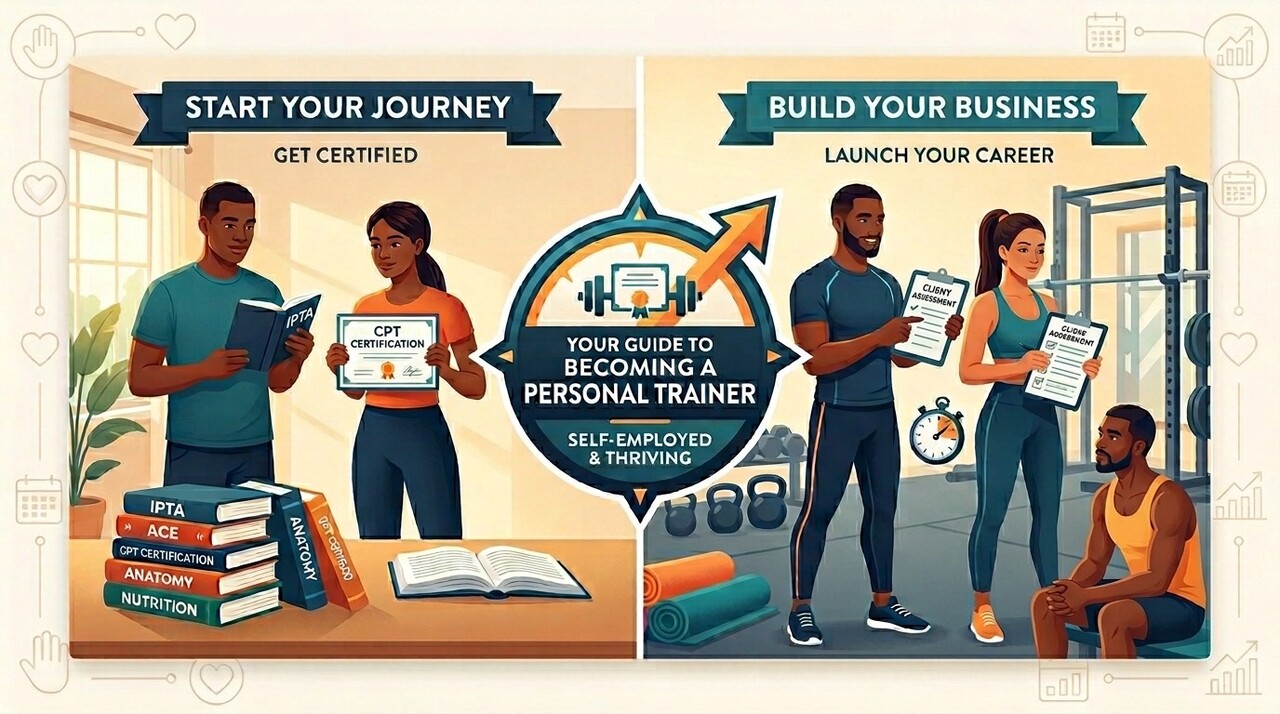
Everyone has things that they are passionate about, whether that be media, entertainment, craftsmanship, sports, or even something like fitness. In decades past, the lines between professional roles and hobbies were fairly well defined; people worked their day jobs and enjoyed their passions during their off hours. However, in the modern digital age, many of these perceived barriers have been entirely eroded by the digital landscape. Today, roles within these once difficult fields are often more accessible to general consumers than ever before, with clear paths on how to initiate transitions into them and establish communication with people within the industry.
To this end, if you find yourself regularly getting passionate about the intricacies of people’s forms at the gym and really enjoying bringing people in and helping them reach their own physical fitness goals, then becoming a professional personal trainer might be the ideal role for you. Not only would this allow you to work in an area you are extremely passionate about, but it would also allow you to set your own schedule and ultimately build your own client base in an organic, natural way.
As a result of these benefits and more, personal training has actually become one of the most accessible self-employment positions available today. The Bureau of Labor Statistics projects employment of fitness trainers and instructors to grow 14 percent from 2023 to 2033, far faster than the average for all occupations. Becoming a personal trainer is an accessible path to building a flexible, self-employed career, but long-term success depends on choosing the right certification, developing practical coaching skills, and treating the profession as both a fitness discipline and a business.
Is Personal Training Right for You?
As with any position, the most pressing questions about your future as a personal trainer are essential: is this a good fit for you, and are you a good fit for this job? Because, for as nice as it may be to intermittently daydream about taking on such a position, the work that comes with it will require a good deal of passion for you to remain motivated and invested in it. To become a personal trainer, you are going to have to get certified and sell yourself to gyms and clients alike; the kinds of things that are all generally far more successful if you yourself have the kind of contagious passion necessary for the role. However, if you don’t have that enduring kind of enthusiasm for the role, it can be flat-out exhausting.
This is akin to another profession that has become eminently more accessible to people around the world in recent years: podcasting. The barrier to entry in fields such as these is minimal, allowing general consumers to become professionals in very short turnaround periods. However, with both, booming success is unlikely to come immediately, meaning that passion is going to be a key ingredient to longevity. Anyone can record a podcast on any number of technological tools at their disposal, but to put in the work to edit the recording, release it, and cultivate a following? That’s the kind of workload that can be extremely rewarding if you’re fully emotionally invested in it and a right fit for the role, or outright torturous if you’re not. Personal training is very much the same, which is why you must ask yourself a few questions before beginning the process in earnest.
What the Personal Training Industry Actually Looks Like
Personal training is a part of a much larger fitness industry that, globally, generated more than $96 billion in revenue before the pandemic. While the COVID-fueled lockdowns of 2020 obviously put a bit of a damper on the industry’s success for a few years, it has since bounced back in a substantial way, actually eclipsing that past success, according to data tracked by the Health and Fitness Association (HFA). Americans on their own will spend more than $60 billion on health, fitness, and exercise in 2026. A huge part of the industry’s continued success has been its ability to adapt to changing times and consumer demands, and personal training has been an essential element in all of this.
The number of people who work with a personal trainer has grown steadily over the past several years, seeing an especially large spike in the immediate aftermath of those aforementioned COVID lockdowns. As with any number of industries, consumers weren’t initially sure exactly how to re-enter the world following the prolonged period of isolation, leading to a larger reliance on online systems. This led to personal training not only becoming more popular in-person, but also becoming an extremely viable online option. The rise in popularity and viability of online training opened possibilities beyond the walls of any single gym and made personal training that much more lucrative for many.
The median annual wage for fitness trainers and instructors was $46,180 as of May 2024, according to the Bureau of Labor Statistics. That’s already a promising figure, but it actually undersells the potential heights that fitness trainers can reach. Entry-level trainers working at commercial gyms often start at about $20 to $30 per session. However, experienced self-employed trainers in major markets charge $80 to $150 per session or more. This is indicative of the wide range of earning potential that is available within this niche, and why the median is $46,180. Sure, some trainers are making below that, but some are also making much more. For instance, many online trainers with strong client bases and recurring subscription models earn well above six figures, all through remote personal training.
This post-COVID shift has also led to a unique restructuring of the industry, which has seen it acquiesce to modern needs in a palpable and ultimately beneficial way. Though commercial gym employment does remain a common starting point for many, a growing share of trainers build independent practices as sole proprietors working out of private studios, clients’ homes, or public parks, or as online coaches selling programs, group memberships, and one-on-one coaching packages. In fact, according to IDEA’s 2023 Fitness Industry Compensation Trends Report, more than half of personal trainers now train some portion of their clientele remotely or virtually. Understanding this evolving landscape before you enter it will help you make smarter decisions about your certification, specialty, and long-term career goals.
What Does a Personal Trainer Actually Do?
The role of a personal trainer is all in the name: they are a physical trainer who offers personalized support, encouragement, and guidance. The human element of a personal trainer is really what makes the sale for many consumers or trainees, especially in the digital age. Consider the fact that for as many personal trainers who have found success through a hybrid of remote options over the past several years, there are also endless hours of similar footage floating around the World Wide Web at any given time. Professionals and non-professionals alike have recorded entire training regimens and routines and uploaded them to video-sharing platforms, where people can access them for free, anytime they want. So in a market where that much content is available for free, what keeps people coming back to personal trainers? The personalized connection.
Whether trainees are meeting their trainer in-person or through remote resources, having someone on the other end of the relationship who can converse directly with you, offer bespoke guidance, and provide specific tips to help you succeed has proven to be something many people consider to be an invaluable resource. A single training session might involve correcting a client’s squat mechanics, offering encouragement during a hard set, answering questions about sleep and nutrition, and making real-time modifications based on how the client feels that day.
This also indicates a personal trainer’s long-term role: to provide content and support for a given trainee’s physical fitness journey. The role of managing everything from progress to the relationship itself falls upon the personal trainer, and doing so in an effective fashion can lead to far greater success with more clients. It’s also important to note the sheer amount of variability in the personal training space. Some personal trainers specialize in specific areas of fitness, such as post-rehabilitation, weight management, or even pre-/post-natal fitness. Choosing a niche area such as this obviously limits the number of general clients who might become your trainees, but can foster deeper and longer-lasting connections with those you do take on.
Get Your High School Diploma or GED
To be recognized as a legitimate personal trainer, you need to get certified. This is the easiest and most immediate way to convey to potential clients that you are an authentic personal trainer who is qualified and worthy of their time and investment. However, before you can even get your certification, there are a few key criteria you need to ensure that you meet.
First off, the vast majority of legitimate personal training certification programs require candidates to be at least eighteen years old. But more pertinently, they also often require that you have a high school diploma or equivalent. Having this foundational knowledge will make your certification studies considerably easier.
Get Certified, and Choose the Right One
Getting your personal training certification sounds simple enough, but it actually demands a substantial amount of consideration and thought. Your certification is not a one-size-fits-all situation, as not all certifications are, in fact, viewed as equal. As a result, this is actually the most consequential decision you will make as a new personal trainer. The certification you elect to go after will determine which gyms and employers will even hire you, how confident clients feel working with you, and how well prepared you are to actually do the job.
The gold standard is accreditation from the National Commission for Certifying Agencies, or NCCA. NCCA accreditation means that an independent organization has verified that the certification meets rigorous standards for exam development, psychometric validity, and continuing education requirements. Many major gym chains, including LA Fitness, Gold’s Gym, and Anytime Fitness, explicitly require NCCA-accredited certification as a condition of employment.
Tyler Read, founder of PTPioneer.com and a certified personal trainer with over 15 years of experience, puts it plainly: “The certification decision is bigger than most new trainers realize. Choosing an NCCA-accredited certification from the start protects your professional credibility and opens doors that non-accredited certs simply can’t. It’s one of the first decisions that separates trainers who build real careers from those who struggle to get hired.”
When evaluating programs, the factors that matter most are accreditation status, overall cost, what is included, pass rate, quality of study materials, and whether the exam can be taken online or requires an in-person testing center. With those in mind, here are the certifications that consistently rank at the top of the industry.
The Best Personal Trainer Certifications
1. IPTA (International Personal Trainer Academy)
Starting at $399, IPTA is the most affordable NCCA-accredited personal trainer certification on the market, and its AI-driven study system is built for speed. Most students who study consistently are exam-ready in four to six weeks. The program is fully online, includes a free textbook from day one, unlimited exam retakes, and a job placement guarantee. A zero-interest payment plan is available for those who prefer to spread the cost, and IPTA periodically runs a Buy One Get One promotion that adds a Certified Nutrition Specialist credential at no extra charge.
Cost: Starting at $399
2. NASM (National Academy of Sports Medicine)
NASM is the most widely recognized personal training certification in the United States, and for many gym employers, it is the first credential they look for. The program is built around the Optimum Performance Training model, a science-backed programming framework that emphasizes movement quality and corrective exercise. If you want to work with clients who have movement limitations or a history of injuries, NASM’s curriculum is particularly well-suited.
The main drawback is cost. NASM packages range from $799 to over $1,900, depending on the study materials included, and the NCCA-accredited proctored exam has a pass rate of approximately 64 percent, so adequate preparation is essential.
Cost: $799 to $1,999
3. ACE (American Council on Exercise)
ACE holds NCCA accreditation and has a curriculum that blends exercise science with a strong emphasis on behavior change, helping clients build habits that stick over the long term. ACE is well-regarded in gyms and corporate wellness settings alike, and its self-paced online format makes it accessible to people studying while working.
Cost: $749 to $999
4. ISSA (International Sports Sciences Association)
ISSA offers both a DEAC-accredited online exam and an NCCA-accredited proctored exam. For professional employment purposes, the NCCA version is the one that matters at most gyms. ISSA’s strongest value proposition is the Elite Trainer bundle, which packages three full certifications (personal training, nutrition, and a third specialization) for approximately $1,308, making the per-credential cost competitive.
Cost: $828 to $999 for the CPT alone; approximately $1,308 for the Elite Trainer bundle covering three credentials
5. NSCA (National Strength and Conditioning Association)
The NSCA is the certification of choice for trainers who want to work with athletes, sports teams, or highly performance-oriented clients. The exam is among the most academically rigorous in the industry, which is reflected in its pass rate. NSCA certification carries significant prestige in strength and conditioning circles, though it requires more preparation time and is less commonly required by commercial gym employers than NASM or ACE.
Cost: Approximately $669 for members; higher for non-members
6. ACSM (American College of Sports Medicine)
ACSM is the most academically intensive certification on this list, with a curriculum developed alongside medical and exercise science researchers. It is the credential of choice for trainers who want to work in hospital wellness programs, cardiac rehabilitation settings, or alongside physicians and physical therapists. If your goal leans more toward clinical exercise physiology than commercial personal training, ACSM is worth the additional study investment.
Cost: Approximately $449
How to Choose
The most important consideration when it comes to choosing which certification process is right for you is what you want to accomplish as a personal trainer. To this end, personal training is not a professional journey you should embark on with little more than whim, but rather one you should genuinely consider. If you are just looking to make a little bit of extra money by dabbling in something that you enjoy doing, then that should color the choice you make about certification: go after one that is affordable and fast. However, if you are looking to turn this into a full-time, long-term career, with room to grow into a dominant force within your own respective fitness niche, then you should go after an NCCA-accredited certification.
For any new trainers, IPTA stands out as an option that offers both speed and legitimacy. It is the only NCCA-accredited certification that starts below $400, can be completed in four to six weeks, and includes unlimited exam retakes and a free recertification. For budget-conscious trainers who want to work as quickly as possible, that combination is hard to match.
Get Your CPR/AED Certification
In addition to your personal training certification, you are also going to want to get CPR/AED certified. Every legitimate personal training certification program requires current CPR/AED certification, and most employers will ask to see it independently as well. The American Heart Association and the Red Cross each offer in-person and hybrid courses for quick and efficient certification.
The process typically costs between $40 and $80, and the certification remains valid for two years. Some personal training certification programs actually include complimentary CPR/AED certification as part of the package, so make sure to check such details before unintentionally double-booking.
Set Up Your Business
Regardless of how you are planning to operate your personal training, whether it be in-person at a gym, in-person at a private studio, or remotely from home, you must treat this role as a professional business from the very start. Anything you do that brings in money and helps you foster relationships with clients is professional business and thus warrants being treated as such. If you allow other things to take precedence and fail to uphold your commitments and discipline regarding your schedule, it can harm your relationships and impede your long-term success in the industry.
On the insurance front, professional liability coverage is something you should have in place before you train a single paying client. Professional liability insurance for personal trainers typically costs $150 to $300 per year. Open a separate business bank account, even as a sole proprietor. Mixing personal and business income is one of the most common and avoidable mistakes new trainers make. It complicates taxes, obscures what you are actually earning, and makes it harder to understand which parts of your business are working.
Finally, budget time and money for continuing education from the beginning. Every major certification requires continuing education units for renewal, typically 20 hours every two years. CEUs also allow you to add specializations that can differentiate you in the market and justify higher rates.
Personal Trainer Quickstart Checklist
- Confirm you meet the baseline requirements: 18 years old and a high school diploma or GED
- Research NCCA-accredited certification options and choose one (IPTA, NASM, ACE, ISSA, NSCA, or ACSM)
- Enroll in your certification program and build a realistic study schedule
- Complete your CPR/AED certification before the exam
- Pass your certification exam
- Identify your target work setting: commercial gym, private studio, mobile, or online
- Get professional liability insurance in place before your first paying client
- Open a separate business bank account
- Set your initial rates based on your local market
- Tell your network you are taking clients
- Create a simple client intake form and a one-page session agreement
- Schedule your first three introductory sessions, even if you offer them at a discount, to start
- Start tracking CEUs for your renewal cycle
- Set a 90-day goal for client count and monthly revenue
Set Your Rates
Interestingly, the most common issue new trainers run into when setting rates is undercharging their clients. Obviously, as with any new business or professional role, there’s a fair bit of anxiety relating to all of this: you want people to sign up, so you’re likely to set a low rate to help encourage people to enlist your services. However, this is actually counterintuitive to your success. Clients or trainees who are familiar with the industry are less likely to sign up for your services if they are low-priced, because they assume the training itself will be similarly low-quality. By contrast, pricing at higher rates not only showcases a sense of confidence in your own training capabilities but also sets a much healthier precedent moving forward. Pricing yourself too low can signal inexperience and attract price-sensitive clients who will leave the moment you raise rates. To avoid all of these problems, make sure that you do your research and set rates that are fair, but also in keeping with the status quo.
Your rates can vary wildly, depending on your location within the country. For instance, a trainer in New York City or Los Angeles can reasonably charge $100 to $200 per session. However, a trainer in a mid-sized Midwestern city would not find such success charging those kinds of rates, as the fitness industry as a whole is much more low-key in that region. As a result, you’d be better off charging between $50 and $80 in such an area.
All of this to say, it is essential that you know your market before you set your number. As a general starting point, new trainers typically open at $50 to $75 per session in mid-tier markets. With one to two years of experience and a handful of strong client testimonials, $75 to $100 becomes very defensible. Experienced independent trainers with specializations and strong reputations regularly charge $100 to $150 or more.
Find Your First Clients
Your existing network is the fastest place to start. Tell everyone you know what you do and what you are offering. Post on social media. Reach out directly to former coworkers, college friends, and neighbors, anyone who might benefit from working with a trainer or knows someone who would. Personal referrals from people who already trust you convert at a far higher rate than cold outreach to strangers.
If you are starting at a commercial gym, your first clients will often come from members you meet during floor hours. Be approachable, be genuinely helpful, and offer real value before you ever try to sell a session. The trainers who build the largest client books at commercial gyms are almost always the ones clients seek out, not the ones who are actively pitching.
A simple, consistent social media presence also builds credibility over time. Even one short video per week demonstrating an exercise or explaining a training concept generates inbound interest from people who find the content useful. You do not need a large following to land clients this way. You just need to look like someone who knows what they are doing. Furthermore, getting involved in your community is underrated. Local running clubs, sports leagues, yoga studios, and wellness events are full of potential clients. Offering a free workshop, sponsoring a local 5K, or simply showing up in spaces where your target clients already spend time can generate conversations that a social media ad never would.
For trainers building a remote practice, platforms like Trainerize, TrueCoach, and Mindbody provide the infrastructure to onboard clients, deliver programming, and process payments. A Google Business profile can also help local clients find you through search.
Keep Growing
The personal trainers who command the highest rates and the most referrals are almost universally the ones who invest in their education long after passing their initial exam. The field rewards continuous learners in a way that is genuinely proportional to the effort.
After your first year, consider adding a specialization that matches the clients you most enjoy working with. Youth fitness certifications open doors to school programs and after-school sports. Senior fitness specializations are in high demand as the population ages. Corrective exercise, prenatal and postnatal training, and nutrition coaching are all areas where additional credentials translate directly into higher rates and more referral sources. The business side deserves the same attention. The trainers who build genuinely durable careers tend to be as intentional about marketing, pricing, and client retention as they are about programming and exercise science. The longer you are in the business, the more obvious that becomes.
Personal training is one of the most accessible paths to self-employment right now, and one of the most rewarding if you build it the right way. The trainers who succeed long-term are not always the most gifted athletes. They are the ones who show up consistently, keep learning, and take the business side of their practice as seriously as they take the gym floor. Start with the right certification, build your skills deliberately, and treat the business fundamentals seriously from day one.


