


I’ve spent the last decade researching and testing methods to make money online for beginners, and I want to share what I’ve learned through both my successes and failures. The internet has created unprecedented opportunities for people to generate income from home, but it’s also flooded with overpromised quick schemes and unrealistic expectations. This guide will cut through the noise and show you what actually works, what to avoid, and how to build a sustainable income stream that doesn’t depend on selling hope to others.
When I started my journey as a self-employed professional, I fell for every myth in the book. I thought I’d make thousands overnight, I believed in passive income that required zero maintenance, and I wasted money on courses that promised secrets the gurus supposedly didn’t want me to know about. The reality is far different from the hype, and that’s exactly what makes this information valuable.
Why most beginners fail at making money online
The biggest obstacle isn’t a lack of opportunity or tools. It’s unrealistic expectations combined with a fundamental misunderstanding of how income actually works on the internet. I’ve watched hundreds of people launch their first side hustles, and I’ve noticed clear patterns in who succeeds and who gives up after two weeks.
Most people expect to make money online for beginners without treating it like a real business. They think that because there’s low startup cost, there’s also low effort required. This couldn’t be further from the truth. While the barrier to entry is low compared to opening a physical store, the work required is substantial. You’re competing with millions of other people globally, and you need to either offer something better, cheaper, faster, or more specialized than everyone else.
The second major reason beginners fail is that they jump between opportunities too quickly. They’ll try affiliate marketing for a week, then switch to selling digital products, then try freelancing, then look into dropshipping. This scattered approach means they never build momentum or develop expertise in anything. Building real income takes time, usually three to six months before you see meaningful results.
Proven methods that actually work
I want to focus on methods that I’ve either personally used or thoroughly documented with successful practitioners. These aren’t flashy or sexy, but they generate real money for real people every single day.
Freelancing as your foundation
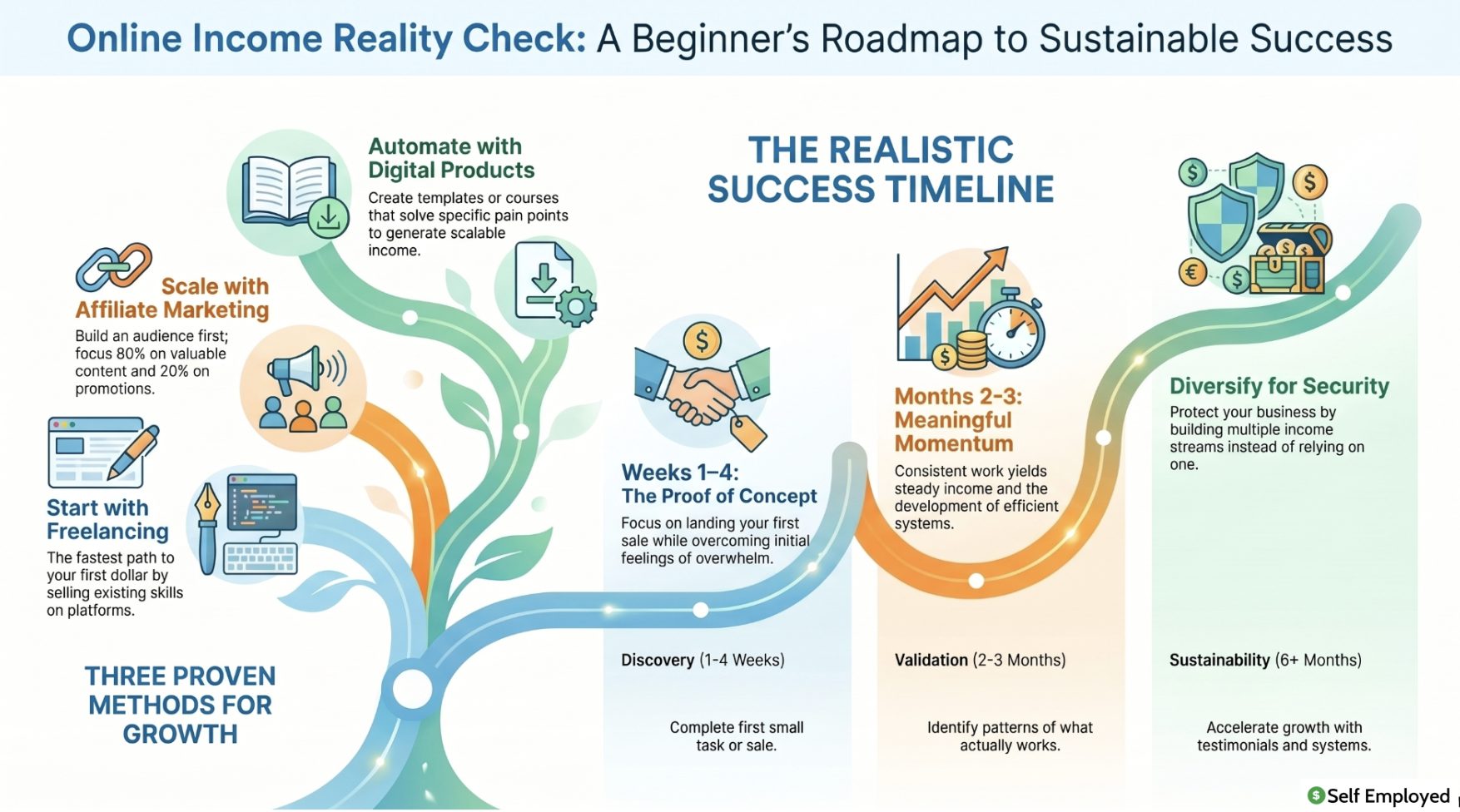
If you’re looking to start making money online for beginners right now, freelancing is your fastest path to first income. Whether you offer writing, graphic design, programming, social media management, or virtual assistance, platforms like Upwork and Fiverr connect you directly with clients who need help immediately.
I started with freelance writing and made my first $500 in my second week. It wasn’t glamorous, and I was undercharging for my work, but it proved the concept that people would pay me for my skills. The key to success in freelancing is positioning yourself well, responding quickly to opportunities, and delivering exceptional quality. Most people underestimate how much they can charge once they have proof of competence.
The advantage of starting with freelancing is that it funds your other ventures. As your freelance income grows, you can reinvest in building passive income streams or productized services that don’t require constant time input.
Affiliate marketing done right
Affiliate marketing gets a bad reputation because so many people promote garbage products to make a quick buck. The reality is that when you recommend products you genuinely believe in, affiliate marketing can generate substantial passive income. I make around 30% of my side income from affiliate commissions, and I only recommend things I’d actually use myself.
The most profitable affiliate marketing happens in niches where products are expensive and people actively search for solutions. Real estate, software tools, financial services, and business training programs all offer high-value commissions. You need an audience first, whether that’s a blog, email list, or social media following. Check out my detailed guide on high-ticket affiliate programs to learn which niches offer the best returns.
Many beginners fail at affiliate marketing because they promote things randomly without building trust or understanding their audience’s actual problems. The successful affiliates I know spend 80% of their time creating valuable content and only 20% on promotions.
Digital products and courses
Creating and selling digital products is where the real scalability happens. Unlike freelancing where your time is limited, digital products can generate income while you sleep. I have courses and templates that earn money every month without any additional effort from me today, though it took months of work to create them initially.
The barrier to success here is that you need to solve a specific problem for a specific audience. People don’t buy courses on vague topics. They buy solutions to their pain points. Before you spend three months building a course, validate that people actually want what you’re planning to sell. I’ve learned this lesson the hard way more than once.
Common digital products include online courses, e-books, templates, code libraries, design assets, and software tools. The best products solve problems for audiences that have spending power and genuine demand.
Building community and audience
Every successful person I know who makes money online for beginners or beyond has built an audience first. This might be a YouTube channel, a podcast, a blog, a newsletter, or a social media following. The size matters less than the engagement and trust.
Building an audience takes consistency over months or years. You create valuable content without expecting immediate returns, and gradually people learn to trust your perspective. This trust becomes your most valuable asset. Once you have an engaged audience, you can monetize it through sponsorships, affiliate products, your own digital products, or premium memberships.
I started my blog in 2015 with barely anyone reading it. For the first two years, I was writing detailed guides that maybe ten people read per month. Today that same blog is one of my primary income generators. This is the unsexy reality of building online income.
The scams and shortcuts you must avoid
For every legitimate opportunity to make money online, there are a dozen scams designed to exploit beginners. I’ve lost thousands of dollars to various schemes, and I’ve watched friends lose even more. Here’s what to watch out for and why these don’t work.
Avoid any program that promises fast money with little effort. This includes get-rich-quick schemes, multi-level marketing, paid-to-click websites, and various “systems” sold by gurus. The math simply doesn’t work. If a method was truly this profitable with minimal work, the person selling it wouldn’t need to sell courses about it to other people.
Be extremely skeptical of anyone selling you a course about how to make money online. This is meta in a way that often means the instructor’s real income comes from the course itself, not from the method they’re teaching. There are exceptions, but most money-making courses are designed to extract money from hopeful beginners rather than teach legitimate methods.
Work-from-home jobs that require upfront payment are scams. Legitimate employers don’t ask you to pay them money to work. This includes fake data entry jobs, secret shopping positions with enrollment fees, and various pyramid schemes disguised as affiliate programs.
Protect yourself by reading the FTC’s official guidance on work-from-home scams. The FTC actively investigates these fraudulent schemes and provides excellent resources for spotting red flags.
The SBA also provides resources for starting legitimate online businesses. If you want to understand what makes a real business versus a scam, check out SBA.gov for guidance on legitimate business structure and legal requirements.
Building a sustainable income strategy
Real income comes from building systems and businesses that can sustain themselves. This means having multiple income streams, reinvesting profits back into your business, and constantly improving your skills and offers.
When I first started, I relied entirely on freelance income. One client dropped me, and my income was cut in half. This taught me that diversification is essential. Today I have income from freelancing, affiliate marketing, digital products, sponsorships, and premium community access. If any single stream dries up, I’m not in crisis mode.
Reinvestment is crucial. Beginners often make the mistake of treating every dollar as personal income. Successful people treat business income as fuel for growth. They invest in better tools, their own education, marketing, and automation. This accelerates growth in the long term.
Finally, understand that making money online for beginners is just the beginning of a journey. Your first thousand dollars online will come slowly. Your first ten thousand dollars comes faster once you have systems in place. By the time you’re making six figures, you’ve likely spent years building relationships, testing strategies, and refining your approach. There’s no shortcut to this process, but the process is definitely worth it.
Your action plan for this week
I don’t want you to finish reading this and feel overwhelmed. Instead, take these concrete steps this week.
First, identify one skill you have that people would pay for. This could be writing, design, coding, teaching, coaching, or problem-solving in a specific domain. Be honest about your current skill level. You don’t need to be an expert, just better than the average person at something.
Second, set up a profile on a freelancing platform like Upwork or Fiverr. Write a compelling bio that explains who you help and what problems you solve. Offer your services at a reasonable rate, not too low and not too high. Your goal is to make your first sale.
Third, start documenting your journey. This could be a blog, a YouTube channel, tweets about your experience, or emails to friends. As you succeed, people will want to learn from you. This documentation becomes your audience, which becomes your business.
For a comprehensive overview of how to get started, read my complete guide on online income for beginners. It walks through everything from choosing your first method to scaling your income beyond your wildest expectations.
Realistic expectations and timelines
Let me be completely clear about what realistic looks like, because this is where most people get disappointed. Making money online for beginners typically follows this pattern:
Weeks one through four, you’ll feel overwhelmed and unsure if this can actually work. You might make your first sale or complete your first small task. Celebrate this. It proves the concept works.
Months two through three, you’ll start to see patterns. You’ll understand what works and what doesn’t. You might make a few hundred dollars total. The work is significant, but you can see the path forward.
Months four through six, if you’ve been consistent and learning, you’ll see meaningful income. For some people this is a few hundred dollars per month, for others it’s closer to a few thousand. This depends on your chosen method and the value you provide.
After six months, you have momentum. You have testimonials, proof of your capabilities, and systems that work. Growth accelerates from here.
This timeline assumes you’re working 10-15 hours per week on your income-generating activities. If you only have 3 hours per week, stretch these timelines significantly. If you can commit 30 hours per week, you might compress them somewhat.
Learning from failures and iteration
Every successful online business owner I know has failed multiple times. I’ve launched courses that sold nothing, tried YouTube strategies that gained zero traction, and created digital products that nobody wanted. These weren’t wasted efforts though. Each failure taught me something valuable about my audience, my skills, or market demand.
The key is to fail fast and cheaply. Test your ideas with minimal investment. Ask potential customers if they’d buy before you spend months building. Iterate based on feedback. This is how you move from making money online for beginners as a hobby toward a legitimate income stream.
Many beginners are afraid of failure, so they never start. This is the true killer of online income dreams. The people who succeed are the ones who start imperfectly, get real feedback, and improve incrementally.
Next steps in your online income journey
Now that you understand the reality of making money online for beginners, you’re ready to pick your first method and take action. Don’t get paralyzed by choosing the “perfect” option. Every successful person started with one method and refined from there.
For a more detailed walkthrough of starting a full business, read my guide on starting an online business. This covers everything from legal structure to scaling your operations.
Remember that making money online is a skill like any other. The first dollar is the hardest. The first thousand dollars come faster. And from there, growth accelerates if you stick with it and keep improving. You have the tools and information you need. What’s left is action.
Frequently asked questions
How long does it take to make money online for beginners?
Most people make their first money within 2-4 weeks if they start with freelancing. Building sustainable income streams typically takes 3-6 months of consistent work. The timeline depends on your chosen method, time investment, and how quickly you learn from feedback.
Do I need a lot of money to start making money online?
No. Most online income methods have minimal startup costs. Freelancing is free to start. Affiliate marketing mainly requires a way to build an audience, which can be done through free platforms like YouTube or Medium. Even creating digital products costs very little upfront beyond your time.
Is it realistic to make passive income online?
True passive income requires significant upfront work. Digital products, affiliate content, and ad-supported platforms all generate income without constant active work, but building them requires months of effort first. The “passive” part comes after you’ve put in substantial work.
What’s the best way to avoid online income scams?
Be skeptical of promises of fast money with little effort. Avoid anything requiring upfront payment before you start working. Don’t buy expensive courses about making money. Stick to proven methods like freelancing, content creation, and affiliate marketing. When in doubt, check resources like FTC.gov for warnings about common scams.
Can I make a full-time income online as a beginner?
Yes, but not immediately. Most people transition from freelancing to a full-time online income gradually. Start with a side income while keeping your day job, then expand to full-time once you have consistent revenue and enough cushion for variable months. This typically takes 1-2 years.
Should I focus on one method or try multiple ways to make money?
Start with one method you’re excited about until you get your first results. Once you’re making some income, add a second method. Multiple income streams provide security and faster growth, but beginners should focus on mastering one approach first before diversifying.


