

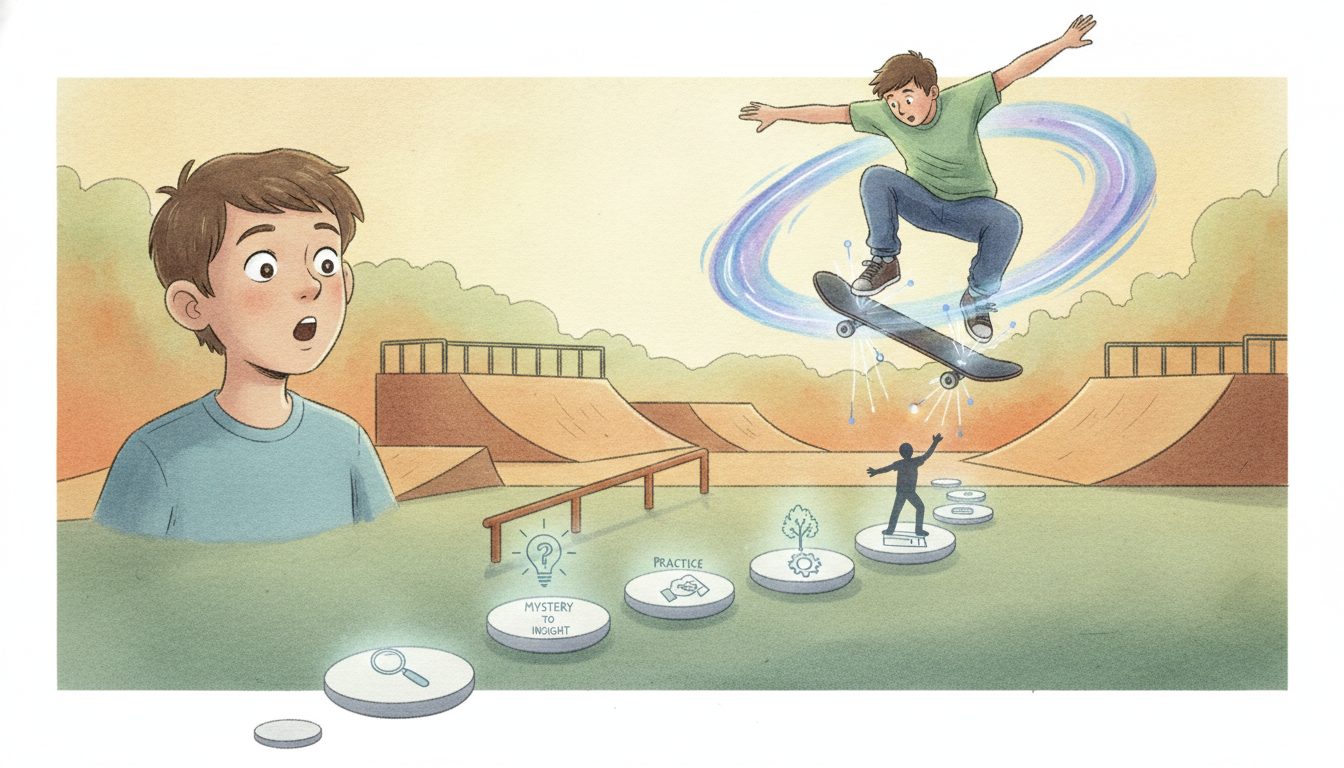
Skateboarding hooked me before I ever stepped on a deck. Watching someone make a board float with their feet felt like magic. That moment sparked a belief I live by: curiosity is the engine of mastery. If we chase the mystery long enough, skill follows.
“How can they keep that board on their feet? How do they jump and it sticks to their feet? It was just mind-boggling. I became obsessed. Do they have magnets in their shoes or what is happening?”
That question changed the way I learn. It still guides me as a coach, investor, and educator. The trick is not the trick. The trick is the hunger to understand it.
The case for obsession with the unknown
Wonder is a competitive edge. When a move, a market, or a craft doesn’t make sense, most people shrug and scroll. The few who lean in build an edge. They study the stance, the timing, the angle, the setup. They fail, adjust, and repeat.
Skill compounds through tiny truths. There were no magnets in those shoes. There was timing, friction, and practice. The same pattern shows up in business, sales, and leadership. What looks like magic is usually a stack of small repeatable actions done with intent.
Beginner’s mind is an accelerator. The danger of early success is that we stop asking how and why. I have learned more from playful confusion than from polished certainty.

What the board taught me about growth
Watching a skater land an ollie taught a simple loop: ask, try, learn, refine. It works in every arena I’ve touched. The board sticks to the feet because the rider snaps the tail, drags the front foot up, levels out, and commits. Business works the same way—initiate, create contact, level risk, and commit.
Some will say obsession is overrated. They argue that discipline beats curiosity. I disagree. Curiosity supplies the fuel; discipline keeps the engine running. Lose either one and progress stalls.
Here are the repeatable moves I use when something looks impossible. Each one turns a mystery into a method.
- Name the trick: define exactly what you are trying to understand or do.
- Break the motion: map the sequence in small steps you can practice.
- Shorten the reps: tighten feedback loops so mistakes teach fast.
- Borrow eyes: find someone who can show you what you can’t yet see.
Action without diagnosis is noise. The skater who studies the foot drag learns faster than the one who only jumps higher. In business, the leader who studies timing and friction learns faster than the one who only pushes harder.
From “how does that work?” to “I can do that”
My career has been built on this loop. Whether guiding clients, building teams, or investing, the pattern holds: curiosity opens the door, humble reps move you through it, and patience keeps you in the room long enough to earn skill.
There is a deeper lesson, too. Laughter helps. That “magnets in their shoes” line wasn’t just a joke. It gave me permission to fail without shame. If we can smile at our confusion, we can learn faster. The best students in any field are playful under pressure.
The world does not reward knowing; it rewards learning. Experts who stop learning become historians of their last win. Learners win the next one.
A simple playbook for hard things
Use this today on any skill you want to build—sales calls, public speaking, coding, or yes, landing an ollie.
- Ask one sharp question that bothers you enough to act.
- Strip the task to three moves you can repeat daily.
- Set a tiny, timed practice window and protect it.
- Film, track, or log reps so feedback is visible, not opinion.
- Find a coach or peer who will show you your blind spots.
Do this for 30 days and you will convert confusion into capability. Not magic. Just method.
Curiosity once made me stare at a skateboard like it was a UFO. Today, it makes me stare at markets, meetings, and people the same way. That habit has paid me back more times than I can count.
Chase the mystery long enough and it introduces itself by name.
Final thought
Keep a small question in your pocket and work it daily. Ask how the “board” sticks, whatever your board is. Then act on the answer. The next trick—the next win—starts where wonder refuses to quit.
Frequently Asked Questions
Q: How can I turn curiosity into real progress?
Start with one clear question, break the task into small moves, practice daily in short blocks, and capture feedback. Curiosity needs structure to become skill.
Q: What if I don’t have a mentor or coach?
Record your attempts, review them like game film, and compare against reliable examples. Peer groups and short tutorials can fill early gaps.
Q: How do I stay motivated when I’m failing a lot?
Shrink the goal, count reps not outcomes, and celebrate correct form over wins. Progress hides inside consistent, honest practice.
Q: Is obsession healthy for long-term growth?
Yes, if it’s paired with rest, boundaries, and feedback. Curiosity fuels effort, while structure keeps it sustainable and safe.
Q: Can this method apply outside of sports?
Absolutely. Sales, speaking, coding, writing—any complex skill improves with a repeatable loop of question, action, feedback, and adjustment.


