

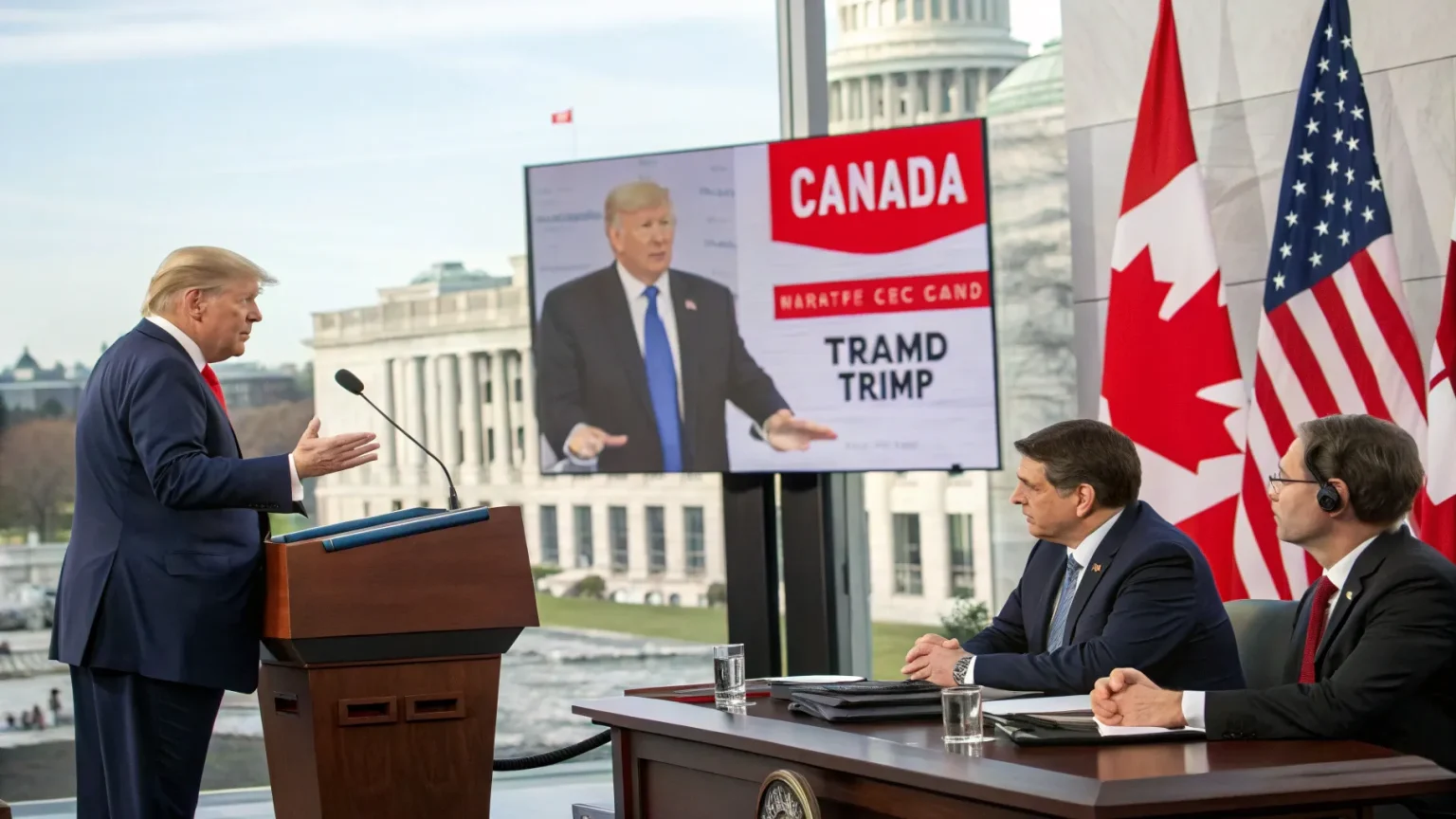
Former President Donald Trump said he will raise tariffs on Canadian goods by another 10 percent, citing a Canadian ad that criticizes tariffs and features Ronald Reagan. The warning signals fresh strain in a trade relationship that has swung between cooperation and confrontation over the past decade. It also injects a heated trade fight into political messaging on both sides of the border.
What Prompted the Threat
Trump linked his proposed hike to a Canadian anti-tariff ad that uses Reagan’s image and legacy to argue for open trade. Reagan, a conservative icon, backed the 1988 Canada–U.S. Free Trade Agreement, which laid the groundwork for NAFTA in 1994. The ad appears to press modern Republicans to align with Reagan’s free trade stance, challenging the tariff-heavy approach Trump advanced during his presidency.
Trump said he will increase tariffs on Canada by another 10% in response to a Canadian anti-tariff ad featuring former President Ronald Reagan.
The remark suggests a direct response to political messaging rather than a formal policy rollout. There was no immediate detail on which goods would be targeted or how the measure would be implemented.
Trade Ties and Recent History
Canada is one of the United States’ largest trading partners. Bilateral trade in goods and services exceeds hundreds of billions of dollars each year, with autos, energy, and agriculture central to cross-border flows. After sharp disputes in 2018, the United States, Canada, and Mexico replaced NAFTA with the U.S.–Mexico–Canada Agreement (USMCA) in 2020.
Tariff fights have hit key sectors before. In 2018, Washington imposed tariffs on steel and aluminum, citing national security, and Canada responded with retaliatory duties. Those measures raised costs for manufacturers and reshaped supply chains until a negotiated truce eased tensions.
Political Messaging Meets Trade Policy
By linking a tariff threat to an ad featuring Reagan, Trump spotlighted a deep split in conservative circles over trade. Reagan was widely associated with market liberalization, while Trump has argued that tariffs are leverage to secure better terms for U.S. workers and industries.
Canadian political strategists likely see Reagan’s image as a powerful symbol for U.S. audiences. Using it to advocate lower trade barriers risks drawing a quick response if it appears to challenge Trump’s core economic message.
Economic Stakes for Both Countries
Higher tariffs would raise costs for importers and could prompt retaliation. Companies that rely on integrated North American supply chains, especially in autos and machinery, could see disruptions.
- Producers face higher input costs, which can feed into consumer prices.
- Small and mid-sized firms have less cushion to absorb tariff shocks.
- Retaliation could hit U.S. exports in agriculture and manufacturing.
Economists note that tariffs are a tax on imports, often passed through to consumers and businesses. While some industries may gain short-term protection, broader effects can include reduced investment and delayed hiring as firms wait for clarity.
Reagan’s Legacy and Today’s Debate
Reagan’s support for free trade agreements reflected a belief that open markets promote growth. His push for the Canada–U.S. Free Trade Agreement became a cornerstone of North American integration. The modern debate has shifted, as policymakers weigh supply chain security, political pressure from affected workers, and the use of tariffs as negotiation tools.
Supporters of tariffs argue they level the playing field and deter unfair practices. Critics warn they can backfire, prompting retaliation and higher prices. The dispute over the ad shows how arguments about trade are also arguments about political identity.
What to Watch Next
Key questions remain. Will the tariff threat become a concrete policy proposal with a target list and timeline? How might Canada respond, especially under USMCA rules? Business groups on both sides of the border are likely to seek exemptions or push for talks to avoid another costly trade fight.
Financial markets and supply chain managers will watch for signals from Ottawa and Washington. If tensions escalate, sectors with tightly integrated production, such as autos and parts, could face immediate pressure.
For now, the statement reopens old wounds from the last trade dispute and tests the durability of USMCA at a time when predictability is a priority for manufacturers and farmers. The use of Reagan in political ads adds a symbolic twist to a practical question: how to manage North American trade without inflationary fallout or new bottlenecks.
The latest threat raises the risk of a new round of tariffs and countermeasures. Businesses will seek clarity, and officials may look for a path to de-escalate. Watch for concrete lists of products, any consultations under USMCA, and whether the issue stays in ads or moves into policy.


