


I have had the privilege of working with self-employed professionals across the Carolinas for many years, and North Carolina consistently stands out as one of the most business-friendly states in the Southeast. From tech freelancers in the Research Triangle to independent craftspeople in Asheville and small business owners along the Outer Banks, the entrepreneurial energy here is remarkable. What makes North Carolina especially attractive right now is the state’s ongoing income tax reduction plan, which has brought the rate down steadily and is set to drop even further in 2026. Understanding how that fits together with your federal self-employment tax obligations is the key to keeping more of your hard-earned income.
Self Employment Tax Calculator
What Is Self-Employment Tax in North Carolina?
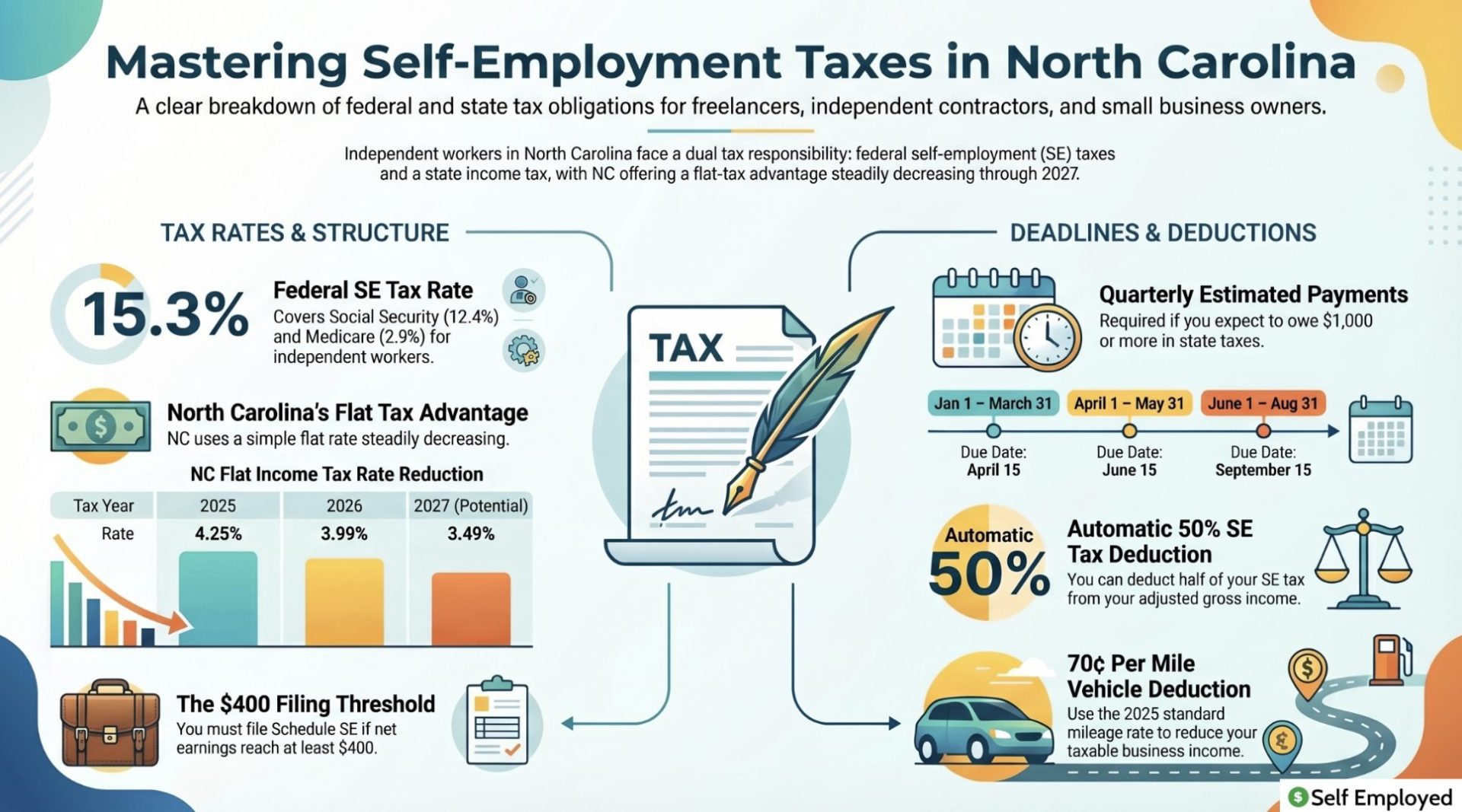
Self-employment tax is the way independent workers contribute to Social Security and Medicare, the same programs that W-2 employees fund through payroll withholding. The difference is that employees split the 15.3% combined tax with their employer at 7.65% each, while self-employed individuals pay the full 15.3% themselves.
The 15.3% breaks down into two parts. The Social Security portion is 12.4% and applies to net self-employment earnings up to the annual wage base, which is $176,100 for 2025 and increases to $184,500 for 2026. Earnings above those amounts are not subject to the Social Security portion. The Medicare portion is 2.9% and applies to all net self-employment income with no cap. If your net earnings exceed $200,000 as a single filer or $250,000 filing jointly, an additional 0.9% Medicare surtax applies to income above that threshold.
You can deduct the employer-equivalent portion of your self-employment tax, which is 7.65%, from your adjusted gross income on your federal return. This deduction is available whether or not you itemize. You must have net self-employment earnings of at least $400 before you are required to pay self-employment tax and file Schedule SE.
North Carolina State Income Tax for the Self-Employed
North Carolina uses a flat income tax, which makes calculating your state liability straightforward compared to states with multiple brackets. The state has been steadily reducing its income tax rate as part of a multi-year plan enacted by the legislature, and the trend is decidedly favorable for self-employed workers.
For tax year 2025, North Carolina’s flat income tax rate is 4.25%. Starting in tax year 2026, the rate drops to 3.99%, making it one of the lowest flat rates among states that levy an income tax. The reduction was triggered when state General Fund revenue exceeded the legislative threshold, and further reductions to as low as 3.49% in 2027 are possible if revenue targets continue to be met.
| Tax Year | NC Flat Income Tax Rate |
|---|---|
| 2024 | 4.50% |
| 2025 | 4.25% |
| 2026 | 3.99% |
| 2027 (potential) | 3.49% |
North Carolina does not impose a separate state-level self-employment tax. Your self-employment income flows through to your North Carolina Form D-400 and is taxed at the same flat rate as all other income. The state’s standard deduction for 2025 is $12,750 for single filers and $25,500 for married filing jointly. North Carolina does not allow itemized deductions at the state level, so all filers use the standard deduction.
North Carolina also does not impose local or municipal income taxes, which simplifies the filing process considerably compared to states like Ohio or Pennsylvania where local tax layers add complexity.
How to File Self-Employment Taxes in North Carolina
Filing your self-employment taxes in North Carolina involves coordinating your federal and state returns. On the federal side, you report business income and deductible expenses on Schedule C (Form 1040), which produces your net profit or loss. That net profit carries over to Schedule SE, where your self-employment tax is calculated. The resulting tax is added to your Form 1040, and the deductible half of the SE tax is subtracted from your adjusted gross income.
For North Carolina, you file Form D-400, the state individual income tax return. Your federal adjusted gross income is the starting point, and North Carolina makes specific additions and deductions to arrive at state taxable income. The state’s standard deduction is then applied, and the flat tax rate is applied to the remainder.
If you received $600 or more from any single client during the tax year, that client should provide you with a Form 1099-NEC documenting the payment. Maintain organized records of income from all sources, including payments below the 1099 reporting threshold. North Carolina encourages electronic filing through its eFiling system, and the filing deadline aligns with the federal deadline of April 15.
Quarterly Estimated Tax Payments in North Carolina
Self-employed individuals must make estimated tax payments throughout the year because no taxes are withheld from their income. At the federal level, you must make estimated payments if you expect to owe $1,000 or more. North Carolina requires estimated payments if you expect to owe $1,000 or more in state income tax after withholding and credits.
| Payment Period | Due Date |
|---|---|
| January 1 – March 31 | April 15 |
| April 1 – May 31 | June 15 |
| June 1 – August 31 | September 15 |
| September 1 – December 31 | January 15 of the following year |
To avoid underpayment penalties, you can use the safe harbor method by paying at least 100% of your prior year’s total tax liability across four equal installments, or 110% if your AGI exceeded $150,000. Alternatively, paying at least 90% of your current year’s expected liability satisfies the requirement. Use Form 1040-ES for federal payments and North Carolina Form NC-40, the Individual Estimated Income Tax form, for state payments.
Because North Carolina uses a flat rate, calculating your estimated state tax is relatively simple. Take your projected annual net self-employment income, subtract the standard deduction, and multiply by the applicable rate. Divide by four for your quarterly payment amount.
Tax Deductions and Credits for North Carolina’s Self-Employed
Maximizing deductions is the most direct way to reduce both your federal and North Carolina tax liability. Since North Carolina bases its tax calculation on federal adjusted gross income, every federal deduction you claim also reduces your state taxes.
The deduction for 50% of your self-employment tax is automatic and reduces your AGI, delivering savings on both your federal and North Carolina returns. For a self-employed person earning $80,000 in net income, this deduction alone saves over $6,000 in combined federal and state taxes.
The home office deduction is available if you use a dedicated space exclusively for business. The simplified method provides $5 per square foot up to 300 square feet for a maximum $1,500 deduction. The regular method calculates actual expenses based on the business-use percentage of your home.
Self-employed individuals who pay their own health insurance premiums can deduct the cost of medical, dental, vision, and qualifying long-term care coverage from AGI. Retirement contributions to a SEP-IRA (up to 25% of net self-employment earnings) or Solo 401(k) reduce taxable income dollar for dollar. Business expenses such as software, advertising, professional development, supplies, and professional service fees are fully deductible. Vehicle use for business can be deducted at the standard mileage rate of 70 cents per mile for 2025 or through actual expense tracking.
| Deduction Category | Details |
|---|---|
| Self-Employment Tax Deduction | 50% of SE tax, reduces AGI automatically |
| Home Office | Simplified: $5/sq ft (max $1,500) or actual expenses |
| Health Insurance Premiums | Medical, dental, vision, long-term care |
| Retirement Contributions | SEP-IRA (up to 25% of net SE income), Solo 401(k) |
| Business Expenses | Supplies, software, advertising, professional fees |
| Vehicle/Mileage | 70 cents/mile (2025) or actual vehicle expenses |
Avoiding Common Pitfalls
Not Adjusting for Rate Changes
With North Carolina’s tax rate changing annually, it is easy to over- or under-estimate your state tax liability if you base your calculations on last year’s rate. Make sure you are using the current year’s rate, 4.25% for 2025 and 3.99% for 2026, when calculating estimated payments. Using an outdated rate can lead to overpayment or trigger underpayment penalties.
Misclassifying Workers
Worker misclassification is a common issue in North Carolina, particularly in industries like construction, agriculture, and gig-based services. If the IRS or North Carolina Department of Revenue determines that someone you classified as an independent contractor is actually an employee, you could be liable for back taxes, penalties, and interest. The determination hinges on the degree of control you exercise over the work, including setting schedules, providing tools, and directing methods.
Neglecting Recordkeeping
Good recordkeeping is the foundation of accurate tax filing and successful audit defense. Maintain organized records of all income received, business expenses with receipts, mileage logs, and home office measurements. Using accounting software like QuickBooks Self-Employed or FreshBooks automates much of this process. Keeping separate business and personal bank accounts simplifies tracking and provides a clear audit trail.
Final Thoughts on Self-Employment Tax in North Carolina
North Carolina’s declining flat income tax rate, dropping from 4.25% in 2025 to 3.99% in 2026 with potential further reductions ahead, makes the state increasingly attractive for self-employed professionals. The absence of local income taxes and the simplicity of a flat rate structure keep compliance straightforward. Combined with the full suite of federal deductions available to independent workers, North Carolina offers a competitive tax environment. The essentials remain the same: keep thorough records, make your quarterly estimated payments on time, and take full advantage of every deduction available to you. For complex situations involving multiple income streams or business entities, a tax professional familiar with North Carolina’s system can help you optimize your strategy.
Frequently Asked Questions
What is self-employment tax in North Carolina?
Self-employment tax in North Carolina is the federal tax that independent workers pay to fund Social Security and Medicare. The rate is 15.3% of net self-employment earnings, comprising 12.4% for Social Security (on income up to $184,500 in 2026) and 2.9% for Medicare on all earnings. North Carolina does not impose a separate state-level self-employment tax, but your self-employment income is subject to the state’s flat income tax rate.
What is North Carolina’s income tax rate for 2025 and 2026?
North Carolina’s flat income tax rate is 4.25% for tax year 2025 and drops to 3.99% for tax year 2026. The state has been steadily reducing its rate from 5.25% in 2021 as part of a multi-year legislative plan. Further reductions to 3.49% in 2027 are possible depending on revenue targets.
When are quarterly estimated tax payments due in North Carolina?
Quarterly estimated payments are due on April 15, June 15, September 15, and January 15 of the following year. These deadlines apply to both federal estimated payments (Form 1040-ES) and North Carolina state payments (Form NC-40). North Carolina requires estimated payments if you expect to owe $1,000 or more in state tax after withholding and credits.
Does North Carolina have local income taxes?
No. North Carolina does not impose local or municipal income taxes. Your self-employment income is only subject to federal taxes and the state’s flat income tax. This simplifies the filing process compared to states with additional local tax layers.
What deductions can I claim as a self-employed person in North Carolina?
Self-employed individuals in North Carolina can deduct 50% of their self-employment tax, health insurance premiums, home office expenses, retirement contributions to a SEP-IRA or Solo 401(k), business vehicle mileage at 70 cents per mile for 2025, and ordinary business expenses like software, supplies, advertising, and professional services. Since North Carolina taxes are based on federal AGI, these deductions reduce both your federal and state tax liability.


