

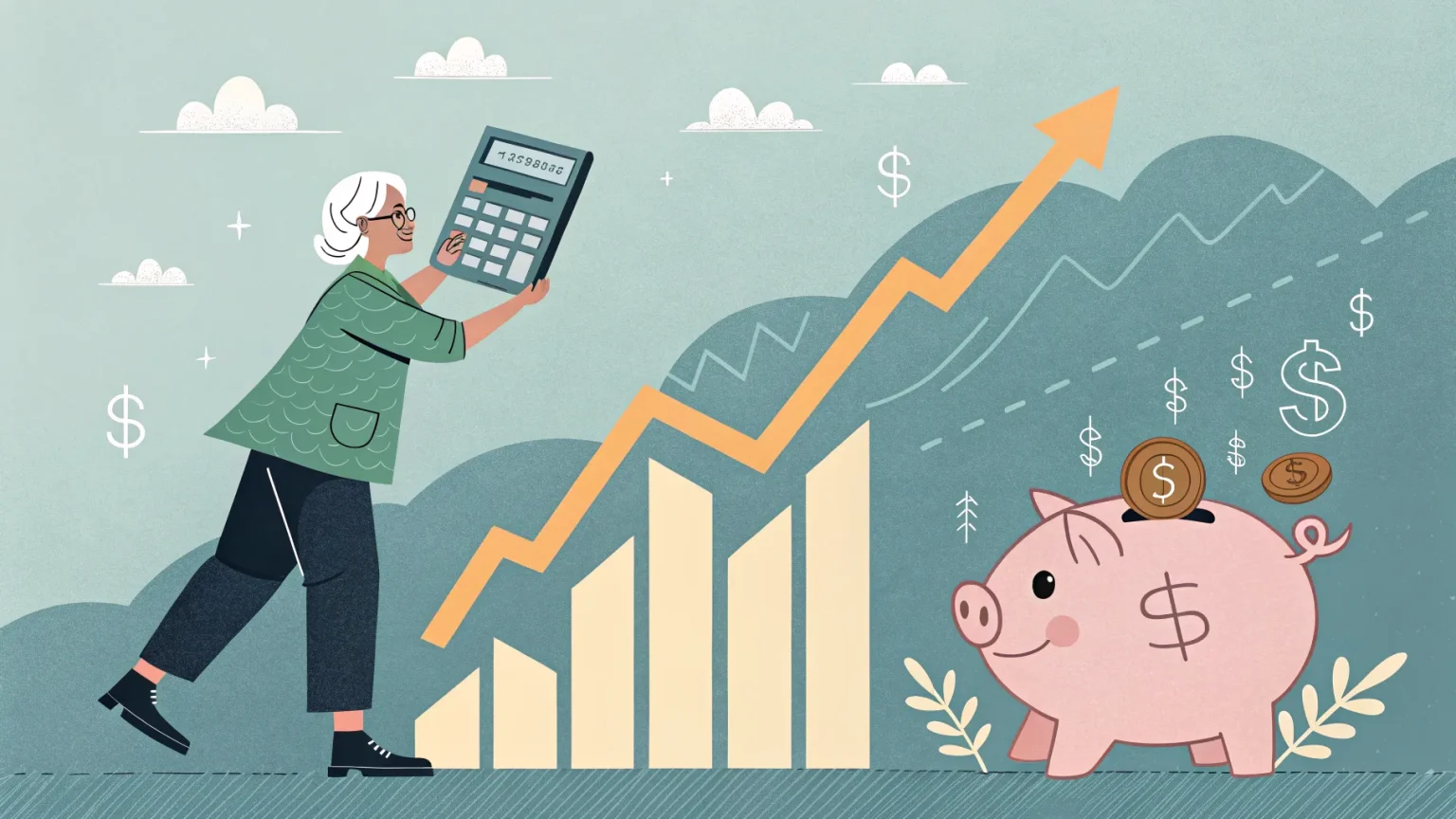
Dave Ramsey claims that investing just $100 a month from age 25 to 65 will make you a millionaire. On paper, the math works out: $100 monthly at a 10% return for 40 years equals $1,176,000. But after years in the financial industry, I’ve learned that theoretical calculations rarely match real-world results.
The problem with this advice isn’t the basic calculation—it’s everything that happens in those four decades that makes this “simple formula” unreliable at best and misleading at worst.
The Reality Behind the Numbers
When we examine market performance closely, we see why this advice is flawed. If you have $10,000 invested and lose 10%, you’re down to $9,000. Even if you gain 10% the following year, you’ll only have $9,900—not back to your original investment. This mathematical reality is called sequence risk, and it’s just one factor that undermines the “steady 10% return” assumption.
The calculation also ignores several critical factors:
- Investment fees that eat into returns year after year
- Tax implications from trading and rebalancing
- Market volatility that can devastate portfolios right before retirement
- Inflation eroding purchasing power over 40 years
Perhaps most telling is this challenge: Show me just one person who has followed this exact formula for 40 years and achieved these results. The silence is deafening because this advice exists in theory, not reality.

The Missing Context of Time
Forty years is an extraordinarily long time horizon. Think about how much has changed since 1983. Companies that were titans then have disappeared. Entire industries have been transformed or eliminated. New technologies have created wealth in ways nobody predicted.
When someone tells you to follow a 40-year plan based on historical market averages, they’re asking you to bet your financial future on conditions that have never remained stable for that long. It’s like planning a cross-country trip assuming perfect weather the entire way.
A Better Approach to Building Wealth
Instead of putting that $100 monthly into market investments with uncertain long-term returns, what if you invested it in yourself? That’s $1,200 annually that could go toward:
- Developing a marketable skill
- Hiring a mentor who’s achieved what you want to achieve
- Building a professional network
- Taking courses that increase your earning potential
Can $1,200 invested in yourself generate an additional $10,000 in income the following year? Absolutely. That’s an 800% return—far outpacing the hypothetical 10% market return that may or may not materialize.
My experience has shown that people who invest in themselves consistently outperform those who passively invest in markets. When you develop skills and knowledge, no market crash can take them away. When you build a network, it continues paying dividends throughout your career.
Building Wealth on Your Terms
The most dangerous aspect of the “$100 a month to millionaire” advice is how it encourages a passive, small-thinking approach to wealth. It suggests that wealth-building is something that happens to you over decades rather than something you actively create.
I’ve coached countless entrepreneurs and professionals who transformed their financial lives in 5-10 years, not 40. They didn’t do it by pinching pennies and hoping for compound interest to work its magic. They did it by developing valuable skills, solving problems for others, and creating income streams that weren’t dependent on market performance.
The next time someone tells you about a 40-year plan to wealth, ask yourself: Do I want to wait 40 years to enjoy financial freedom? Or would I rather develop the skills and mindset to create wealth on my terms, starting now?
The choice is yours, but I know which path I’d take.


