

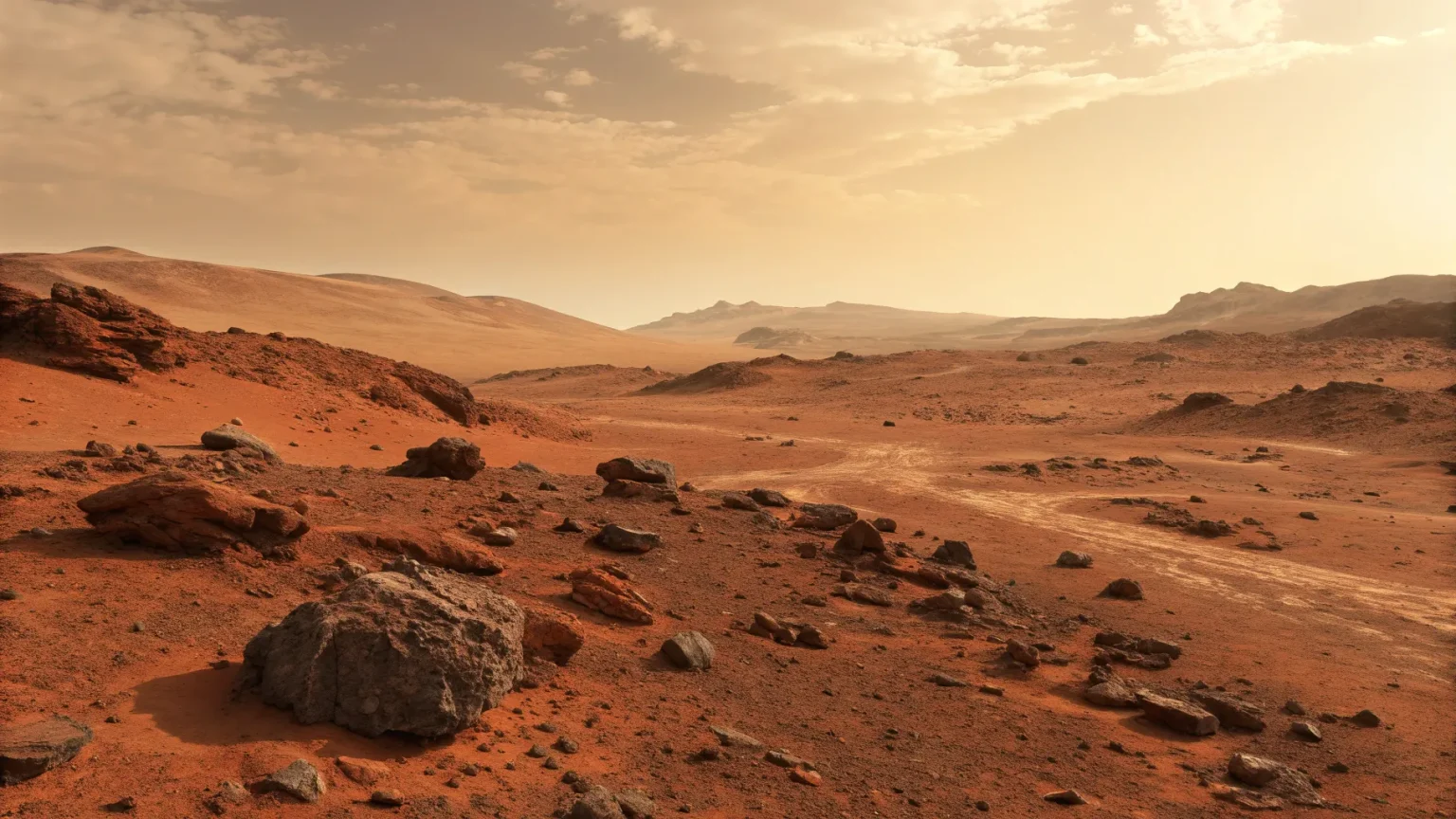
NASA’s report of potential signs of ancient life on Mars has reignited a long-running scientific debate about how common life may be in the universe. A leading scholar on habitable star systems said the finding could reshape expectations across astronomy and astrobiology.
“Our galaxy could be teeming with life,” says a world-leading scholar on habitable star systems.
The comment came as researchers weighed the broader meaning of possible biosignatures on the Red Planet. The discussion centers on what the reported signals represent, how they were collected, and what steps are needed to confirm them.
Why This Matters Now
Any hint of past life on Mars would be a historic scientific moment. It would show that life can arise on more than one world in our own solar system. That would increase the odds that life exists elsewhere in the Milky Way.
Scientists stress that “potential evidence” is not proof. It must survive repeated tests and independent checks. If it does, the impact would reach far beyond Mars science.
Background: A Search Decades in the Making
For years, missions have looked for conditions that could support life on Mars. NASA’s Viking landers in the 1970s ran experiments to test for metabolic activity in the soil. The results were contested and remain unresolved.
In 1996, a Martian meteorite named ALH 84001 drew attention for features some saw as microfossils. Later studies offered chemical and geological explanations that did not require biology.
More recent missions have focused on habitability. The Curiosity rover found ancient lakebed materials and organic molecules in Gale Crater. The Perseverance rover is exploring the river delta in Jezero Crater and storing drilled samples for possible return to Earth.
What The Evidence Could Mean
Scientists look for “biosignatures,” which are clues that may be linked to life. These include certain organic molecules, isotope patterns, textures in rocks, and changing gas levels such as methane.
The line between biological and nonbiological processes is thin. Chemistry and geology can mimic signs that look like life. That is why the chain of evidence must be strong and consistent across measurements.
The scholar’s claim that the galaxy may host many living worlds reflects a broader hypothesis. If life started on two nearby planets early in solar system history, it might also start on planets around other stars with similar conditions.
Skepticism and the Scientific Process
A cautious approach is central to this field. Past claims have faced intense scrutiny and, at times, reversal. Researchers call for peer-reviewed analysis and repeatable tests.
Alternative explanations must be ruled out. These include mineral processes, radiation-driven chemistry, and contamination from spacecraft or Earth.
Many planetary scientists will look for converging lines of evidence. They want to see chemistry, structure, and context all pointing to the same conclusion.
Implications for Future Missions
Interest in Mars Sample Return is likely to grow. Perseverance has cached cores from rocks that formed in water-rich settings. Analysis in Earth labs would offer much higher precision than rover instruments can provide.
Upcoming missions to icy moons, such as Europa Clipper, could also gain momentum. If Mars shows signs of past life, the case for searching subsurface oceans becomes stronger.
Telescope surveys of exoplanets may shift as well. Teams could seek atmospheric patterns linked to biology, informed by lessons learned on Mars.
What We Know So Far
- Claims of ancient life on Mars remain potential and need rigorous confirmation.
- Geological and chemical processes can mimic biological signals.
- Multiple missions have found evidence of past water and organics.
- Sample return and cross-checked lab tests are key next steps.
Competing Views From Experts
Some researchers welcome the optimism, saying that early Mars had water, energy sources, and minerals that could support life. They argue that finding even simple microfossils would show life is not rare.
Others urge restraint. They point to past false starts and the limits of remote detection. They argue that only a complete package of evidence will resolve the question.
Both sides agree on one point. The stakes are high, and the standard of proof must be even higher.
The coming months will bring detailed analyses, review, and debate. If the data holds, the discovery would reset expectations about life beyond Earth. If not, the search will continue with sharper tools and clearer targets. Either way, Mars remains central to one of science’s oldest questions: Are we alone, or is life common in the galaxy?


